Manny Pacquiao, the only eight-division world champion in boxing history, has officially closed the chapter on his extensive political career following a loss in the 2025 Philippine Senate elections.
Representing a journey that spanned nearly two decades, Manny Pacquiao transitioned from a global sports icon to a legislator in both the House of Representatives and the Senate, eventually mounting an unsuccessful bid for the presidency in 2022.
His time in public office was defined by a focus on anti-corruption, education, and poverty alleviation, though it frequently faced scrutiny over his attendance and legislative engagement.
The political career of Manny Pacquiao began with a setback in 2007 when he ran for a seat in the 1st District of South Cotabato under the Liberal Party. He lost that initial race to incumbent Darlene Antonino-Custodio but successfully established the People’s Champ Movement (PCM) in 2009.
By 2010, the “Pac-Man” secured a landslide victory for the lone district of Sarangani province, a seat he held for two terms, including an unopposed re-election in 2013.
Early years in the House and legislative challenges
During his tenure in the House of Representatives from 2010 to 2016, Manny Pacquiao earned praise for a significant 2010 speech supporting an anti-human trafficking law. However, his congressional record was not without controversy. Critics often targeted his poor attendance and a perceived lack of engagement with legislative duties, noting that several of the bills he filed failed to progress past the committee level.
Despite these criticisms, his popularity remained vast as he balanced his duties in Sarangani with a high-profile boxing career. Many fans wondered how he could maintain his edge in the ring while serving in government. This dual identity drew comparisons to other legends of the sport, such as when com/manny-pacquiao-most-skilled-opponent-snubs-mayweather-marquez-cotto/”>Manny Pacquiao compared the technical skill of rival Juan Manuel Marquez to Floyd Mayweather, highlighting the mental focus required for elite competition.
And while his legislative output was debated, his political climb continued. In May 2016, he was elected to the Philippine Senate, placing 7th overall with more than 16 million votes. This success allowed him to take on more formal leadership roles, eventually chairing the Senate Public Works Committee and the Senate Ethics and Privileges Committee during his six-year term.
Transition to the Senate and the presidential bid
As a Senator, Manny Pacquiao aligned with the administration of then-President Rodrigo Duterte on several key issues. He supported the return of capital punishment and the Free Irrigation Law, while also advocating for higher salaries for public school teachers.
But by 2021, a rift had formed within the ruling PDP–Laban party, leading Manny Pacquiao to challenge those in power over corruption allegations and territorial disputes in the South China Sea.
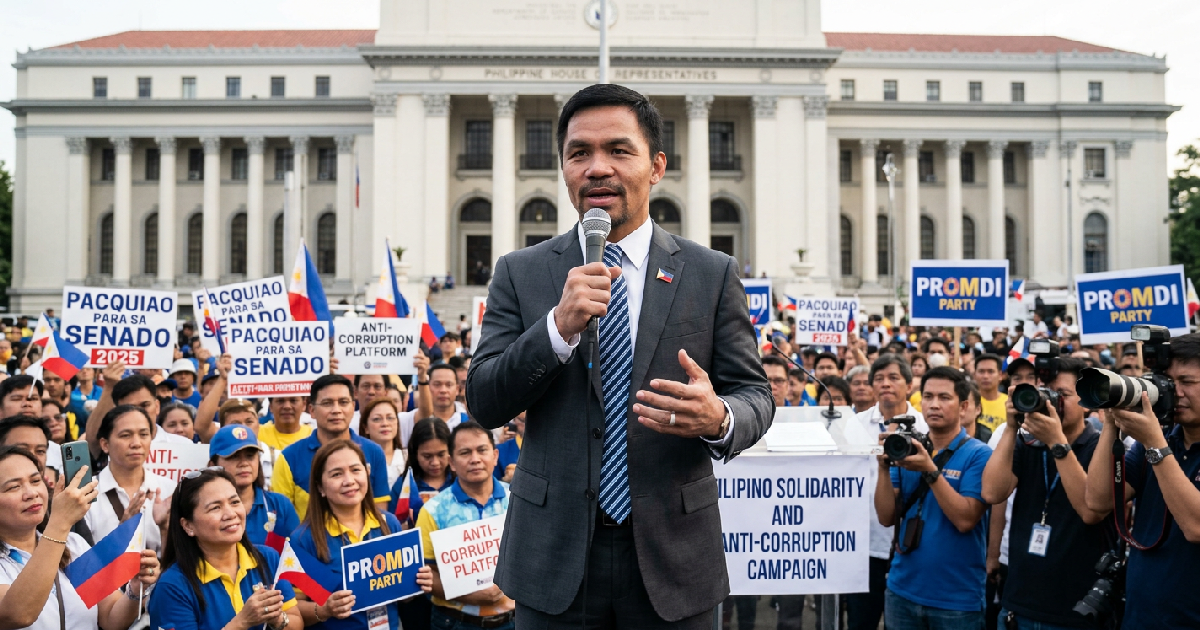
On September 19, 2021, Manny Pacquiao declared his candidacy for the presidency. He campaigned under the “MP3 Alliance,” which included his PCM party and the PROMDI (Progressive Movement for the Devolution of Initiatives) party. His platform leaned heavily on his personal history of rising from indigence, promising to fight graft and provide nationwide housing for the poor.
The 2022 election results saw Manny Pacquiao finish third among ten candidates, receiving 3,663,113 votes. While he conceded to Ferdinand “Bongbong” Marcos Jr., the campaign proved he could still command a significant following. This period of his career showed a shift in priority, much like how com/terence-crawford-canelo-alvarez-retirement-outlook-2026/”>Terence Crawford has discussed the retirement outlook for modern champions who must eventually decide when to leave their primary stage.
Core pillars of the Pacquiao political platform
Throughout his presence in the legislative and executive branches, Manny Pacquiao focused on several specific social and economic issues. These pillars remained central to his campaign rhetoric and his committee work in the Senate:
- Poverty Alleviation: Inspired by his own youth, he championed housing projects, scholarships, and livelihood programs for the poor.
- Education: He advocated for increased funding for public schools and improved training and pay for teachers.
- Anti-Corruption: A cornerstone of his platform, he vowed to strengthen the fight against graft and increase transparency.
- Sports Development: He used his position to support legislative initiatives aimed at developing the Philippine sports sector.
The 2025 Senate race and return to boxing
Following his presidential loss, Manny Pacquiao sought to return to the Senate in the 2025 elections. He joined the slate of President Ferdinand Marcos Jr. under the Partido Federal ng Pilipinas (PFP). Despite his enduring name recognition, he failed to secure one of the 12 available seats, placing 18th with 10,397,133 votes.
This result marked a definitive turning point for the former champion. Shortly after the 2025 election results were finalized, he announced his intention to retire from politics. He has since shifted his focus back to boxing, the sport that initially catapulted him from poverty to international stardom.
His departure from the political arena concludes a era of the “fighting senator.” While his transition back to the ring suggests his competitive fire remains, his political legacy is defined by his attempt to translate his individual success into systemic change. He remains a figure who bridged the gap between the impoverished masses and the highest halls of power in the Philippines.