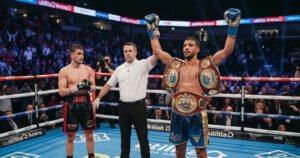
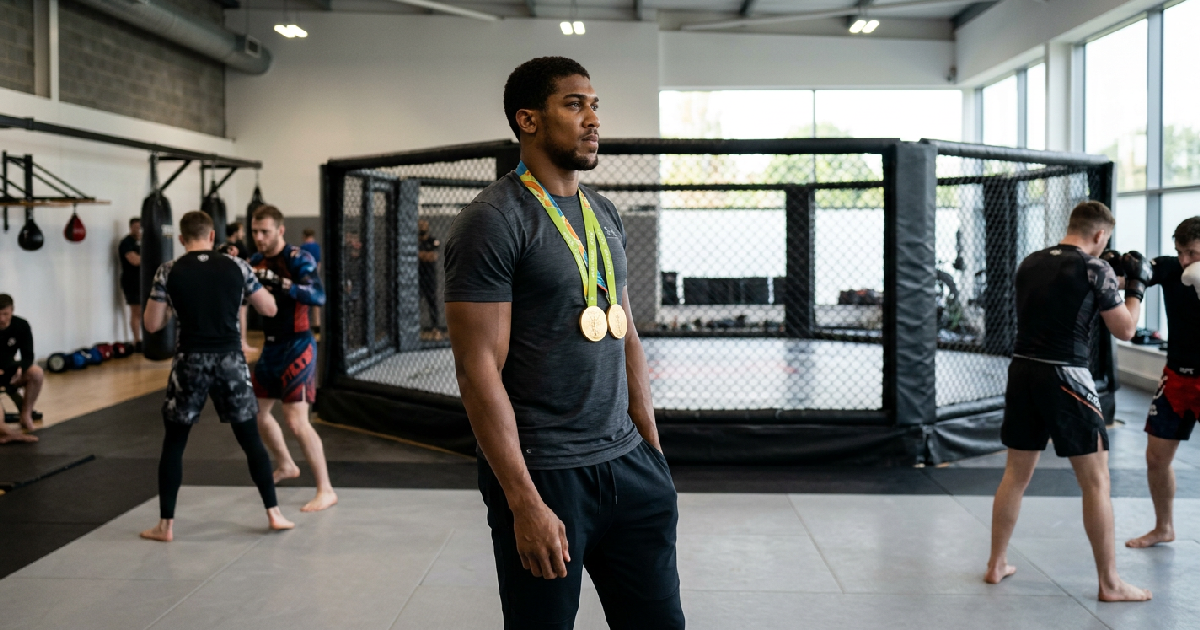
Former two-time unified world heavyweight champion Anthony Joshua has expressed a public interest in transitioning to Mixed Martial Arts (MMA). In an interview reported on June 4, 2026, the British fighter questioned why elite boxers do not more frequently challenge themselves in the cage given the number of MMA athletes who cross over into boxing.
Anthony Joshua described the prospect as “big business,” highlighting his desire to see how a top-tier heavyweight would fare in a different combat territory.
The Olympic gold medalist noted that current MMA and kickboxing stars are highly experienced professionals rather than amateurs, making the challenge a significant one. While many boxers have flirted with the idea of the octagon, few have successfully made the leap. Anthony Joshua has already reached the pinnacle of boxing, but com/tyson-fury-anthony-joshua-confirmed-2026-wembley-signed/”>contracts for a 2026 Wembley bout suggest a heavy boxing schedule remains his primary focus for now.
The motivation behind the potential move stems from the increasing number of crossover events that have dominated the combat sports landscape. “Believe me, I was thinking, why don’t I step over into one of their territories, because they keep on coming to our territory?” Anthony Joshua stated during the interview.
He emphasized that testing boxing’s elite against the best in MMA would provide a unique spectacle for fans of both sports.
Historical challenges for boxers in the octagon
If Anthony Joshua pursues an MMA debut, he must contend with a history that has rarely been kind to pure pugilists. The most frequently cited cautionary tale is that of James Toney, the defensive master and multi-weight world champion. In 2010, at UFC 118, the veteran Randy Couture defeated James Toney in just over three minutes by using his wrestling to secure a first-round submission.
James Toney appeared outclassed once the fight moved to the ground, a common hurdle for those who spend their lives mastering the “sweet science.” While Anthony Joshua has superior physical attributes and a significant reach, the transition from the ring to the cage requires a total shift in defensive philosophy.
Without specific grappling training, even the most powerful heavyweight punchers can find themselves neutralized by a single takedown.
Success stories and modern precedents
Despite the risks, there are notable successes that Anthony Joshua can point to as inspiration. He specifically cited Holly Holm, who transitioned from a decorated boxing career to become the UFC bantamweight champion. Holly Holm became a global star by defeating the previously unbeaten Ronda Rousey, proving that a high-level striking background can be lethal in MMA when paired with the right strategy.
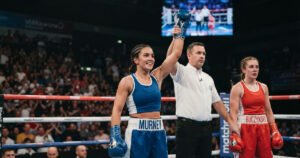
Other modern champions have also experimented with the move, though with varied results. As women’s boxing continues its emerging prime, stars like Claressa Shields have tested the waters of the PFL. Claressa Shields completed a three-fight stint in MMA, finishing with a 2-1 record. She eventually stepped away from the sport, noting the immense time commitment required to master new disciplines.
Claressa Shields revealed the difficulty of the transition on “The Ariel Helwani Show,” stating that “MMA is done” for her because she lacked the time to train for it. She explained that it takes at least six to eight months of dedicated preparation just to learn how to defend takedowns effectively.
This timeline presents a logistical challenge for an active fighter like Anthony Joshua, who is still a top contender in the heavyweight division.
Financial and physical considerations for Anthony Joshua
The financial structure of the two sports remains a major factor in any potential crossover. While top-tier boxing matches often provide massive paydays, MMA typically lacks the frequent high-level payouts seen in heavyweight boxing. Anthony Joshua is currently involved in high-stakes negotiations for his future bouts, and past contract disputes have shown how complex the business side of the sport can be.
Physically, the toll of learning wrestling and Brazilian Jiu-Jitsu is substantial for any veteran athlete. Whether Anthony Joshua is willing to risk his standing in the boxing world to learn these new skills remains the central question. For now, the heavyweight star appears content to tease the possibility while maintaining his status as one of boxing’s most bankable draws.
The coming year will determine if these comments lead to a concrete agreement with an MMA organization or if they remain rhetorical. As the boxing world waits for definitive news on his next opponent, Anthony Joshua has once again found a way to keep himself at the center of the global combat sports conversation. His interest alone highlights the growing synergy—and rivalry—of the two disciplines.