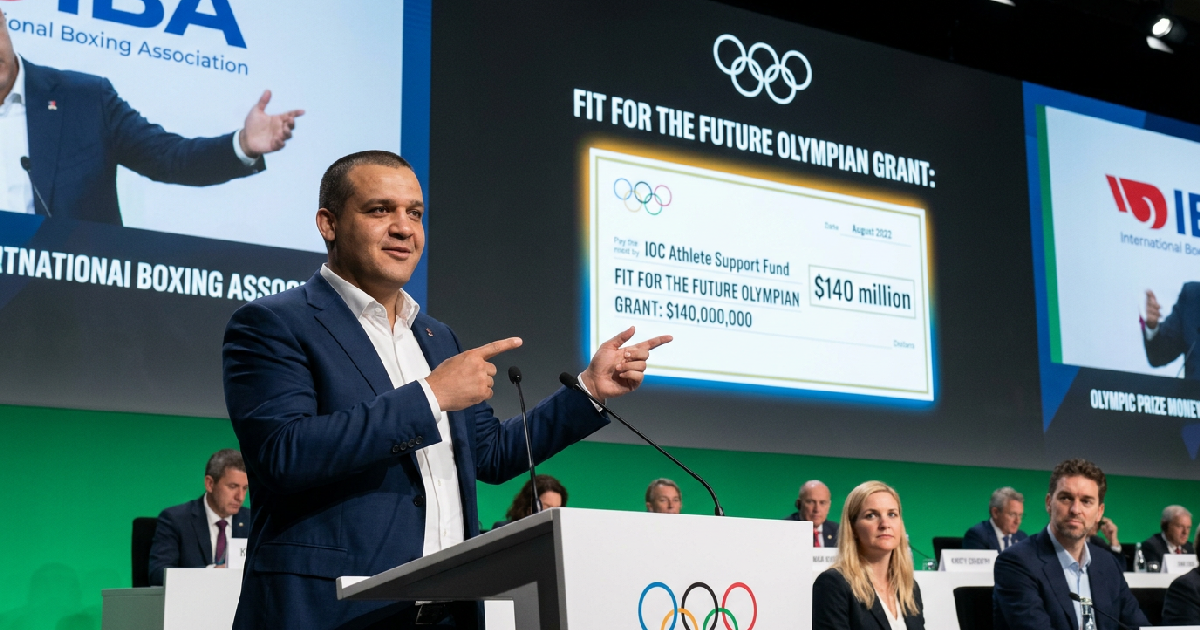
International Boxing Association (IBA) President Umar Kremlev has formally welcomed the International Olympic Committee’s (IOC) decision to establish a $140 million athlete support fund, calling it a long-overdue sign of reform. The “Fit for the Future Olympian Grant” was officially announced on Wednesday, June 24, 2026, during the 146th IOC Session held in Lausanne, Switzerland.
The fund aims to provide direct financial assistance to athletes, a move Kremlev claims was catalyzed by the IBA’s own pioneering efforts to pay prize money to boxers.
IBA leadership claims victory in athlete compensation debate
The new initiative will allow eligible Olympians to apply for $10,000 grants for each Olympic Games they compete in, starting with the Milano Cortina 2026 Winter Games. This tactical shift by the IOC follows a period of intense pressure from the boxing community and other sporting bodies regarding the financial recognition of athletes.
While the IOC has historically avoided direct payments to keep the “amateur” spirit of the Games, the pressure to share its multibillion-dollar commercial revenue has become impossible to ignore.
President Umar Kremlev was quick to frame the IOC’s decision as a validation of the IBA’s strategy. The boxing organization was the first international association to introduce prize money for its athletes, a precedent that has since been followed by World Athletics. “Finally, the IOC has listened and started reforms,” Kremlev said following the announcement.
He noted that the “boxers did it first,” and that the shift is a direct response to global calls for better financial support for those who “spend years sweating in the gym.”
The IBA has consistently positioned itself as a “financial shield” for its competitors, particularly during the transition to the Los Angeles 2028 Summer Games. The organization previously discussed high-profile boxing opportunities in Russia to explore athlete-centered compensation models outside traditional Olympic structures.
Key details
For Kremlev, the IOC’s $140 million commitment is just a start; he has challenged the committee to eventually scale its athlete support to $1 billion to match the scale of its commercial success.
Understanding the Fit for the Future Olympian Grant structure
The fund will be overseen by high-level Olympic officials, including IOC Athletes’ Commission Chair and IOC member Pau Gasol, as well as IOC President Kirsty Coventry. Unlike the IBA’s performance-based prize money, the “Fit for the Future” grants are flat rates intended to support an athlete’s journey and career transition.
Approximately 14,000 athletes are expected to be eligible over each four-year cycle, with the IOC projecting that $110 million will be distributed during the Los Angeles 2028 Summer Games alone.
Applications for those who competed in the Milano Cortina 2024 Winter Games are scheduled to open at the end of 2026, with the first payments expected in 2027. While President Kirsty Coventry has previously expressed personal reservations about paying athletes directly, the creation of this fund acknowledges that the “central stakeholders” must be heard.
However, the IBA remains cautious, noting that the only “amateur” thing about the current Olympic system is how the athletes are paid compared to the $7.7 billion in commercial revenue generated by the IOC between 2021 and 2024.
Boxing prize money sets a high bar for Olympic standards
The IBA’s established model for prize money remains significantly more lucrative for top-tier finishers than the new IOC grant. During the Paris 2024 Olympics, the IBA distributed over $3 million to boxers who reached at least the quarterfinals.
Gold medalists received $100,000, silver medalists $50,000, and bronze medalists $25,000, with funds split between the athlete, their coach, and their National Federation. Under this system, fifth-place finishers also secured $10,000—the same amount the IOC now offers as a flat grant to all participants.
This discrepancy in funding remains a point of contention as the sport moves toward the next Olympic cycle. Athletes are increasingly prioritizing financial security, similar to how Oleksandr Usyk raises brain health concerns alongside professional stability in the heavyweight ranks.
President Umar Kremlev has stated that if the IOC does not continue to evolve its strategy to protect athletes by 2028, the IBA is prepared to step in again and pay medallists the same amounts as before to ensure they are not left without fair compensation.
Future outlook for athlete financial rights toward Los Angeles 2028
The announcement in Lausanne marks a definitive shift in the global sports landscape, but the path forward remains complex. The IOC’s grant will be delivered through existing National Olympic Committee (NOC) structures, while the IBA advocates for direct, performance-linked rewards.
As World Athletics and the IBA have shown, individual federations are no longer waiting for the IOC to lead on financial reform. This decentralized approach to prize money is likely to expand as more sports demand a share of the Olympic revenue pie.
For now, the boxing community views this as a hard-won victory in a long-standing political battle. Whether the IOC eventually meets Kremlev’s $1 billion challenge remains unlikely, but the precedent for direct payment has been set.
As the global sporting community prepares for the Milano Cortina and Los Angeles Games, the focus will remain on whether these grants are enough to professionalize the “amateur” experience and satisfy the people who create the spectacle that generates billions in global audience revenue.