
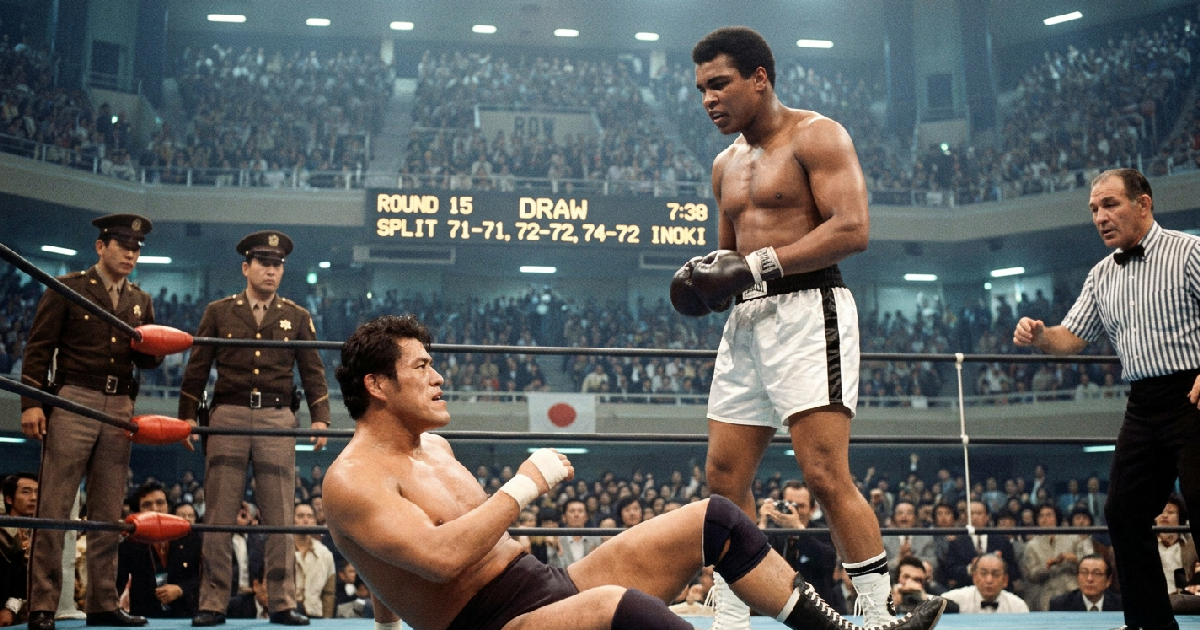
Heavyweight champion Muhammad Ali and Japanese wrestling icon Antonio Inoki fought to a 15-round split draw on June 26, 1976, during a heavily restricted contest at the Nippon Budokan in Tokyo. Billed as “The War of the Worlds,” the event aimed to determine the ultimate martial arts discipline but ended in frustration for fans, many of whom demanded refunds. The spectacle was watched by an estimated 1.4 billion people worldwide, yet it remains one of the most controversial crossovers in combat sports history.
Ali, who was the undisputed heavyweight champion at the time, reportedly earned roughly $6.1 million for the appearance. Antonio Inoki, a “strong style” pioneer trained by the legendary Karl Gotch, received approximately $2 million. While the promotion generated massive global interest, the match itself was hampered by last-minute rule changes that stripped Inoki of his most effective wrestling maneuvers.
The restrictive rules that shaped Ali vs Inoki
The contest was originally promoted as a legitimate clash between boxing and wrestling, but Ali’s camp successfully negotiated strict limitations just days before the first bell. These rules prohibited Inoki from throwing, tackling, or grappling with Ali. Furthermore, the wrestling star was only allowed to execute kicks if he kept one knee on the canvas. These constraints effectively forced Inoki into a defensive posture, as he could not engage the boxer through traditional wrestling techniques without violating the agreement.
Left with no other way to safely attack, Inoki spent nearly the entire fight in a supine position, sliding across the ring to kick at Ali’s legs from the floor. Ali responded by circling the perimeter, taunting his opponent to “stand up like a man” and shouting insults throughout the rounds. Because Inoki remained outside of traditional punching range, Ali found it difficult to land meaningful strikes against a grounded opponent, leading to a repetitive stalemate that lasted the full 15 rounds.
This type of strategic deadlock is often what happens when match-ups lack a balanced competitive framework. Today, fans often face different frustrations, such as when contract disputes and stalled negotiations prevent high-profile bouts from ever reaching the ring. In 1976, the fight happened, but the lopsided ruleset ensured it could not live up to the “Martial Arts Championship of the World” branding.
Fan backlash and the split draw verdict
The audience at the Nippon Budokan reacted with open hostility as the bout concluded. Many spectators threw rubbish into the ring and chanted “Money back!” after witnessing 15 rounds of low kicks and verbal taunting. The official judges ultimately turned in a split draw, with referee Gene LeBell—an expert grappler and stuntman—scoring the contest 71-71.
Newspapers and boxing critics were largely dismissive of the event, labeling the restrictive rules and Inoki’s unconventional tactics a failure. The match demonstrated the inherent difficulty of staging cross-discipline fights without a unified set of regulations. Despite the immediate outcry, the bout is now recognized as a significant precursor to mixed martial arts, showing how new disciplines and divisions eventually evolve from experimental stages into respected global sports.
Physical consequences for the heavyweight champion
While the fight was criticized for its lack of action, the physical toll on Muhammad Ali was devastatingly real. Inoki’s relentless leg kicks caused severe bruising, swelling, and bleeding throughout the middle and late rounds. Following the contest, Ali was hospitalized with two massive blood clots and an infection in his left leg.
The damage significantly impacted Ali’s mobility and footwork for the remainder of his professional career. Observers noted that the champion, who was 34 at the time and entering the match with a 52-2 record, never fully regained the legendary agility that had defined his earlier years. The “War of the Worlds” proved that even a “boring” fight could have life-altering consequences for its participants.
Evolution from a spectacle to an MMA foundation
In the decades since 1976, the legacy of Ali vs. Inoki has been rehabilitated by historians. It served as a vital influence for Japanese promotions such as Pancrase and PRIDE Fighting Championships, which eventually perfected the concept of cross-discipline competition under more complete rulesets. Antonio Inoki utilized the fame from the match to expand New Japan Pro-Wrestling (NJPW) and later embarked on a successful political career in the Japanese House of Councilors.
The event also highlighted the importance of clear competitive boundaries in modern crossovers. We see this today in various high-stakes promotions, where every detail must be finalized to avoid the confusion seen in Tokyo. For instance, the Gualtieri-Jones IBF Middleweight bout approaches with much clearer expectations for the fans regarding the rules of engagement and the prestige of the titles involved.
Ultimately, the Ali-Inoki fight remains a singular moment in time. It was an awkward, frustrating, and sometimes painful experiment that paved the way for the multibillion-dollar industry of modern mixed martial arts. While those in attendance in 1976 felt they had witnessed a farce, they were actually seeing the unpolished birth of a new era in combat sports.