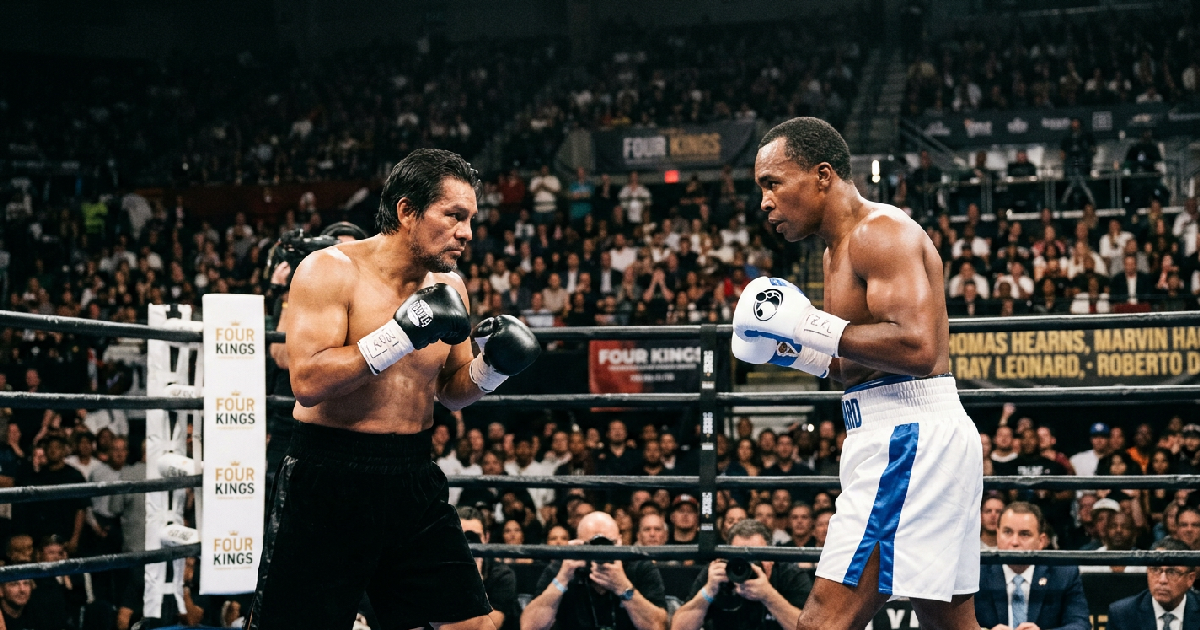
**Sugar Ray Leonard** has detailed the psychological toll of his legendary rivalry with **Roberto Durán**, revealing that the Panamanian was more intimidating to him than **Mike Tyson**. In a resurfaced interview, the five-weight world champion admitted that despite Tyson’s reputation as the heavyweight division’s most terrifying force, it was the “Hands of Stone” who inspired a unique level of fear during their 1980s encounters.
The admission highlights the visceral atmosphere surrounding the “Four Kings” era, where Leonard, Durán, **Thomas Hearns**, and **Marvelous Marvin Hagler** dominated professional boxing. While **Mike Tyson** famously branded himself a “student of war” and an “annihilator,” Leonard’s recent reflections suggest that the intimidation factor brought by a technical, relentless pressure fighter like Durán was, for him, a greater mental mountain to climb.
Roberto Durán and the intimidation of Sugar Ray Leonard
Leonard’s professional career, which spanned from 1976 to 1997, saw him secure world titles in five divisions. However, his 1980 WBC welterweight title defense against **Roberto Durán** remains a pivotal moment in sports psychology. Resurfaced footage shows Leonard explicitly comparing the Panamanian’s aura to that of the former heavyweight king.
“Roberto Durán – he was more intimidating than Mike Tyson,” Leonard stated in the clip. He followed the blunt comparison with a recognition of the genuine animosity he felt at the time, adding, “I hate that motherf***ker.” This intensity was a far cry from the technical respect often shown between rivals today, underscoring the raw emotional stakes of their initial 15-round encounter in Montreal.
During that 1980 bout, Durán successfully baited Leonard into a stagnant slugfest, abandoning the fluid movement that had become the American’s trademark. The Result was a unanimous decision victory for Durán, handing Leonard his first professional defeat. It was an outcome that forced Leonard to re-evaluate his mental approach to the sport.
Intimidation factors across the Four Kings era
While Durán held the title for psychological menace in Leonard’s mind, the other members of the Four Kings provided distinct physical challenges. **Thomas “The Hitman” Hearns** stood 6ft 1in and possessed a freakish reach for the welterweight limit. Leonard eventually stopped Hearns in the 14th round of their 1981 classic, but only after navigating a boxing clinic from the taller man.
**Marvelous Marvin Hagler** brought a different brand of pressure, built on a decade of middleweight dominance. When Leonard returned from retirement in 1987 to face Hagler, he fought as a significant underdog. Unlike the intimidation he felt against Durán, the challenge with Hagler and middleweight titles often centered on durability and consistent output over fifteen rounds.
Durán’s intimidation stemmed from his transition from the lightweight division, where he had famously dethroned **Ken Buchanan** in 1972. Even as an undersized 147lb contender, his reputation as a “street-fighter” in the ring proved more effective at rattling Leonard than the explosive power of Hearns or the granite-jawed persistence of Hagler.
Mike Tyson and the psychological walk to the ring
The comparison to **Mike Tyson** is particularly striking because Tyson’s entire career was built on the concept of beating opponents before the first bell. Tyson often studied historical warriors to refine his terrifying ring presence. He once described his strategy as looking to “annihilate” his opposition, relying on a psychological edge that saw many heavyweights defeated during the walk to the ring.
However, Leonard’s perspective suggests that the intimidation factor is subjective. While a 1988 Los Angeles Times report noted Tyson was “more terrifying” than contemporary peers, Leonard found the personal, focused aggression of a smaller rival like Durán harder to manage. This acknowledges that Roberto Durán was a master of his craft, capable of shifting the mental state of even the most decorated technicians.
Leonard eventually solved the Durán puzzle in their immediate rematch, famously known for the “No Mas” incident in the eighth round. By refusing to engage in the brawl Durán demanded, Leonard inverted the intimidation, causing the Panamanian to quit out of frustration. It solidified Leonard’s legacy as the only one of the Four Kings to defeat the other three members of the group.
Modern reflections on historic boxing rivalries
As boxing moves further into the 21st century, the era of the Four Kings remains the primary benchmark for competitive depth. Current discussions regarding Terence Crawford and Canelo Alvarez often draw parallels to these 1980s legends, yet the specific, unfiltered hatred Leonard described toward Durán is increasingly rare in the modern age of public relations.
Leonard’s admission serves as a specific reminder that at the elite tier of combat sports, the most significant battles are often internal. The ability to overcome a fighter who is more intimidating than even the most feared heavyweight in history is what separated the legends of the 1980s from the standard champions of their time.
Today, Leonard remains a frequent guest on media platforms, including Tyson’s own “Hotboxin'” podcast. While they have shared lighthearted moments and trash-talked mutual rivals like Hearns, Leonard’s historical perspective on Durán’s aura continues to frame how fans understand the difference between physical power and psychological dominance. Accomplishing a victory over the man who once inspired such fear remains the defining achievement of his storied career.