
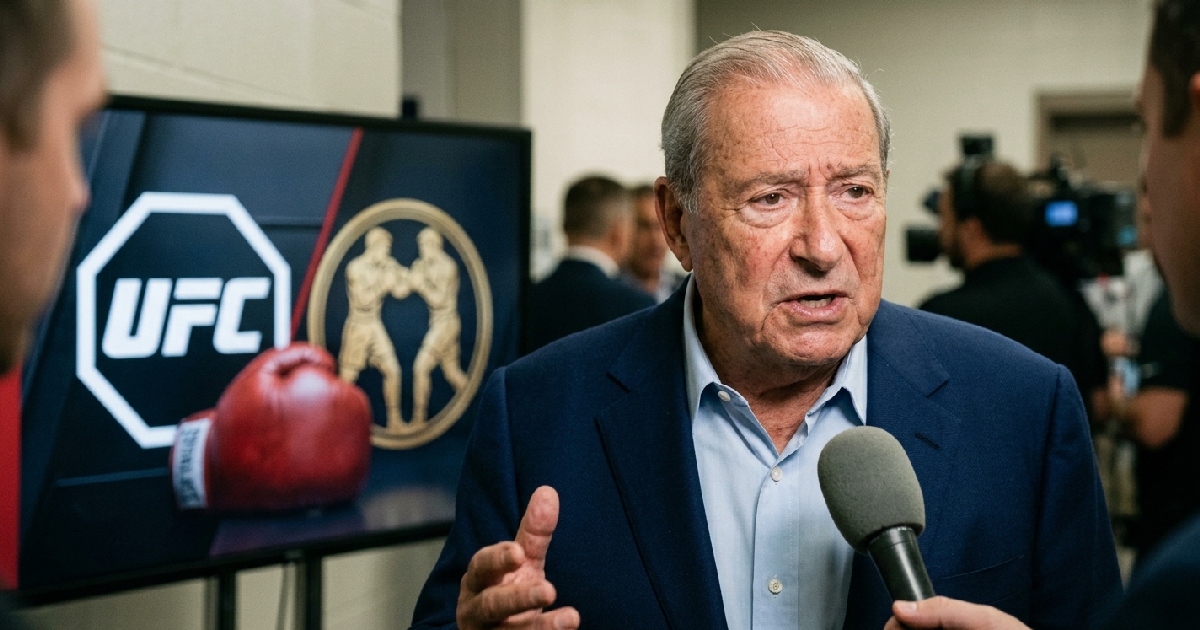
Top Rank Boxing founder and CEO Bob Arum has launched a searing verbal attack on UFC President Dana White, calling the mixed martial arts executive a “cancer for boxing” during an interview with Fight Hub TV. Arum, who is 94 years old as of February 2025 and turns 95 this year, warned that White’s business model via Zuffa Boxing represents a foundational threat to the sport. The Hall of Fame promoter’s comments, reported between June 25 and June 29, 2026, center on fears that White’s entry into boxing will lead to the systematic underpayment of athletes.
The conflict stems from the launch of Zuffa Boxing earlier this year, a venture that seeks to bypass traditional sanctioning bodies like the WBC, WBA, WBO, and IBF. Arum, a former Department of Justice lawyer, believes White’s goal is to centralize power to suppress fighter wages. “Dana White really is a cancer for boxing because you come in and you want to get rid of all the sanctioning bodies, and we know where that’s going to lead,” Arum stated during the interview.
Concerns over centralization and fighter compensation
Arum’s primary grievance is the “closed-loop” league format that White has successfully implemented in the UFC. In the current boxing landscape, multiple promoters and sanctioning bodies create a market where top-tier athletes can often negotiate higher purses. Arum fears that if Zuffa Boxing replaces these independent institutions with its own internal championships, fighters will lose their leverage.
Discussing the long-term impact on boxing talent, Arum provided a grim forecast. “If they got a foothold in boxing, in my opinion, it would be the same thing as far as the boxers were concerned. Initially, they’d make money, but ultimately they’d be like paupers,” Arum said. This warning echoes long-standing debates about the transition of women’s boxing into a new golden era, where increased visibility has finally begun to translate into fairer pay.
References to UFC antitrust litigation
To support his “cancer” label, Arum highlighted the legal troubles that have followed White’s management of the UFC. He specifically cited the Le v. Zuffa antitrust lawsuit, which the UFC settled for $375 million. That case represented fighters who competed for the organization between December 16, 2010, and June 30, 2017, alleging that the UFC used its market dominance to suppress wages.
“We know what happened with Dana White and the UFC and how they made a lot of money by underpaying the fighters,” Arum claimed. He further asserted that the UFC is “about to lose another lawsuit for $400 million,” referring to the active Johnson v. Zuffa case filed in 2021. While the $400 million figure is Arum’s personal assertion and has not been confirmed as a court-ordered loss, he uses it to argue that White’s expansion into boxing carries ethical and financial risks for the industry.
Bypassing sanctioning bodies with Zuffa Boxing
The Zuffa Boxing model is a radical departure from the sport’s 100-year-old tradition. White has confirmed his intention to recognize only his own championships and Ring titles, effectively stripping the WBC and WBA of their authority within his events. This mirrors the UFC’s structure, where the organization is the sole arbiter of rankings and title shots.
While some observers argue that a unified league could solve issues like the way Joshua and Fury contract talks stalled in previous years, Arum views it as a dangerous monopoly. He contends that despite their flaws, sanctioning bodies act as a check against any single promoter gaining absolute control. Without external oversight, Arum believes the sport would lose the competitive tension that allows independent promoters like Top Rank to flourish.
Legislative shift and the Muhammad Ali Act
The tension between Arum and White is unfolding against the backdrop of federal legislative changes. The Muhammad Ali American Boxing Revival Act (H.R. 4624) passed the U.S. House of Representatives in March 2026. Currently under consideration in the Senate, the act aims to create a unified system similar to the UFC. If passed, it could provide the legal framework for Zuffa Boxing to operate without traditional sanctioning.
Arum remains skeptical of any moves toward a unified league, even those proposed by Saudi official Turki Alalshikh. While Alalshikh has suggested “peace talks” between major promoters, Arum dismissed the idea that these should be taken seriously. He also noted that while significant capital has flowed into the sport recently, the era of “pissing away” unlimited cash is coming to an end.
Industry response to the Zuffa expansion
The veteran promoter’s stance is supported by other figures in the community. Former WBC cruiserweight champion Tony Bellew has also voiced opposition to White’s model. Bellew argued that boxing should not be under the control of a single individual or entity, as it could prevent independent fighters from reaching the top of the sport based on merit alone.
But White has already begun building his roster, signing notable fighters like Conor Benn and Jai Opetaia to Zuffa Boxing. This indicates that despite Arum’s fierce opposition, the MMA mogul is already an active player in the market. Arum, however, prefers the decentralized model, speaking positively of partners like DAZN that collaborate with multiple promoters to regain mainstream traction.
The clash between Arum and White represents a generational and philosophical divide. On one side is the established, decentralized system that has defined boxing since Arum promoted Muhammad Ali in 1966. On the other is the corporate-league model that has made the UFC a multi-billion-dollar success. For Arum, protecting the “free agent” nature of boxing isn’t just business—it’s preventing what he views as a terminal threat to the athletes’ livelihoods.