The 1999 welterweight championship clash where Oscar De La Hoya defends his title against Ike Quartey remains one of the most polarizing results in modern boxing history, continuing to spark debate among analysts and fans over twenty-five years later.
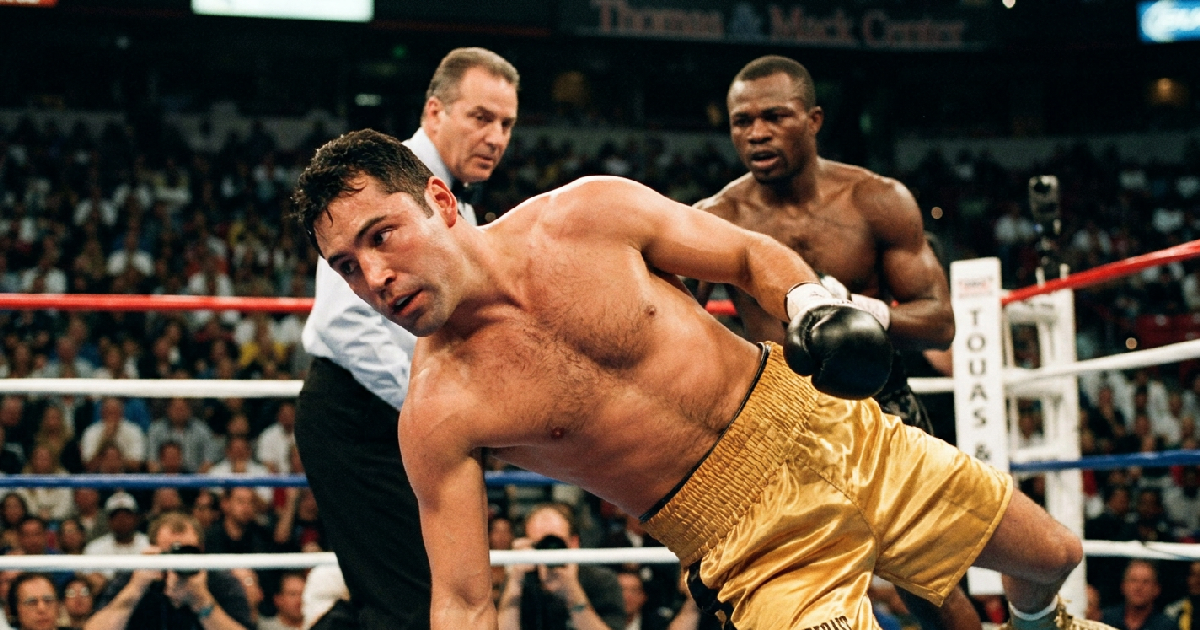
On February 13, 1999, at the Thomas & Mack Center in Paradise, Nevada, Oscar De La Hoya successfully defended his WBC welterweight title via a narrow split decision, surviving a mid-fight knockdown to secure a victory that solidified his status as a pound-for-pound elite.
High stakes and the quest for welterweight legitimacy
Ike Quartey, the undefeated former WBA champion from Ghana known as “Bazooka,” entered the ring with a record of 34-0-1 and a reputation for possessing perhaps the most disciplined lead jab in the sport.
Despite a 16-month layoff due to promotional entanglements, the challenger pushed “The Golden Boy” to the absolute brink, flooring the champion in the sixth round and nearly matching him punch-for-punch throughout a technical yet brutal contest.
The final scorecards—116-112 and 116-113 for De La Hoya, against 114-115 for Quartey—divided the boxing world immediately, with many ringside observers believing the Ghanaian had done enough to earn the nod.
Heading into early 1999, Oscar De La Hoya was the undisputed face of boxing, but his resume at 147 pounds was under scrutiny. While he had defeated legends, critics argued those wins came against icons past their prime.
To silence the detractors, his team targeted Ike Quartey, a man frequently cited as the most avoided fighter in the division. For De La Hoya, the bout was about more than a belt; it was about proving he could dismantle a dangerous, prime opponent who brought crushing power and technical mastery.
Key details
Ike Quartey entered the arena as a formidable threat who had never tasted defeat. His style was built around a high, tight guard and a piston-like jab that functioned as both a defensive wall and an offensive weapon.
The contrast between De La Hoya’s flamboyant combinations and Quartey’s stoic, fundamental pressure set the stage for a tactical chess match that quickly descended into a physical war of attrition.
The battle of the jabs and early rounds
From the opening bell, Quartey established the rhythm of the fight. His left jab was relentless, repeatedly snapping De La Hoya’s head back and preventing the champion from closing the distance. The Ghanaian’s accuracy was startling, swelling De La Hoya’s face in the early stages and forcing the champion to rethink his approach.
By the mid-rounds, it was clear that De La Hoya was in a fight he might actually lose.
De La Hoya, however, showed the resilience that would define his later career. He began to vary his attacks, targeting Quartey’s body in an attempt to lower the challenger’s guard. While he was losing the battle of the jabs, he was winning the battle of activity, throwing more punches even if fewer were landing cleanly.
This fundamental difference in philosophy—clean, heavy punching versus high-volume activity—is what ultimately created the scoring disparity that persists today.
The dramatic sixth round and double knockdowns
The sixth round of this welterweight classic is widely regarded as one of the greatest rounds in the division’s history. Just seconds into the frame, De La Hoya landed a clinical left hook that sent Quartey to the canvas for the first time in his professional life.
The Thomas & Mack Center erupted, sensing a spectacular finish. But the celebration was short-lived. Quartey rose with calm determination and, moments later, countered a De La Hoya flurry with his own thunderous left hook, dropping the champion in return.
The remainder of the round was a chaotic trade of power shots, with neither man willing to concede an inch of territory. It swept the honors for The Ring magazine’s Round of the Year and served as a microcosm of the entire fight.
In many ways, this fight shares the same legendary status as other era-defining bouts, much like how Manny Pacquiao would later engage in multi-fight rivalries that defined the next generation of boxing.
Championship rounds and the decisive 12th flourish
As the fight entered the final third, the fatigue of the pace began to show. Ike Quartey continued to rely on his jab and straight right hands, while De La Hoya leaned on his footwork and quick bursts to steal the end of rounds.
Going into the 12th, many unofficial scorecards had the fight dead even. Both corners knew the final three minutes would likely decide the winner of the WBC crown.
Oscar De La Hoya produced a final round flourish that ultimately saved his title. Early in the 12th, another left hook dropped Quartey for a second time. Sensing the finish, De La Hoya pinned Quartey against the ropes and unleashed a sustained barrage of nearly 70 punches.
Key details
Although Quartey survived the onslaught and even fought back in the closing seconds, the sheer optics of the knockdown were enough to sway two of the judges.
Analyzing the official scorecards and statistics
The split decision remains a flashpoint for debate due to the razor-thin margins. Judge Ken Morita scored it 116-112 for De La Hoya, and Judge John Keane saw it 116-113 for the champion. However, Judge Larry O’Connell favored the challenger with a score of 114-115 for Quartey. HBO’s unofficial scorer Harold Lederman also believed Quartey won, turning in a card of 114-113 for the Ghanaian.
CompuBox statistics from the night illustrate just how little separated the two men. De La Hoya landed 206 of 551 punches, while Quartey landed 201 of 608. While the total connects were almost identical, Quartey finished with the edge in power punches.
However, the 12th round was the statistical outlier; De La Hoya landed 41 punches to Quartey’s 18, a margin that likely secured him the victory. Today, as Terence Crawford evaluates his own legacy, the standard set by these vintage champions remains the benchmark for elite matchmaking.
Legacy and the absence of a rematch
The aftermath of the fight left a sour taste for many fans who felt Ike Quartey deserved a second chance. Despite the drama and the financial success of the event, a rematch never materialized.
De La Hoya moved on to a massive, albeit controversial, loss against Felix Trinidad later that year, while Quartey’s career momentum stalled. The Ghanaian would eventually move up in weight, but he was never again the central protagonist in a fight of this magnitude.
For De La Hoya, the Quartey victory was a transformative moment. It proved he could handle the grueling, bloody rounds where talent alone is not enough. The debate over Oscar De La Hoya vs. Ike Quartey isn’t just about who won; it’s about what we value in boxing.
Do we reward the technician who controls the pace with a perfect jab, or the aggressor who provides the most dramatic moments? Decades later, the answer remains as elusive as it was that February night in Las Vegas.