
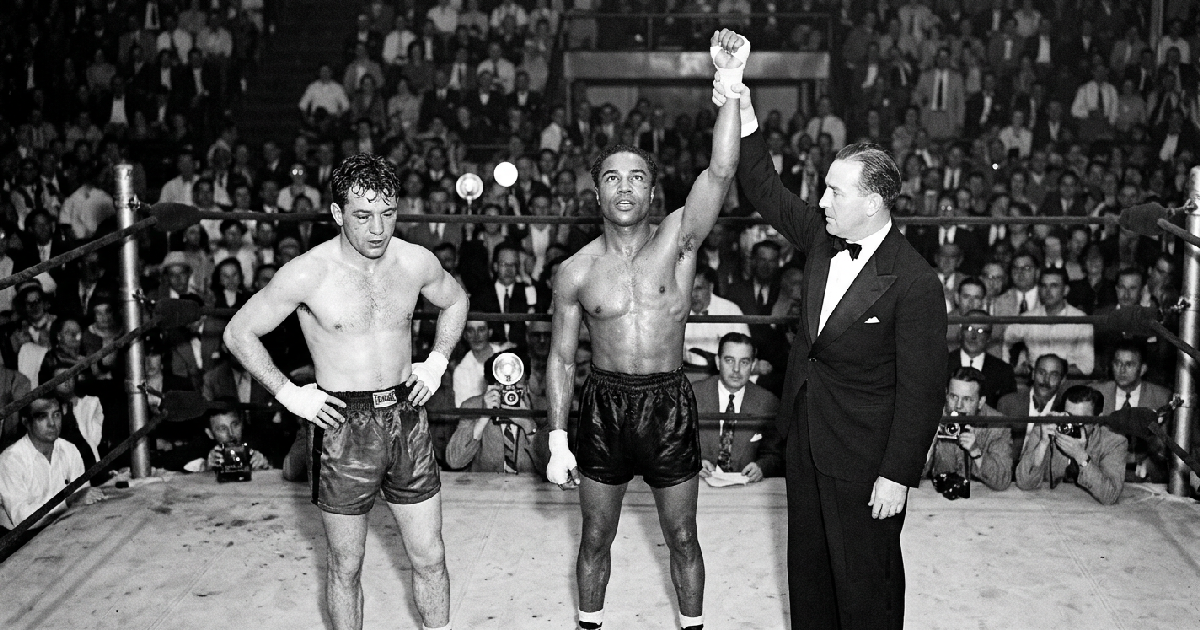
Henry Armstrong etched his name into the record books on August 17, 1938, by defeating lightweight champion Lou Ambers via split decision over 15 brutal rounds at Madison Square Garden. The victory established Armstrong as the first and remains the only boxer to hold world championships in the featherweight, lightweight, and welterweight divisions simultaneously.
Achieving this during an era with only one recognized champion per weight class, Armstrong’s three-belt reign is widely considered one of the sport’s most untouchable milestones.
Henry Armstrong vs Lou Ambers: The historic triple crown
The challenger, already the reigning featherweight and welterweight king, weighed in at 134 pounds for his pursuit of the undisputed lightweight title. Lou Ambers, known as the “Herkimer Hurricane,” also tipped the scales at 134 pounds, bringing a formidable record of 89-8-7 into the ring.
The ensuing battle was so physically demanding that The Ring Magazine named it the 1938 Fight of the Year and later ranked it the #12 greatest title fight of all time.
From the opening bell, Henry Armstrong lived up to his “Homicide Hank” moniker, applying relentless pressure that forced Lou Ambers into a grueling, high-paced encounter. The challenger’s aggression paid dividends early when he landed a heavy right hand late in the fifth round, sending Ambers to the canvas.
Armstrong dropped the champion again in the sixth round for an eight-count, nearly ending the contest before the “Herkimer Hurricane” found the resilience to continue.
Despite the two knockdowns, the fight remained dangerously close due to penalties assessed against the challenger. Referee Billy Cavanaugh penalized Armstrong for repeated low blows, deductions that resulted in four rounds being awarded to Ambers. These points were critical, as they threatened to negate the physical dominance Armstrong displayed throughout the middle and late frames of the 15-round war.
The physical toll on Armstrong was immense, with blood flowing from a severely cut mouth and lacerations around both eyes. Reports Indicate that Billy Cavanaugh considered stopping the bout, telling Armstrong, “The ring is full of blood, and it’s your blood.”
The challenger reportedly refused to quit, discarding his mouthpiece to swallow the blood and remain in the contest, telling the referee, “Then I’ll stop bleeding.” This level of grit draws parallels to how Roberto Duran identified Ken Buchanan as a premier example of world-class excellence and durability.
Split decision verdict sparks Madison Square Garden chaos
After 15 punishing rounds, the official scorecards reflected just how much the four-round penalty influenced the outcome. Judge Marty Monroe scored the bout 8-6-1 for Armstrong, while Judge George LeCron turned in a card of 7-6-2 for the challenger.
The third official, whose name was not specified in the official result, scored the fight 8-7 in favor of Lou Ambers. This split decision handed Armstrong the win, though the verdict was met with hostility from a crowd that believed Ambers had done enough to retain his title.
Spectators showered the ring with debris following the announcement, protesting the result despite Armstrong’s two knockdowns of the champion. The victory was life-altering for Armstrong, who earned a $25,000 payday for his historic achievement.
However, the physical price was steep; Armstrong later admitted he was “sick and almost out of my head with pain” after the final bell. He required between eight and fifteen stitches on the inside of his mouth to repair the damage sustained during the fight.
This achievement serves as a historical benchmark, much like how Terence Crawford and Canelo Alvarez are often analyzed through the lens of their multi-division legacies today.
While modern fighters chase belts in an era of multiple organizations, Armstrong was the undisputed ruler of three traditional divisions at once, a feat that necessitated him being three different fighters in terms of weight and style within a single calendar year.
The aftermath and a championship rematch at Yankee Stadium
The rivalry between these two Hall of Fame inductees did not conclude at Madison Square Garden. Lou Ambers received his opportunity for revenge a year later, on August 22, 1939, at Yankee Stadium. In front of a crowd of roughly 30,000 fans, Ambers reclaimed the lightweight championship by defeating Armstrong via unanimous decision.
Referee Arthur Donovan and judge Frank Fullam both scored it 8-7 for Ambers, while judge Bill Healy provided a wider margin of 11-3.
Following his initial victory over Ambers, Henry Armstrong was forced to vacate the featherweight championship because he could no longer safely make the 126-pound limit. He focused his efforts on the welterweight division, where he embarked on a legendary streak of 19 successful title defenses.
His manager, Eddie Mead, famously claimed his fighter was “jobbed” following the loss in the 1939 rematch, though historians generally view the two-fight series as one of the most significant pairings in boxing history.
Today, both Henry Armstrong and Lou Ambers remain icons of the “marathon” era of 15-round championship boxing. Their 1938 encounter stands as a testament to human endurance, defined by blood, point deductions, and a level of simultaneous divisional dominance that has never been repeated in the 88 years since that historic night in New York City.