
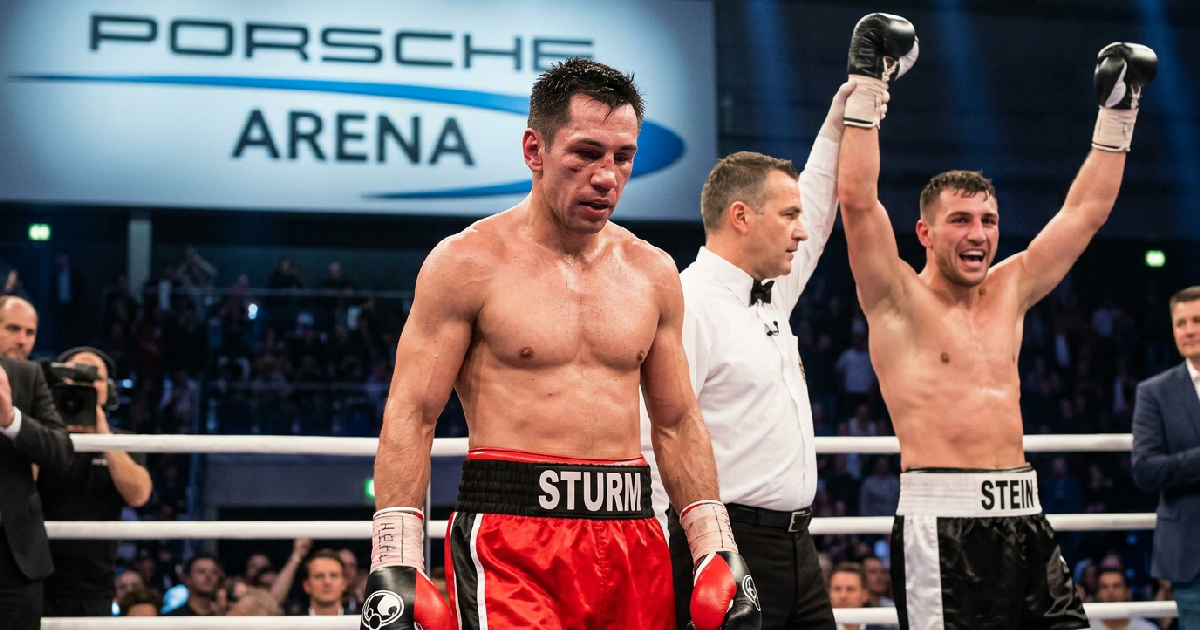
Felix Sturm concluded his storied 25-year professional career on Saturday night at the Porsche Arena in Stuttgart, suffering a narrow split-decision loss to Granit Stein in a 10-round light heavyweight contest.
The 47-year-old German icon, who held world titles across five separate reigns throughout his tenure, was unable to overcome the relentless pressure of his 33-year-old opponent in a bout promoted as “One Last Dance.”
Granit Stein secures career-defining victory over Felix Sturm
While Felix Sturm showed flashes of the technical brilliance that once defined his middleweight dominance, two judges scored the contest in favor of the younger Granit Stein, ending the veteran’s career with a final record of 45-7-3 with 20 knockouts.
The atmosphere inside the Porsche Arena was charged with nostalgia as thousands of fans gathered to witness the final walk of a man who served as a cornerstone of German boxing for two decades.
Felix Sturm had entered the ring following a clear promise to his family that this would be his definitive farewell to the sport. Despite the high stakes for his legacy, he faced a hungry and well-prepared rival in Granit Stein, who improved his professional record to 21-2-1.
The decision was met with a mixture of disappointment for the local hero and a standing ovation that recognized the immense contributions the former champion made to the European fight scene.
From the opening bell, Granit Stein made it clear that he was not in Stuttgart merely to serve as a footnote in another man’s retirement party. The 33-year-old established a high-tempo game plan immediately, utilizing a stiff jab and a consistent body attack to negate the reach and experience of Felix Sturm.
By staying within punching range, Granit Stein forced the older man into a physical grinding match, preventing the five-time champion from finding the rhythm needed to control the distance.
The strategy paid dividends as the rounds progressed. Granit Stein focused on high-volume combinations, often finishing his flurries with hooks to the ribs that appeared to sap the veteran’s energy. While Felix Sturm remained competitive, the disparity in youthful output became the defining characteristic of the middle rounds.
Every time the veteran landed a clean counter, his opponent responded with three or four-punch salvos that caught the eyes of the judges sitting ringside.
For Granit Stein, this victory serves as a vital course correction after a recent split-decision loss in his previous outing. Defeating a name as substantial as Felix Sturm, even in the twilight of the champion’s career, provides the German light heavyweight with significant leverage for future televised bouts.
He fought with a disciplined aggression that suggested he had studied the cagey, defensive style that once made the former champion so difficult to hit.
Scorecards reflect the competitive nature of the farewell bout
The 10-round affair was a tactical battle that lacked knockdowns but remained tense until the final bell. Neither man was ever truly in danger of being stopped, as Felix Sturm’s legendary high-guard defense remained largely intact despite his declining speed.
The veteran relied on his ring generalship, occasionally picking his younger foe apart with precise counters that reminded the audience why he was once considered one of the smartest opponents in boxing history during his prime years in the 160-pound division.
When the final bell rang, the tension moved from the canvas to the judges’ table.
The scores reflected just how closely the rounds were contested:
- Judge 1: 95-94 for Granit Stein
- Judge 2: 96-95 for Granit Stein
- Judge 3: 96-93 for Felix Sturm
While the veteran landed the cleaner individual shots, the sheer activity of the younger man across the full three minutes of each round was the deciding factor for two of the three officials.
Reflecting on the 25-year legacy of Felix Sturm
Felix Sturm’s departure from the ring marks the end of an era for German pugilism. Beginning his career in the early 2000s, he rose to international prominence during a golden age for the sport in Europe.
His technical proficiency and durability allowed him to hold versions of the middleweight and super-middleweight world titles across five distinct periods, a feat rarely matched in any weight class. He became a household name not just for his wins, but for his involvement in high-profile clashes that defined the sport’s narrative for years.
Many fans still remember his 2004 encounter with Oscar De La Hoya, a fight many observers believed the German should have won. That performance on American soil solidified his reputation as a world-class operator.
Over the subsequent two decades, he faced the likes of Arthur Abraham, Matthew Macklin, and Darren Barker, consistently drawing huge television audiences and sell-out crowds in his home country. His career was a testament to longevity, surviving through various shifts in the boxing landscape.
It remains to be seen if he will stay involved in the sport in a coaching or promotional capacity. Much like how Terence Crawford has discussed the retirement outlook of other modern greats, the transition away from active competition is often the hardest fight a boxer faces.
For the man born Adnan Catic, the promise to his family seems to be the final word on a career that spanned a quarter of a century.
The future of the German light heavyweight scene
With this victory, Granit Stein moves into a position where he can target regional titles or potentially an IBF eliminator. The light heavyweight division in Europe is currently experiencing a period of revitalization, and a win over a legend provides the necessary momentum to jump into higher-tier negotiations.
While he is 33, Granit Stein showed a level of physical conditioning that suggests he has several years of prime competition left.
The domestic boxing scene in Germany will now look for a new figurehead to replace the vacuum left by the retirement of its veteran icons. While the sport has seen a rise in international stars, the local market relies heavily on figures like Felix Sturm to drive ticket sales and broadcast interest.
As Vincenzo Gualtieri prepares for upcoming middleweight bouts, the next generation of German fighters will be under pressure to replicate the sustained excellence that the retiring five-time champion provided for so long.
Final moments at the Porsche Arena
As the final decision was read, Felix Sturm stood in the center of the ring, looking more contemplative than angry. He embraced Granit Stein, acknowledging the passing of the torch, before taking a microphone to address the Stuttgart crowd for the final time.
The audience, many of whom had followed his career since his professional debut in 2001, stayed in their seats to offer a sustained ovation as he climbed through the ropes and headed back to the locker room.
The “One Last Dance” may not have ended with the victory Sturm desired, but it provided the closure he sought.
In a sport where many stay too long and exit through the back door, Sturm walked away on a big stage, having proven he could still navigate ten hard rounds against a man 14 years his junior.
He leaves the sport as one of the most decorated German athletes of his generation, secure in a legacy that includes multiple world titles and a permanent place in the record books.
The departure of a five-time champion always invites questions about what is lost when the old guard leaves. For Germany, it is the loss of a fighter who could reliably sell out arenas and hold his own against the very best in the world.
For the man himself, it is the beginning of a life away from the daily rigors of the gymnasium and the weight scales. As he heads into retirement, the boxing world acknowledges a career defined by resilience, skill, and an unwavering commitment to the Sweet Science.