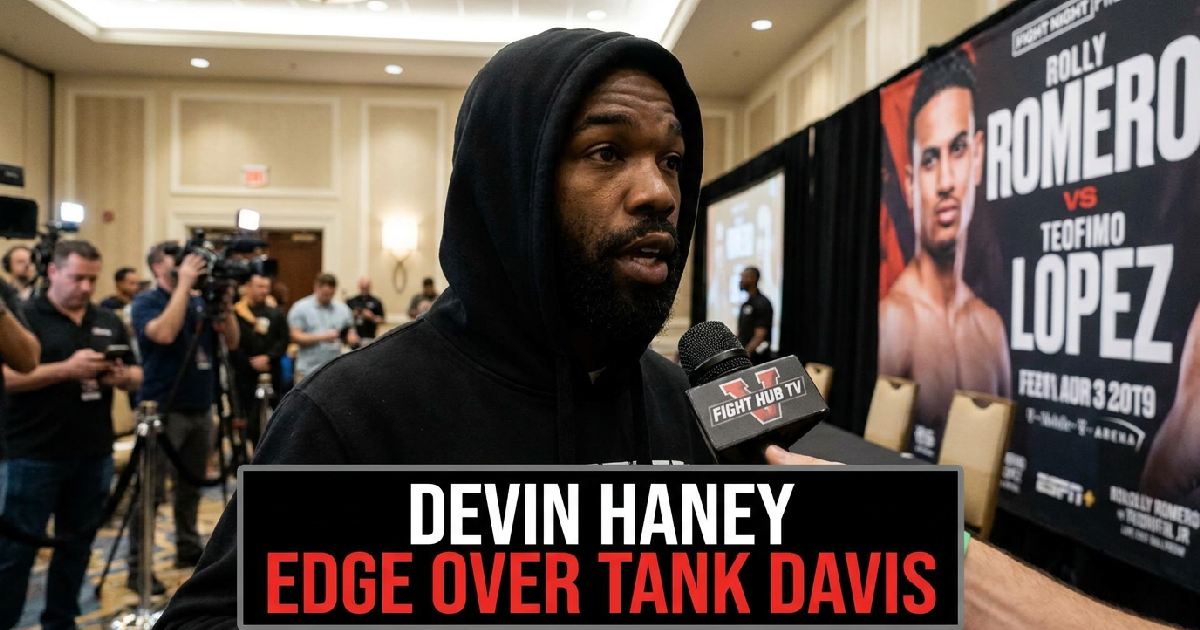
Gary Russell Jr., a former featherweight world champion, weighed in on one of boxing’s most anticipated hypothetical matchups this week. Speaking to Fight Hub TV on July 14, 2026, Russell Jr. asserted that Devin Haney holds a distinct edge over Gervonta “Tank” Davis in a potential clash. He didn’t stop there, also predicting that fellow lightweight contender Shakur Stevenson would defeat Davis, sparking further debate among boxing enthusiasts.
These candid comments came in the wake of the press conference for the Rolly Romero versus Teofimo Lopez fight, an event that provided the backdrop for his detailed analysis. Russell Jr. specifically addressed the intense online discussions and rivalries simmering among top fighters like Stevenson, Haney, and Davis. His insights offer a seasoned fighter’s perspective on the complex stylistic dynamics at play within the sport’s talent-rich lightweight division.
Devin Haney’s movement confounds flat-footed Tank Davis
Gary Russell Jr. wasted no time in highlighting Devin Haney’s defensive acumen as his primary weapon against Gervonta “Tank” Davis. Haney’s ability to “get the f—k out the way,” as Russell Jr. put it, transforms what many might perceive as mere evasiveness into a profound strategic asset. This isn’t just about avoiding punches; it’s about dictating the fight’s tempo and frustrating an opponent psychologically.
Russell Jr. stressed that Haney would “stick to the script,” relying on his established methodology of disciplined boxing and constant lateral movement. This consistent motion creates a moving target, making it incredibly challenging for a fighter like Davis to set his feet and unleash his renowned power. Effectively, Haney’s style forces opponents into a difficult chase, often leading to missed punches and wasted energy for his aggressor.
This tactical approach isn’t merely about defense; it’s an offensive strategy in itself. By continuously forcing Davis to reset and pursue, Haney can drain his opponent’s energy reserves and diminish his punching accuracy over the course of a fight. It turns the ring into a mental and physical maze for a flat-footed opponent. This patient, calculated style is a hallmark of defensive specialists, reminiscent of how Roberto Duran identified Ken Buchanan as an astute fighter.
Gervonta Davis requires solid planting for power punches
Gervonta “Tank” Davis, a devastating puncher known for his knockout power, possesses a distinct style that Russell Jr. believes could be exploited. The former champion characterized Davis as a “flat-footed fighter” who inherently “needs to really plant to get his punches off.” This isn’t a criticism of his power, but rather an observation of his fundamental mechanics.
This physical requirement means Davis thrives when he can brace himself, transferring his body weight into concussive blows that often end fights abruptly. Russell Jr. contends that any boxer capable of maintaining consistent lateral movement would pose a substantial threat to this approach. Haney’s ceaseless movement would effectively deny Davis the solid base he requires, neutralizing much of his offensive potency and reducing him to lunging attempts.
For Davis, this means he’d be unable to consistently generate the torque necessary for his signature knockout blows. Instead of landing flush, he’d be catching air or connecting with glancing shots, which dramatically reduces their impact. This constant search for a stationary target can wear down even the most patient power puncher, eroding both their physical stamina and mental resolve over the championship rounds.
Predicted fight scenarios for Haney versus Davis
Given these stark stylistic disparities, Russell Jr. ultimately leans towards Devin Haney clinching a victory over Gervonta Davis. He predicted a fight that would be “very long, boring,” a description that speaks volumes about Haney’s tactical approach rather than a lack of intrinsic excitement. This long, drawn-out affair would stem from Haney’s adeptness at controlling the distance, meticulously minimizing close-quarter exchanges where Davis typically excels.
This forecasted outcome provides a sharp reminder of how crucial stylistic matchups are in boxing. Even immense raw power, like that possessed by Davis, can sometimes be utterly neutralized by a fighter whose primary goal is to avoid being hit and to systematically outmaneuver their opponent. Haney’s methodical boxing could systematically dismantle Davis’s explosive game plan, preventing him from ever truly unleashing his fight-ending artillery.
The term “boring” in this context reflects a tactical masterclass rather than a dull affair for a boxing purist. It implies a fight dominated by defensive skill, ring generalship, and point-scoring rather than sensational knockouts. Haney’s approach would be to patiently accumulate rounds, forcing Davis to chase without reward and eventually break his rhythm.
This strategy, while not always a crowd-pleaser, is highly effective against aggressive punchers who rely on overwhelming force. It’s a testament to the intelligence and discipline required to defeat a fighter of Tank Davis’s caliber, emphasizing skill over brute strength and relentless pressure.
Shakur Stevenson also poses a significant threat to Tank Davis
Russell Jr.’s strategic outlook didn’t stop with Haney. He extended his analysis to another prominent lightweight, Shakur Stevenson, forecasting a similar result should Stevenson ever meet Gervonta Davis in the ring. The former featherweight champion firmly believes Stevenson’s elite defensive capabilities and stinging jab would ultimately be too challenging for Davis to conquer.
A potential Stevenson versus Davis encounter, according to Russell Jr., would likely be “boring as hell.” This blunt assessment underscores Stevenson’s commitment to defensive mastery and precise counter-punching. He anticipates Stevenson would “put that stick on Tank ass,” consistently landing punches with his long jab while meticulously avoiding risks and swiftly getting out of the way. This would lead to a prolonged, highly tactical contest rather than a brawl.
What this analysis means for Tank Davis is clear: his signature power-punching style faces significant hurdles against elite defensive movers. Both Haney and Stevenson embody a particular archetype in boxing, one designed to disarm explosive fighters. They’d systematically deny Davis the stationary target he instinctively seeks to leverage his formidable knockout power, forcing him into uncomfortable positions he’s unaccustomed to. This strategic avoidance of engagement by top contenders has, at times, led to accusations similar to those Shakhram Giyasov made against Rolando Romero.
Russell Jr. articulated that both Haney and Stevenson excel at making opponents “do things outside of their comfort zone.” This strategic mastery is often the downfall of pure power punchers, who struggle when they can’t dictate the pace or find their rhythm. It’s a testament to the adage that styles make fights, and some styles just don’t match up well against a moving target.
Stevenson’s jab, often referred to as “the stick,” is not just a range-finder but a weapon that can keep Davis at bay and disrupt his offensive flow. He’s a master of controlling distance and tempo, making it incredibly difficult for opponents to find their footing. This sustained pressure through evasion and precise counters can erode an aggressor’s confidence over twelve rounds, leading to a clear points victory.
Analyzing a potential Haney versus Shakur Stevenson matchup
Though Russell Jr. views both Haney and Stevenson as victors over Davis, he foresees a far more complex and challenging bout if Haney and Stevenson were to face each other. He candidly acknowledged that “both of them would have problems with each other,” primarily due to their shared boxing-first mentalities. It’s a clash of defensive titans, each looking to outmaneuver the other in a strategic game of chess.
Neither fighter is renowned for an aggressive, come-forward style; they both prefer to fight off the back foot, utilizing counter-punching and defensive maneuvers. This mutual inclination would likely force them “to do things outside of their comfort zone,” potentially leading to a chess match of the highest order. The fight could become a subtle battle for positional advantage and timing, with each fighter meticulously trying to create openings.
A critical nuance Russell Jr. introduced for a potential Haney-Stevenson bout involves their physical attributes, specifically arm reach. He posited that Stevenson, possessing “shorter arms” compared to Haney, would encounter a tougher challenge in bridging the distance. This physical disadvantage is significant in a sport often decided by inches, where reach can dictate who controls the outside.
To land punches effectively on Haney, Stevenson would be compelled to “cross that threshold,” meaning he would need to actively close the distance and engage. This forward aggression runs contrary to Stevenson’s typically comfortable, back-foot style, and could expose him to Haney’s disciplined counter-attacks and evasive movements. It’s a tactical dilemma that could decide the fight’s rhythm and eventual outcome, forcing Stevenson to adapt or risk being outpointed.
When two highly skilled defensive boxers meet, the fight often becomes a contest of who can force their opponent to make the first mistake. It’s less about explosive exchanges and more about subtle shifts, feints, and timing. The anticipation would be immense, as fans would witness a masterclass in technical boxing, a testament to the sweet science.
Stevenson’s shorter reach means he’d have to overcome a natural barrier, perhaps by employing more head movement and footwork to get inside Haney’s longer jab. This adaptation could either lead to brilliant adjustments or leave him exposed if not executed perfectly. It’s a high-stakes strategic puzzle for both camps, pushing their ring IQ to its absolute limits.
Implications for the competitive lightweight division
Gary Russell Jr.’s candid observations offer invaluable insights into the dynamic and ever-shifting landscape of boxing’s lightweight division. This weight class consistently stands out as one of the sport’s most talent-rich categories, boasting an enthralling blend of elite skills and sharply contrasting fighting styles. These are precisely the types of matchups that keep boxing fans captivated and eager for potential showdowns.
His expert analysis forcefully underscores the pivotal role that stylistic matchups play in determining fight outcomes, often outweighing individual power or perceived dominance. The intricate dance between powerful, aggressive punchers and agile, defensively astute boxers frequently produces unexpected and compelling results. Russell Jr. has essentially given us a detailed blueprint for how these elite fighters might nullify each other’s strengths.
Such detailed opinions from a respected former world champion like Russell Jr. naturally ignite further speculation and anticipation among boxing enthusiasts. As fans ponder these potential mega-fights, his breakdown contributes significantly to the narrative surrounding the sport’s elite. It shapes discussions about who truly holds the advantage among the division’s top contenders and why, feeding the constant boxing dialogue.
This sort of insider perspective is exactly what fans crave when considering blockbuster fights that, for now, remain hypothetical. It helps to contextualize the inherent strengths and weaknesses of each fighter, moving beyond simple win-loss records to a deeper understanding of ring craft. The division’s future seems poised for these exact types of clashes, driven by compelling stylistic contrasts and the strategic genius of its top combatants. Meanwhile, other news keeps the boxing world busy, with Andy Ruiz Jr. reportedly nearing a comeback, adding another layer of intrigue to the sport.
The lightweight division continues to evolve, with new talent emerging regularly and established champions facing constant challenges. Russell Jr.’s predictions add another layer of complexity to the already fascinating discussions surrounding the division’s hierarchy. It makes the prospect of these fights even more alluring, turning every rumour and online jab into headline news.
Ultimately, these hypothetical matchups are the lifeblood of boxing discourse, driving fan engagement and setting the stage for future blockbuster events. The insights from a fighter of Russell Jr.’s caliber serve to deepen that conversation, offering a glimpse into the strategic thinking that defines championship boxing at the highest level.