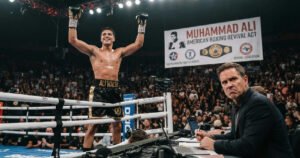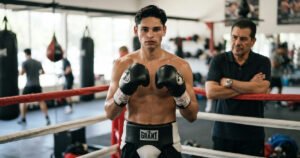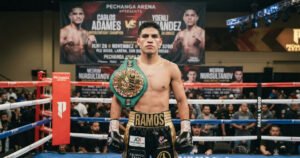
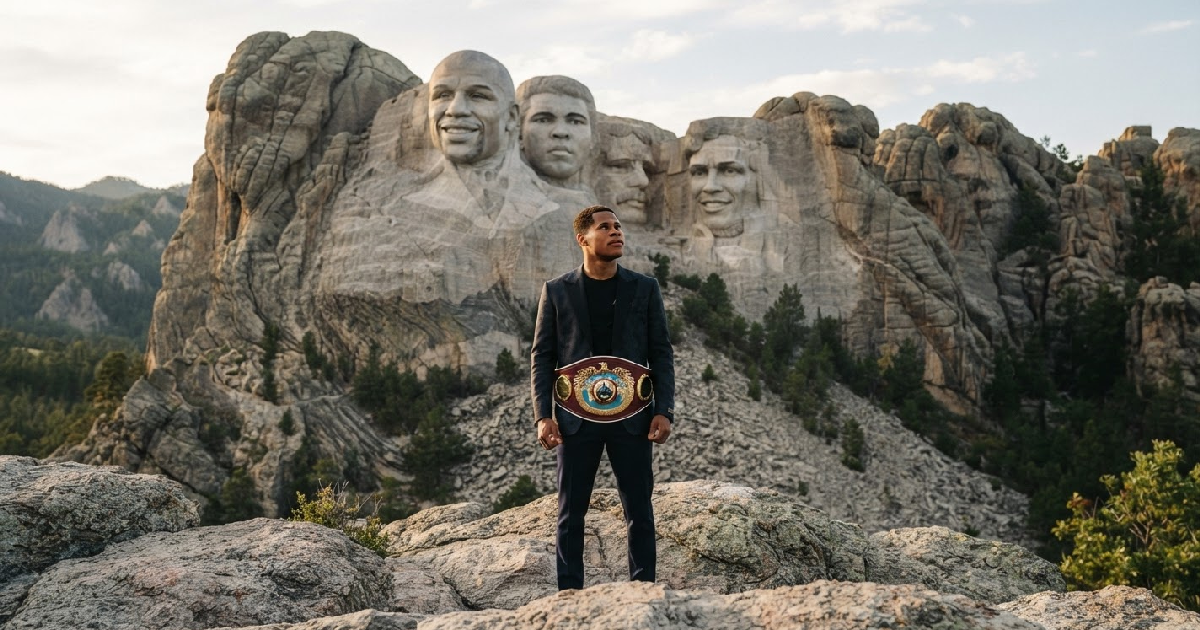
Devin Haney, the reigning World Boxing Organization (WBO) welterweight champion, recently revealed his personal “Mount Rushmore” of boxing greats, naming Floyd Mayweather Jr., Sugar Ray Leonard, Muhammad Ali, and Sugar Ray Robinson. The undefeated fighter shared his esteemed list on “Inside The Ring,” as he gears up for what promises to be a busy period in his own career.
Haney’s selection comes as he awaits his next opponent, with a WBO mandatory defense against Keyshawn Davis looming. The 27-year-old American boxer, known as “The Dream,” is looking to solidify his own legacy, having captured titles across three weight classes.
Haney’s picks for boxing’s Pantheon
Haney didn’t hesitate when asked to name the four fighters he believes stand atop the sport’s history. His choices reflect a blend of defensive mastery, offensive prowess, and iconic cultural impact.
“My Mount Rushmore of fighters are Floyd [Mayweather] because he changed the game, his defence, he just brought a whole different vibe to the sport of boxing,” Haney explained. This nod to Mayweather highlights the technical brilliance and business acumen that defined “Money” Mayweather’s career.
The enduring legacy of “Money” Mayweather
Floyd Joy Mayweather Jr. retired with an impeccable 50-0 professional record, securing 27 knockouts. He claimed 15 major world championships across five different weight divisions, cementing his status as one of the most dominant fighters ever.
Mayweather’s unparalleled defensive skills and strategic approach transformed boxing into a lucrative enterprise, earning him over $1 billion in purses. His induction into the International Boxing Hall of Fame in 2021 was a foregone conclusion given his impact.
“My next is Sugar Ray [Leonard] because he was just a killer in the ring, he had the offence and the defence, his defence was his offence, he was just Sugar Ray,” Haney continued. This assessment captures the essence of Leonard’s electrifying style and competitive spirit.
Sugar Ray Leonard’s electrifying style and dominance
Ray Charles Leonard, an Olympic gold medalist at the 1976 Montreal Summer Games, became a professional legend. He secured world titles in five weight classes and achieved undisputed welterweight champion status.
Leonard was a central figure in the “Four Kings” era of the 1980s, famously battling Roberto Durán, Thomas Hearns, and Marvin Hagler. He stands alone among them for defeating all three rivals, showcasing his extraordinary talent and ring intelligence. His career record of 36 wins, 3 losses, and 1 draw, with 25 knockouts, speaks volumes.
Beyond the ring: Ali’s enduring impact
Haney placed Muhammad Ali third on his list, stating, “[Muhammad] Ali. Ali just stood for so much and he is ‘The Greatest’.” This sentiment echoes the global recognition of Ali not just as a boxer, but as a towering cultural figure.
Born Cassius Marcellus Clay Jr., Ali transcended the sport with his charisma and unwavering principles. He famously became a three-time world heavyweight champion, engaging in legendary bouts like “The Rumble in the Jungle” against George Foreman and “Thrilla in Manila” against Joe Frazier.
Muhammad Ali: The greatest of all time
Ali’s impact reached far beyond the ropes, as he became a prominent social activist during the Civil Rights era. His refusal to be inducted into the U.S. Army during the Vietnam War cemented his status as a principled icon, even at great personal cost to his career.
His professional record of 56 wins and 5 losses, with 37 knockouts, only tells part of the story. Ali’s influence on sports and society remains unparalleled, justifying his enduring title as “The Greatest.”
“Number four, this is hard, the fourth spot, I’ll go Sugar Ray Robinson. What he was doing back in those days, fighting so often and all of those fights that he won. He is just a legend, so I would say Sugar Ray Robinson,” Haney concluded. His respect for Robinson highlights the sheer volume and quality of his work.
Sugar Ray Robinson’s unparalleled dominance and longevity
Often considered the greatest pound-for-pound boxer of all time, Sugar Ray Robinson (born Walker Smith Jr.) turned professional in 1940. He dominated the welterweight division, holding the world title from 1946 to 1951.
Robinson also claimed the middleweight title five times, an unprecedented feat for his era. His incredible 91-fight unbeaten streak from 1943 to 1951 is a testament to his sustained excellence over a quarter-century career.
With an astounding 175 wins, including 110 by knockout, Robinson’s resume is arguably the most impressive in boxing history. His induction into the International Boxing Hall of Fame in 1990 acknowledged his legendary status.
Devin Haney’s own pursuit of greatness
Haney’s admiration for these legends underscores his own aspirations in the sport. He currently holds the WBO welterweight title, which he secured last November by dominating Brian Norman Jr. Haney became the youngest undisputed lightweight world champion in the modern four-belt era in 2022.
The undefeated fighter has been actively pursuing big names, with past links to a rematch against Ryan Garcia and potential bouts with Conor Benn and Shakur Stevenson. These are the kinds of matchups that define a champion and build a legacy.
But while those high-profile clashes remain speculative, Haney’s immediate challenge is a mandatory defense. The WBO has ordered him to face Keyshawn Davis, a fight that will proceed to purse bids if an agreement isn’t reached by Monday, July 20.
This situation puts pressure on Haney’s team to finalize terms, demonstrating the complexities champions face in scheduling fights. Securing the biggest bouts often requires navigating mandatory challenger obligations. Similar challenges are common across weight classes for titleholders.
The meaning of boxing’s Mount Rushmore for current fighters
For a fighter like Haney, articulating a “Mount Rushmore” isn’t just idle speculation; it’s a reflection of the standards he holds for himself. Each legend he named represents a different facet of boxing excellence: Mayweather’s defensive mastery and business savvy, Leonard’s explosive offense, Ali’s iconic presence, and Robinson’s consistent dominance.
These selections suggest Haney values a complete fighter — one who can adapt, dominate, and leave a lasting impact both inside and outside the ring. It’s a blueprint for the kind of career he appears to be meticulously building.
His choices are also a subtle statement about the lineage and historical context of boxing. By aligning himself with these all-time greats, Haney signals his ambition to be considered in the same breath as those he reveres. It’s an acknowledgment of the past that informs his drive for future success.
As Haney continues to establish his dominance in the welterweight division, his public declaration of boxing’s greatest serves as a benchmark. It provides fans with insight into the minds of today’s champions and what truly inspires them. Discussions among fighters about active and past greats are a constant in the sport, revealing much about their perspectives.
Haney’s immediate future: Mandatory challenge looms
The WBO’s directive for Haney to face Keyshawn Davis marks a crucial juncture for the champion. This mandatory defense could either further elevate his status or present an unexpected hurdle in his quest for superstardom.
Davis represents a significant threat and a necessary step for Haney to retain his welterweight strap. Failing to reach an agreement could force the fight into purse bids, a process that can sometimes lead to less favorable terms for the defending champion.
Beyond Davis, the boxing world still anticipates those blockbuster matchups involving Ryan Garcia and Shakur Stevenson. Haney’s ability to navigate his mandatory duties successfully will dictate the timing and feasibility of those future mega-fights, potentially in 2027.