Saudi official Turki Alalshikh is accused by Simon Jordan of manufacturing discord in boxing before presenting himself as its peace arbiter. These sharp claims come from talkSPORT pundit Simon Jordan, who alleges Alalshikh actively fuels divisions before offering solutions through his much-publicized promoter peace summit.
Jordan made his pointed observations during a discussion on the prospective Tyson Fury versus Anthony Joshua super-fight, a bout that has been years in the making. His remarks highlight growing scrutiny over Alalshikh’s escalating influence and the financial power he wields over the sport’s biggest decisions, particularly through Riyadh Season events.
Jordan’s claims about Alalshikh’s strategic disruption
Simon Jordan didn’t mince words, suggesting Turki Alalshikh employs a calculated strategy of creating friction within the boxing landscape. “What Turki does is he creates disruption and then comes along and says, ‘I’ll provide the solution,’” Jordan stated, drawing parallels to Alalshikh’s proposed peace summit.
He argued that the Saudi powerbroker is behind many of the “arguments that he’s creating, by the way,” among promoters. Jordan sees this as a self-serving move, designed for Alalshikh to then step in as the benevolent “peacemaker.”
The disputed Fury-Joshua fight location
Jordan’s initial comments centered on the ideal location for a potential Tyson Fury vs. Anthony Joshua clash. He suggested the bout’s immense profile is “artificially inflated by one man’s wish,” referring to Alalshikh.
The talkSPORT pundit believes Alalshikh favors a US location for the blockbuster event. He cited Alalshikh’s perceived investment in TKO Group Holdings and its subsidiary Zuffa as a key motivator, suggesting it “suits him” to host such a high-profile event there.
This perspective adds another layer of complexity to the ongoing saga of the Fury-Joshua fight. While many fans simply want to see the two British heavyweights finally meet, the commercial and political implications of the venue choice are clearly significant.
The proposed promoter peace summit and its reception
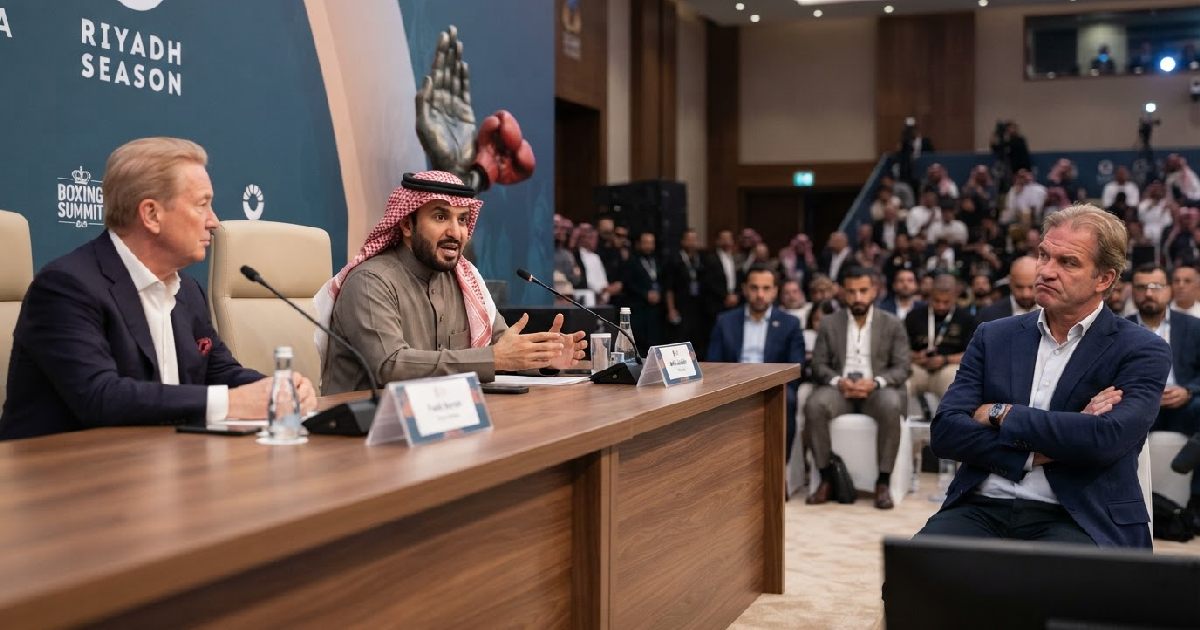
The “peace summit” Jordan referenced aims to ease tensions between boxing’s leading promoters and broadcasters. Turki Alalshikh’s proposal brought together high-profile figures like Dana White, Nick Khan, Frank Warren, Eddie Hearn, Oscar De La Hoya, and DAZN executives.
Alalshikh had previously expressed hope that fans would witness “the white smoke rise from the chimney” if the meeting proved successful, signaling a new era of cooperation. However, recent developments suggest those divisions are far from resolved, fueling Jordan’s skepticism.
Unresolved tensions despite summit efforts
Despite a much-publicized photograph showing Alalshikh with several key boxing figures, including Nick Khan, the promised era of peace hasn’t materialised. Months after the initial discussions, the industry fragmentation that Jordan highlighted largely remains.
This persistence of unresolved issues casts a shadow over the effectiveness of the summit. It also lends credence to the idea that underlying conflicts, perhaps even those instigated by new power dynamics, are proving difficult to overcome.
The boxing world is accustomed to rivalries, but the current climate appears particularly fraught. The lack of concrete resolutions from Alalshikh’s initiative reinforces the idea that true unity remains elusive.
Saudi Arabia’s growing influence in boxing
Turki Alalshikh, as Chairman of the General Entertainment Authority (GEA), has become a pivotal figure in modern boxing. His significant financial backing through Riyadh Season events has undeniably reshaped the sport, bringing unprecedented paydays and high-profile matchups to Saudi Arabia.
This injection of capital has, however, created a new power dynamic, shifting influence away from traditional promotional structures. Alalshikh’s involvement aligns with Saudi Arabia’s Vision 2030, a broader initiative to diversify the economy and enhance global standing through major sports and entertainment events.
Financial might reshaping the sport’s hierarchy
The Saudi investment isn’t just about individual fight purses; it extends to broader commercial ventures. Turki Alalshikh is a co-founder of Zuffa Boxing, a TKO-owned professional boxing promotion. Sela, a Saudi entertainment conglomerate, holds a 60% controlling stake in Zuffa Boxing, while TKO Group Holdings holds a 40% minority stake.
Zuffa Boxing, led by Dana White, held its first numbered event in January 2026, further cementing Saudi involvement at a foundational level of the sport. This financial clout raises questions about who truly controls boxing’s direction and who ultimately benefits from its biggest events.
It’s a stark change from previous eras where established promoters held nearly all the cards. Now, a new player with seemingly limitless resources can dictate terms, potentially marginalizing those who built the sport.
The future of boxing’s power structure
Jordan’s commentary isn’t new; he previously questioned whether traditional promoters would become unnecessary if Saudi Arabia continued to centralize money, matchmaking, and decision-making power. This ongoing debate reflects a fundamental shift in the sport’s ecosystem.
The influx of Saudi investment has undeniably delivered mega-fights and unprecedented opportunities for fighters. But it also introduces a single, dominant entity with the capacity to consolidate power, potentially at the expense of competition and traditional promotional rivalries.
Balancing commercial success with industry harmony
The challenge for boxing now lies in navigating this new landscape. While the financial benefits are clear, maintaining a balanced and competitive promotional environment is crucial for the sport’s long-term health.
The current structure sees major promoters like Frank Warren of Queensberry Promotions and Eddie Hearn of Matchroom Sport, who also has a significant deal with DAZN, operating in an environment increasingly shaped by Riyadh’s initiatives.
Despite his criticisms, Jordan conceded that the ultimate goal remains for big fights like Fury vs. Joshua to happen. He stressed that “the fight happens is the most important thing,” with the location being “probably secondary.” This pragmatic view underscores the fan desire for top-tier action, regardless of the behind-the-scenes machinations.
But the questions raised about Turki Alalshikh’s motives and methods will continue to fuel discussion. As Saudi Arabia’s influence grows, so too will the scrutiny over whether this new era prioritizes genuine collaboration or simply consolidates control under a new banner.
The health concerns faced by Alalshikh, who has publicly spoken about his battle with cancer and a brain tumor, have also added a layer of urgency to his stated desire for a peace summit. He has expressed worries that his cognitive abilities could deteriorate, pushing for swift resolution to the sport’s divisions.
This personal dimension adds a human element to what is otherwise a complex power struggle, reminding stakeholders of the pressures he faces.
The sport of boxing has always been a dynamic arena, both inside and outside the ropes. However, the recent shift in power, heavily influenced by Saudi investments and figures like Alalshikh, presents a unique inflection point. The traditional rivalries between promoters like Hearn and Warren now play out against a backdrop where a single entity can significantly impact their operational autonomy and revenue streams.
Ultimately, while the infusion of capital has undeniably led to some highly anticipated bouts, the broader implications for the sport’s structure, its competitive balance, and the autonomy of its long-standing figures remain a subject of intense debate. Whether Alalshikh is a disrupter or a true unifier, his impact is undeniable and will continue to shape boxing for years to come.