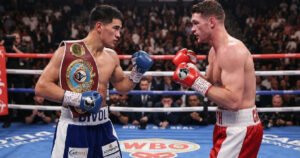
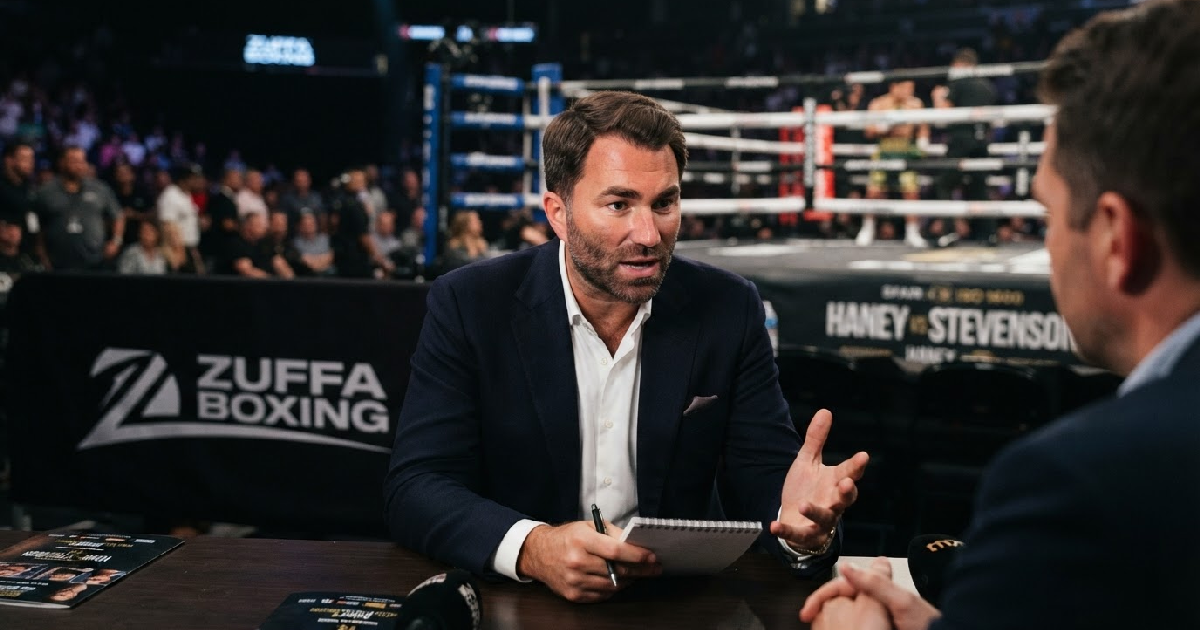
Eddie Hearn states Zuffa, the UFC’s parent company, faces a significant financial challenge to secure Devin Haney for a bout against Shakur Stevenson.
Hearn, in remarks published as recently as July 17, 2026, contends that Zuffa’s hefty investment in Stevenson has inadvertently handed Haney immense leverage in any potential negotiations.
Zuffa’s Shakur Stevenson investment creates Haney leverage
Hearn’s comments also touched on the recently announced Ryan Garcia vs. Conor Benn fight, which he views as a humbling experience for Zuffa’s ambitious foray into boxing promotion. This dual assessment offers a candid look into the intricate and often contentious world of top-tier boxing deals, particularly as new players like Zuffa attempt to establish dominance.
Zuffa’s recent acquisition of Shakur Stevenson, a highly touted talent, came with a substantial price tag. Hearn acknowledged it was a “great deal” for Stevenson, though he noted: “I know the numbers they’re giving Shakur great deal for Shakur he he gave up his legacy. but he’s got legacy. and now he’s got a great deal good for him.”
Rumours circulating in the boxing world, according to Hearn, suggest Stevenson is commanding around $20 million per fight from Zuffa. This considerable investment, Hearn argues, puts Zuffa in a bind: they desperately “need him to fight Devin Haney” to justify such an outlay.
The problem, as Hearn sees it, is that without a marquee opponent like Haney, Zuffa struggles to find a challenger worthy of Stevenson’s reported salary. He dismisses the idea that Stevenson can simply “fight whoever I want,” pointing out that many champions and big names are tied to rival promoters and broadcasters like DAZN.
Hearn sarcastically questioned: “who else can you fight right now? Rayo Valenzuela? Good fight. But you’re going to pay Shakur that kind of money to fight Rayo Valenzuela?!” This highlights the commercial imperative for Zuffa to deliver a blockbuster fight, and for Stevenson, that means Devin Haney.
Devin Haney’s strong negotiation position in boxing
Despite some industry chatter that Devin Haney might be “in no man’s land,” Hearn holds the opposite view. He believes Haney is “in a brilliant position” precisely because Zuffa now has a vested interest in making the fight with Stevenson happen.
Hearn advised Haney and his father, Bill Haney, to fully grasp their newfound negotiating power. He suggested they should be telling Zuffa, “you actually you really need me right now, don’t you Zufa.”
The Haney camp is well-known for its shrewd business dealings. Hearn wryly commented that Devin and Bill Haney are “f-ckin’ hard work” when they understand their leverage. This underscores the challenge Zuffa faces in bringing Haney to the table.
Past reports from April 2026, citing Hearn himself, indicated that Haney was demanding “crazy money” for fights, leading to difficulties in securing opponents. With Zuffa now in need of a top-tier opponent for Stevenson, it appears Haney’s financial demands might finally be met, potentially by the deep pockets of Zuffa, reportedly backed by Saudi investment.
Ryan Garcia versus Conor Benn: a humbling lesson for Zuffa
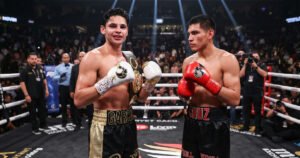
Shifting focus, Hearn also weighed in on the politics surrounding the Ryan Garcia vs. Conor Benn fight, which was formally announced recently. He recalled Zuffa’s initial expectations for the bout, believing it would be “a Zuffa show on Paramount, that is it, and Sky Sports which is their other partner.”
However, the reality proved different. The fight is now confirmed as a “ring card co-promoted by Oscar De La Hoya and Zuffa on DAZN and Paramount.” This turn of events, Hearn noted, has been “incredibly humbling” for Zuffa, providing them with a stark lesson in the complexities of the boxing business.
Oscar De La Hoya, head of Golden Boy Promotions, reportedly took to social media to announce the fight was “done,” further illustrating the collaborative, rather than fully controlling, nature of this particular event. Hearn implies that Zuffa, known for its dominant approach in MMA, struggles with sharing the spotlight.
This co-promotional structure means Zuffa isn’t fully in charge, a situation Hearn believes “it’ll be eating them up so bad.” Despite the apparent discomfort, Hearn noted, “I think that’s great for the fight. They should embrace that, but they can’t because they’re control freaks.” The intricacies of contract negotiations are a common theme in high-profile boxing, often leading to co-promotions or delays.
Hearn’s ongoing critique of Zuffa Boxing ambitions
These recent developments fit squarely into a broader pattern of criticism Eddie Hearn has leveled against Zuffa Boxing. Back in May 2026, Hearn had already “sharply criticized Dana White and Zuffa Boxing,” questioning their long-term viability and impact on the sport.
Hearn consistently dismisses the idea that fighters like Devin Haney and Shakur Stevenson would routinely headline standalone Zuffa cards. He argues that Zuffa’s current strategy often involves placing fighters on “Ring cards on Netflix cards,” rather than truly building their own promotional events from the ground up.
He hasn’t minced words, mocking the scale of Zuffa Boxing’s events. Hearn once claimed he was “barely aware one of their cards had even taken place,” further suggesting a lack of significant impact compared to established promoters.
His biting assessments include descriptions of Zuffa shows as being held “in the garage getting changed in the squash courts with your own gloves, and shoes and socks provided for you. And it is absolute toilet.” This colourful language underscores his belief that Zuffa lacks a fundamental understanding of boxing promotion.
comparing Zuffa to traditional boxing promoters
Hearn has repeatedly challenged Zuffa’s claims of surpassing established promoters in the boxing world. He provided concrete figures to support his argument, stating that Zuffa had “done four shows this year,” while Matchroom had “done 10” and Frank Warren’s outfit “probably done 10.” Golden Boy, another long-standing promoter, had “done six.”
These numbers highlight a significant disparity in activity, suggesting Zuffa’s footprint in boxing remains relatively small despite its grand ambitions. Hearn’s long experience as Chairman of Matchroom Sport, a company founded by his father, Barry Hearn, provides him with an authoritative perspective on the industry.
He also accused Zuffa TKO, the merged entity of UFC and WWE, of falsely claiming to be promoters for fights like Tyson Fury against Agit Makhmudov. Hearn insisted Zuffa TKO had “nothing to do with” that particular event, suggesting a pattern of overstating their involvement.
implications for fighter autonomy and big fights
The situation with Shakur Stevenson and Devin Haney, alongside the Ryan Garcia and Conor Benn co-promotion, reveals the evolving dynamics within professional boxing. Fighters like Stevenson, lured by substantial financial offers, may find themselves in a golden cage, where their promoter needs them to fight specific opponents to recoup their investment.
This contrasts with the idealised vision of “best versus best” that fighters often articulate. While Stevenson might genuinely believe his deal allows him to “fight whoever I want,” Hearn’s practical assessment suggests the commercial realities of boxing, especially with massive contracts, dictate otherwise.
For a fighter like Devin Haney, understanding and leveraging this landscape becomes paramount. His ability to command “crazy money” points to a growing trend where top-tier athletes, especially those not tied to an exclusive promoter, can wield considerable power at the negotiation table.
It also indicates that newer, well-funded entities like Zuffa, while bringing financial muscle, are still learning the ropes of boxing’s deeply entrenched promotional ecosystem. Their struggle to exert complete control over the Garcia-Benn fight serves as a stark reminder that boxing operates on different rules than MMA.
potential mega-fights and promotional hurdles
Beyond the immediate focus, Hearn frequently muses on other potential mega-fights and the promotional hurdles they face. He expressed frustration that a rematch between Ryan Garcia and Devin Haney isn’t currently on the cards, calling it “the biggest fight out there.”
This is due to the “narrative and the history and the beef and like the the first fight the drugs test the fathers” surrounding their initial encounter. Such compelling backstories are golden tickets for promoters, but securing them often requires navigating complex contractual landscapes and rival promotional interests.
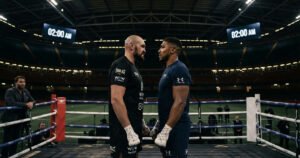
Hearn also mentioned other hypothetical matchups, like “AJ Fury” (Anthony Joshua vs. Tyson Fury), noting that Dana White of Zuffa was claiming to promote it. This further highlights the competitive jockeying for position among major promoters.
The challenge of making such fights, even with immense public demand, often comes down to the willingness of various promotional outfits and broadcasters to collaborate. Hearn’s recent comments on Zuffa indicate that such collaboration, though sometimes begrudging, is essential for delivering the biggest events to fans.
The ongoing saga of Tyson Fury vs. Anthony Joshua has shown just how complex these negotiations can be, with contract disputes often delaying or derailing highly anticipated matchups. For Zuffa, succeeding in boxing will mean not just signing top talent but also mastering these intricate dance steps with rival promoters and broadcasters.