
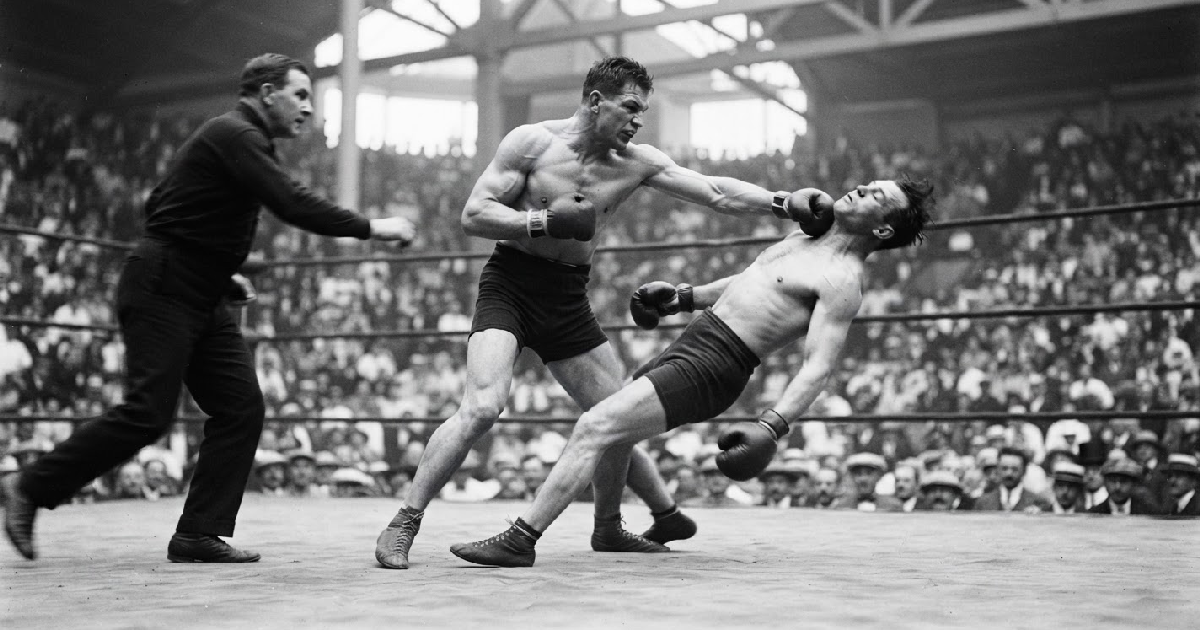
Stanley Ketchel, known as “The Michigan Assassin,” emphatically retained his world middleweight championship on July 31, 1908. He delivered a spectacular Stanley Ketchel knockout against top contender Hugo Kelly in the third round at the Coliseum in San Francisco, California. The sudden, powerful finish capped a competitive bout that showcased both fighters’ skills.
While Ketchel ultimately found the decisive blow he sought, the initial rounds saw Kelly, a formidable Chicago challenger, present a surprisingly stiff test. Kelly’s speed, defensive prowess, and ring intelligence made him one of the most challenging opponents the champion had faced during his dominant run.
Early rounds test Ketchel’s championship resolve
Before his encounter with Ketchel, Hugo Kelly, whose birth name was Ugo Gino Micheli, had forged a strong reputation within the middleweight division. His professional record included significant victories over Philadelphia Jack O’Brien, Mike Schreck, and Joe Grim, alongside draws with Tommy Ryan and Billy Papke. This established him as a legitimate threat.
Kelly’s formidable track record underscored his position as a top-tier contender, bringing a professional record of 34 wins, 10 losses, and 21 draws into the championship fight. Many observers believed he possessed the tactical acumen to genuinely challenge Ketchel’s powerful grasp on the middleweight championship.
Kelly’s early tactics unsettle the champion
From the opening bell, Ketchel advanced in his characteristic aggressive style, unleashing heavy punches in pursuit of an early knockout. But Kelly met this onslaught with unexpected resilience, skillfully countering and slipping many of the champion’s wider swings. He found success landing blows to both Ketchel’s head and body.
A clean right hand from Kelly near the end of the first round even managed to briefly stagger Ketchel, a rare sight for the notoriously durable champion. The Chicago contender maintained his strong performance into the second round.
He effectively blocked punches and evaded Ketchel’s rushes with impressive footwork. Kelly also landed accurate left hands, demonstrating his initial tactical superiority.
Both fighters showed visible signs of the intense exchanges, with blood appearing around their mouths. Surprisingly, Ketchel appeared to sustain the heavier damage in these early stages. Despite Kelly’s success, “The Michigan Assassin” never eased off, relentlessly searching for his signature decisive blow.
The Michigan Assassin delivers crushing left hook
Stanley Ketchel, born Stanisław Kiecal, was a fighter defined by unwavering resolve and immense punching power, traits that cemented his “Michigan Assassin” moniker. He absorbed punishment while continuously probing for a vulnerability in Kelly’s defense. This relentless pursuit often exposed Ketchel, but his ability to deliver devastating blows mitigated his defensive risks.
The breakthrough arrived early in the third round. In a critical moment of tactical misjudgment, Kelly feinted, momentarily leaving his jaw exposed. It was the precise, split-second opportunity Ketchel had been patiently awaiting since the fight began.
Ketchel capitalises on exposed opening
Without hesitation, Ketchel fired a crushing left hook that landed flush on Kelly’s chin, sending the challenger crashing to the canvas. Kelly failed to respond within the referee’s count, ending the fight via knockout. This sudden victory cemented Ketchel’s world middleweight championship reign.
Ketchel later confirmed he had been waiting for that exact opening, highlighting the calculated nature behind his aggressive style. This knockout preserved his middleweight title and added another memorable finish to an extraordinary year in his career. Just four months later, Ketchel would regain the title from Billy Papke, a historic first for the gloved era.
A look back at the middleweight championship era
Ketchel’s victory over Kelly highlighted his status as one of boxing’s most active and dominant champions during the early 20th century. He had first claimed the world middleweight title by knocking out Jack “Twin” Sullivan in 20 rounds on February 22, 1908, in Colma, California. He also defended the title against Billy Papke in June 1908, winning a 10-round decision.
This period saw Ketchel defend his title four times in as many months, showcasing his non-stop aggression and punching power. His willingness to take on tough challengers frequently enhanced his growing legend.
Boxing’s landscape in 1908
Boxing in 1908 operated under a vastly different structure than today’s sport. Major sanctioning bodies like the World Boxing Association (WBA) or the International Boxing Federation (IBF) simply did not exist. Champions earned recognition primarily through public acclamation and significant victories, making Ketchel’s consistent dominance crucial for his legitimacy. This historical context is important when considering a modern middleweight bout.
The middleweight division, generally contested between 154 and 160 pounds, boasted a rich history dating back to the 1840s. Fighters such as Ketchel captivated audiences with their blend of power and speed, helping to define what many consider boxing’s golden age. His reign marked a peak for the division.
Legacies of two formidable fighters
The Stanley Ketchel knockout of Hugo Kelly is a significant chapter in “The Michigan Assassin’s” incredible story. Ketchel’s career, though tragically cut short by his murder at age 24 in 1910, left an indelible mark on boxing history. Nat Fleischer, founding editor of The Ring magazine, considered him the greatest middleweight ever.
Ketchel was posthumously inducted into The Ring magazine Boxing Hall of Fame in 1953 and the International Boxing Hall of Fame in 1990. This recognition testifies to his lasting impact and ferocious fighting style.
Kelly’s impact beyond the ring
While Hugo Kelly ultimately didn’t capture the middleweight crown, his career highlighted the depth of talent present in boxing during that era. He was a highly respected contender who pushed champions to their limits, offering a technical and defensive contrast to the brawling styles of his opponents.
After retiring from boxing in 1912, Kelly embarked on a successful second career as a motion picture magnate in Illinois. This demonstrated a sharp business acumen that mirrored his intelligence in the ring. His life and career show how fighters transition, sometimes in ways that echo contemporary championship confrontations and subsequent career shifts for athletes.