
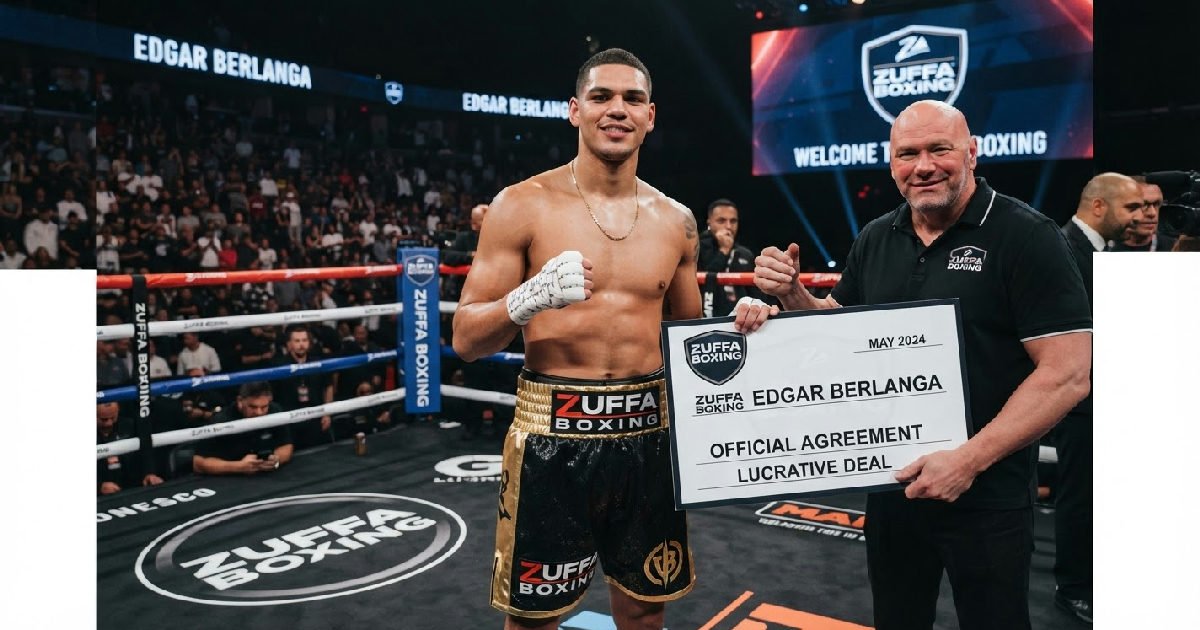
Super middleweight Edgar Berlanga has reportedly secured a more lucrative deal with Zuffa Boxing than he earned from his high-profile bout against Saul “Canelo” Alvarez. This revelation offers a rare glimpse into the significant financial commitments the new promotional outfit, led by Dana White, is making to attract and retain top-tier talent in the boxing world.
The Brooklyn native, who holds a professional record of 24 wins, two losses, and 19 knockouts, confirmed this financial edge when asked directly by Ring Champs whether fighting Alvarez or signing with Zuffa proved richer. His unequivocal answer, “Zuffa,” underscores the potentially game-changing economics Zuffa Boxing is introducing to the sport.
Edgar Berlanga’s Zuffa Boxing deal surpasses Canelo earnings
While the exact financial figures remain private, Berlanga’s claim is particularly striking given the reputation of Canelo Alvarez for generating massive paydays. It’s widely understood that facing Alvarez represents one of boxing’s most significant financial opportunities, a benchmark for fighter earnings.
Berlanga reportedly earned millions from his September 2024 challenge against Alvarez. However, industry rumors now place his multi-fight Zuffa agreement at upwards of $10 million, though neither figure has been officially confirmed by either party.
The value of this new contract gains additional significance when considering Berlanga’s recent career path. Before joining Zuffa, he also headlined a card backed by influential Saudi figure Turki Alalshikh, where he fought Hamzah Sheeraz in Queens.
Zuffa Boxing’s strategic playbook emerges
Zuffa Boxing, under the guidance of its principal, Dana White, seems to be deploying a clear, albeit familiar, strategy: invest heavily in established names and meticulously manage their careers to maximize promotional value. White has openly expressed his ambition for Berlanga to become a major superstar, particularly in New York.
Berlanga’s Zuffa debut on July 26, 2026, at Madison Square Garden against Steven Butler offers an early insight into this approach. Berlanga ultimately secured a seventh-round technical knockout after recovering from a second-round knockdown.
Butler arrived in the ring with a record showing six losses, including defeats to notable opponents like Patrice Volny, Zhanibek Alimkhanuly, Jose de Jesus Macias, and Ryota Murata. His career history indicated a pattern of struggling against higher-level competition.
This particular matchup, while providing Berlanga with a win, suggests a calculated decision by Zuffa. They opted for an opponent perceived as less threatening compared to other super middleweight contenders like Osleys Iglesias, Lester Martinez, Jacob Bank, or Kevin Lele Sadjo, who would have presented a considerably tougher challenge following Berlanga’s loss to Sheeraz.
Building fighter value, not immediate gauntlets
The strategy employed with Berlanga isn’t new to boxing but is being executed with significant financial backing. It involves providing lucrative contracts and then carefully selecting opponents to allow fighters to regain momentum and build their brand before facing the division’s elite.
This patient approach stands in contrast to throwing an expensive acquisition straight into the deepest end of the super middleweight pool, especially after a recent loss. The goal, as articulated by Dana White, is to cultivate a superstar presence for Berlanga in key markets like New York.
This pattern of favorable matchmaking to increase promotional value is one Berlanga is familiar with from earlier stages of his career. Top Rank initially built his name through similar strategic pairings, which led to a string of first-round knockouts and generated considerable early hype around him.
Later, Matchroom Boxing guided him towards his eventual payday against Canelo Alvarez. After losing to Canelo, Berlanga returned against Jonathan Gonzalez-Ortiz, defeating him by first-round technical knockout on March 15, 2025, and announcing his free agency from the ring. He then fought Hamzah Sheeraz on July 11, 2025, suffering a fifth-round knockout loss.
Zuffa Boxing appears to be initiating a similar rebuilding process, albeit on a much larger financial scale. Berlanga now benefits from a substantial contract, a promoter keen on establishing him as a major New York attraction, and, at least in his debut, matchmaking designed to minimize immediate risk and ensure a return to the win column.
Other prominent Zuffa signings have reportedly received comparable treatment. Conor Benn, for example, faced Regis Prograis in a significant bout, while Richardson Hitchins was matched against Ricardo Salas. These pairings reflect Zuffa’s broader philosophy of carefully curating opportunities for its roster.
Berlanga’s career trajectory and new chapter
Edgar Berlanga Jr., a Brooklyn-born boxer with Puerto Rican heritage, has experienced a dynamic professional career since turning pro. Beginning at age seven, his amateur career was decorated, including a gold medal at the 2015 US Youth National Championships as a middleweight.
His professional journey quickly gained traction with Top Rank, where his impressive string of first-round knockouts ignited significant buzz. This early dominance positioned him as a formidable prospect in the super middleweight division, known for his aggressive style and punching power.
Moving to Matchroom, Berlanga sought bigger challenges, culminating in his unified super middleweight championship bout against Canelo Alvarez on September 13, 2024. Despite a spirited effort, Berlanga lost that fight by unanimous decision, marking a pivotal moment in his career.
Following the Alvarez defeat, he returned to defeat Jonathan Gonzalez-Ortiz by first-round technical knockout on March 15, 2025, subsequently announcing his free agency. He then faced Hamzah Sheeraz on July 11, 2025, suffering a fifth-round knockout loss, before his high-value move to Zuffa Boxing.
His Zuffa debut on July 26, 2026, at Madison Square Garden against Steven Butler was a crucial step. Surviving an early knockdown, Berlanga showcased resilience before stopping Butler in the seventh round, demonstrating he could still deliver decisive finishes.
The backing of influential figures like Turki Alalshikh further solidifies Zuffa’s position and its ability to secure major events and lucrative deals. This partnership aligns with Zuffa’s mission to elevate boxing events and fighter profiles.
Industry implications and future outlook
The reported financial terms of Edgar Berlanga’s Zuffa Boxing deal send a powerful message through the boxing world. It signals that Zuffa Boxing, despite being a relatively new player, is prepared to challenge established promotions by offering unprecedented financial incentives to fighters.
This aggressive recruitment strategy, combined with careful matchmaking aimed at rebuilding fighter profiles, could reshape career decisions for many boxers. It might incentivize more fighters to prioritize long-term earning potential and strategic career development over immediate, high-risk bouts.
Dana White’s vision of creating New York superstars through Zuffa Boxing is gaining traction, with Berlanga at its forefront. The focus on establishing a strong regional fanbase before escalating the level of competition is a proven method for cultivating lasting appeal.
The trajectory of Berlanga’s next few opponents will be a key indicator of Zuffa’s overarching strategy and commitment to this model. Will they continue with measured challenges, or will they begin to push him towards the division’s more dangerous contenders to validate his superstar potential?
The recent signing of undefeated four-division world champion Shakur Stevenson on July 9, 2026, as Zuffa Boxing’s highest-profile acquisition since launch, further underscores this aggressive strategy. It shows a commitment to acquiring top talent across different weight classes.
This influx of capital and strategic planning from Zuffa Boxing represents a significant shake-up in the promotional landscape. Fighters like Berlanga, who are willing to navigate this new terrain, stand to gain substantially, both financially and in terms of career longevity. The focus on building a fighter’s marketability before a string of brutal fights is a stark contrast to some traditional boxing models.
As the landscape evolves, fighters are increasingly considering not just immediate fight purses but also the broader promotional package, including strategic career management and global reach. This shift could empower athletes to make choices that align with their long-term financial and competitive goals, beyond just a single pursuit for an undisputed champion title.
Zuffa Boxing’s approach suggests a future where fighter welfare, in terms of both financial security and strategic career progression, takes a more central role. How this impacts the wider sport and the competitive nature of boxing remains to be seen, but for now, Edgar Berlanga is certainly reaping the benefits.