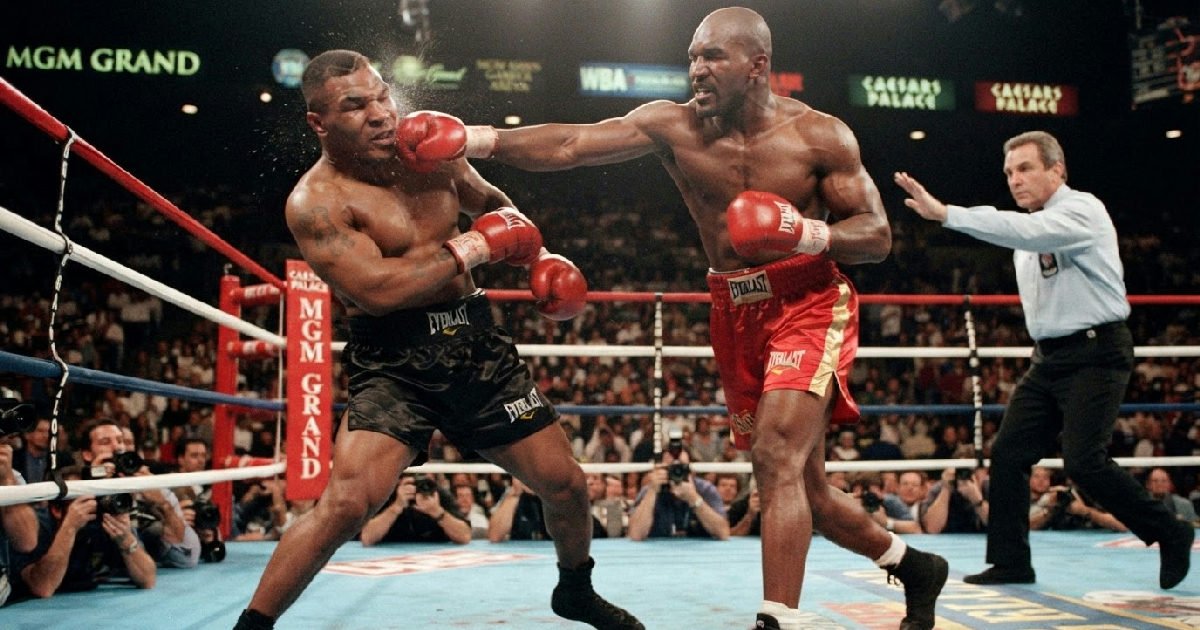
On November 9, 1996, challenger Evander Holyfield fought WBA heavyweight champion Mike Tyson at the MGM Grand Garden Arena in Las Vegas. In one of boxing’s greatest upsets, Evander Holyfield broke Mike Tyson’s bully formula by securing an 11th-round technical knockout victory. Holyfield overcame massive odds to conquer Tyson’s legendary intimidation.
Prior to this historic clash, many critics believed the 34-year-old challenger was a heavily damaged fighter. Holyfield had recently returned from a brief retirement following a heart diagnosis. Yet, his tactical brilliance completely shattered the psychological advantages that had previously made Tyson seem entirely invincible.
How Evander Holyfield broke Mike Tyson’s bully strategy
Many boxing writers expected the defending champion to dominate the match easily. Oddsmakers initially listed Holyfield as a significant 18-1 underdog, with some lines widening to 25-1 before the opening bell. This widespread skepticism ignored Holyfield’s meticulous preparation and unmatched resolve.
Tyson entered the ring riding a wave of spectacular, rapid knockout victories. He had easily steamrolled Peter McNeeley in just 89 seconds and stopped Frank Bruno in three rounds. Later, he dismantled Bruce Seldon in under two minutes to secure the WBA title.
These rapid finishes created a highly deceptive image of Tyson’s actual competitive form. They never forced him to solve an elite heavyweight who refused to crumble. Tyson expected another opponent looking for easy work inside the ring.
Instead, Holyfield implemented a plan that turned Tyson’s greatest strength into a massive liability. He refused to retreat, forcing Tyson into a grueling physical contest from the opening bell. This immediate resistance took away the psychological edge Tyson relied on to win.
Underdog status and Holyfield’s prior health battles
Before rebuilding his career, Holyfield had to overcome immense physical adversity. In April 1994, doctors diagnosed him with a non-compliant left ventricle following a loss to Michael Moorer. This serious heart condition forced a brief, painful retirement from professional boxing.
Many ringside observers believed Holyfield’s best days were far behind him. His subsequent comeback victory over Bobby Czyz was viewed as unconvincing and sluggish. The Nevada State Athletic Commission even ordered extensive medical tests before licensing him to face Tyson.
Holyfield ignored the doubts and designed a grueling training camp. He performed extensive roadwork, hill sprints, and stadium stair runs to build elite conditioning. His sparring sessions were specifically tailored to simulate Tyson’s explosive, short-range attacks.
This physical preparation allowed Holyfield to maintain a relentless pace that Tyson could not match. By focusing on late-round endurance, the challenger prepared himself for a long and brutal war of attrition. He knew Tyson grew frustrated when early knockouts failed to materialize.
Overcoming the cardiac diagnosis and career doubts
The “stiff heart” diagnosis had led many to believe Holyfield was risking his life by returning. However, after consulting top specialists and altering his conditioning, he received a clean bill of health. His triumphant return proved that his determination remained entirely unshaken.
Holyfield’s amateur background, including a light heavyweight bronze medal at the 1984 Summer Olympics, gave him deep technical roots. He was boxing’s first undisputed cruiserweight champion before moving up to the heavyweight ranks. His championship pedigree was far superior to Tyson’s previous comeback opponents.
Tactics behind the WBA heavyweight championship upset
Holyfield’s battle plan relied on directly neutralizing Tyson’s explosive aggression. Instead of retreating in straight lines, the challenger stepped forward to meet Tyson. He used his physical strength to push the champion backward and dominate the clinches.
Tyson landed a powerful right hand in the opening minute of the fight. Holyfield absorbed the blow cleanly without showing any visible signs of distress. He then stepped chest-to-chest, denying Tyson the physical distance needed to swing his hooks.
This persistent resistance completely disrupted Tyson’s standard offensive approach. The champion stopped slipping inside with the bobbing head movement of his prime years. Instead, he loaded up on isolated single power shots that Holyfield easily timed.
Holyfield operated intelligently behind his jab from the outside. When Tyson charged, Holyfield immediately clinched and used his head, shoulders, and forearms to wear Tyson down. This rough, physically demanding style frustrated the champion and neutralized his leverage.
Deconstructing Tyson’s technical limitations
As the rounds progressed, Tyson’s technical limitations became increasingly obvious. He struggled to find punching room on the inside against a stronger foe. Holyfield controlled the distance, operating behind his jab before smothering Tyson’s leverage.
Tyson’s trainers had accustomed him to opponents who hid behind high guards and retreated. Holyfield’s willingness to fight dirty on the inside exposed Tyson’s lack of a backup plan. The champion could not adjust once his primary power was neutralized.
Turning the tide at the MGM Grand Garden Arena
In the sixth round, an accidental clash of heads opened a cut over Tyson’s left eye. While Tyson’s corner complained about rough tactics, the physical breakdown continued. Holyfield then dropped Tyson with a clean left hook later in the round.
This was the first time Tyson had been knocked down since Buster Douglas stopped him in Tokyo. The psychological impact of the knockdown was immediate and profound. Holyfield’s relentless pace began to systematically break Tyson’s resolve.
By the tenth round, Tyson was reeling against the ropes under a barrage of clean shots. He barely survived the round, saved only by the bell. This dominant performance contrasted sharply with the typical soft matchmaking that often protects rising prospects.
The quiet confidence Holyfield projected throughout the fight completely unnerved Tyson’s corner. They had no answers for an opponent who was physically stronger and mentally tougher. The WBA heavyweight champion was forced to fight for every single inch of the canvas.
The dramatic eleventh round stoppage
Holyfield relentlessly pursued his advantage as the eleventh round commenced. He landed a flurry of heavy, unanswered punches on a defenseless champion. Referee Mitch Halpern stepped in, stopping the bout 37 seconds into the round.
This historic victory made Holyfield a three-time heavyweight champion, matching Muhammad Ali’s legendary record. He had proved that Tyson’s aura of fear was entirely psychological. When confronted by a fearless opponent, Tyson’s defensive vulnerabilities were fully exposed.
The fallout and the infamous rematch
The highly anticipated rematch on June 28, 1997, at the MGM Grand Garden Arena ended in absolute chaos. Both fighters weighed exactly 218 pounds, but the dynamic had completely shifted. Holyfield entered as the defending champion, while Tyson was the desperate challenger.
The fight generated massive global interest, attracting nearly two million pay-per-view buyers. Holyfield was set to earn a massive $35,000,000 purse, while Tyson’s purse was set at $30,000,000. The pre-fight tension was incredibly high.
Frustrated by headbutts, Tyson bit Holyfield’s ears twice during the third round, severing a piece of cartilage. Referee Mills Lane disqualified Tyson, leading to the temporary revocation of his boxing license. Tyson later admitted he bit Holyfield because he “just wanted to kill him.”
While the rematch is remembered for its bizarre nature, the first fight remains the more significant sporting contest. Holyfield secured a historic TKO by systematically dismantling Tyson’s aggressive formula. He proved that strategic resolve can shatter even the most intimidating force in sports history.