
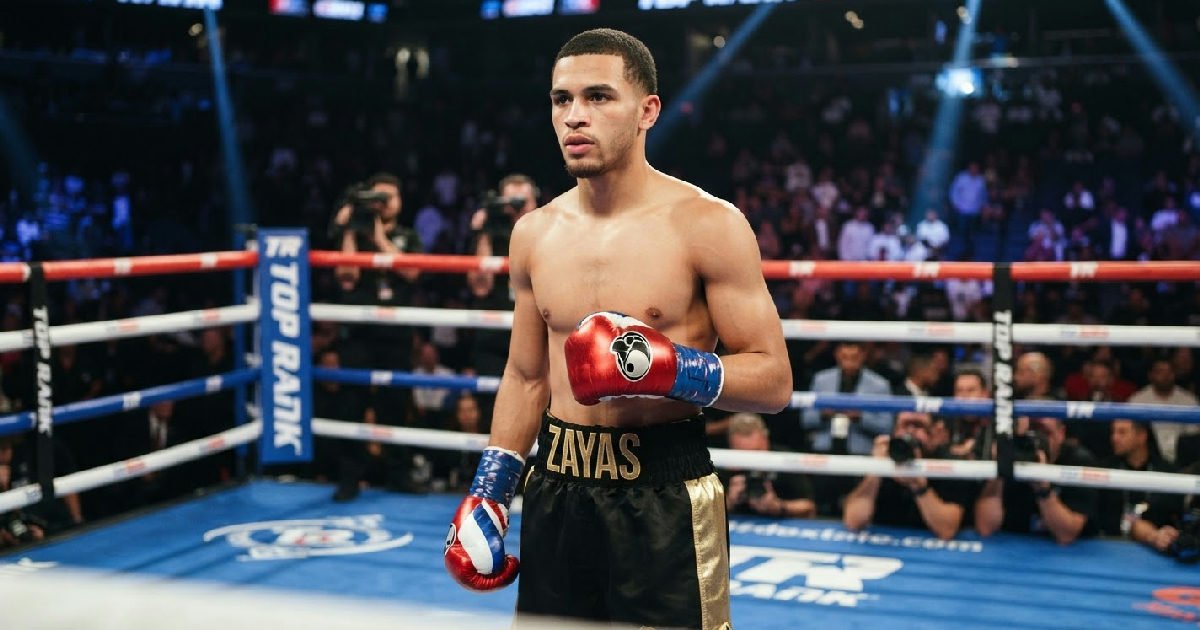
Xander Zayas’ middleweight move to the 160 lbs division follows his seventh-round stoppage loss to Jaron “Boots” Ennis on June 27, 2026.
This transition follows the loss of his unified WBA and WBO junior middleweight (154 lbs) titles. Zayas is reportedly targeting a return to the ring in February 2027 against a top-15 opponent, with aspirations for a world title later that year.
Xander Zayas middleweight move targets debut
The decision to move up in weight comes after Zayas defended his WBO and WBA World Junior Middleweight titles against Ennis, a fight that saw him dropped three times. This shift is primarily aimed at alleviating the strain of making the 154-pound weight limit, a common issue for growing fighters.
However, the middleweight division presents its own set of formidable challenges. It’s filled with naturally bigger and stronger men who won’t be intimidated by Zayas’s punching power, which wasn’t always his defining characteristic in the lower weight class.
His professional career began in October 2019 under the Top Rank banner, quickly establishing him as a promising talent. Zayas had an undefeated record of 23 wins with 13 knockouts before the Ennis fight, showcasing a style more reliant on combinations and movement than one-punch finishes.
The Ennis loss and its lasting impact
The unification bout against Jaron Ennis proved to be a brutal reality check for Zayas. Ennis, a southpaw, systematically broke him down, dropping the young fighter in the first, fifth, and seventh rounds.
Despite managing to hurt Ennis with a right hand in the third round, Zayas’s corner ultimately threw in the towel at 1:49 of Round 7. This defeat exposed vulnerabilities, particularly Zayas’s ability to handle sustained pressure from a physically dominant opponent.
Moving up just six pounds won’t erase the memory of that stoppage or magically imbue Zayas with the knockout power needed to deter natural middleweights. It’s a harsh lesson that could shape his entire approach to this new division.
Power and style concerns in a new weight class
At junior middleweight, Xander Zayas wasn’t known for devastating one-punch power. He secured 13 knockouts in his first 23 victories, frequently relying on his technical skills, rapid combinations, and footwork to outmaneuver opponents.
His punches might carry even less authority against fighters accustomed to absorbing shots from 160-pound power punchers. This raises questions about his ability to truly hurt, or even deter, the top contenders in the middleweight ranks.
The physical differences between junior middleweight and middleweight are significant, often involving more than just a few pounds. Many middleweights are accustomed to fighting at or near 160 pounds for their entire careers, developing robust frames and iron chins.
Adapting to middleweight physicality
The middleweight division is a different beast altogether. Fighters like Yoenlis Hernández, who is ranked #2 by The Ring magazine, are known for their size, activity, and sheer strength, posing a significant threat to any newcomer.
Zayas will need more than just comfort at 160 pounds; he’ll require enhanced durability and a refined strategy to withstand and counter the relentless pressure that top middleweights can apply. His team will have to consider these factors when selecting future opponents.
Current middleweight champions present tough challenges
The current landscape of the middleweight division is highly competitive, offering no easy path to a world title. Reigning champions each bring distinct attributes that could spell trouble for Xander Zayas.
Carlos Adames, the World Boxing Council (WBC) champion, is known for his relentless pressure and considerable power, precisely the qualities that troubled Zayas against Ennis. The World Boxing Organization (WBO) titleholder, Denzel Bentley, who became the full champion in July 2026, also possesses sufficient size and power to capitalize on mistakes.
Meanwhile, the International Boxing Federation (IBF) belt belongs to Aaron McKenna, a physically strong fighter with a high work rate. And then there’s the veteran Erislandy Lara, the World Boxing Association (WBA) champion, whose seasoned counterpunching skills remain potent despite his age.
Any of these champions would represent a monumental task for Zayas, especially early in his transition. His team will need to pick their path wisely.
Navigating Top Rank’s strategic matchmaking path
Top Rank, Xander Zayas’s promoter, faces a delicate balancing act. They need to find a suitable opponent for his February 2027 return—likely a top-15 contender who allows him to acclimate to the middleweight division without immediately facing a crushing challenge.
The real difficulty lies in steering him toward a world title opportunity by the end of 2027 without forcing him into a fight with one of the division’s most dangerous operators too soon. This strategic matchmaking is crucial for rebuilding confidence and momentum.
Chris Mannix, a respected boxing reporter, noted the ambitious schedule, particularly for a 23-year-old coming off a seventh-round stoppage. He suggests that while Zayas could win a world title at 160 pounds, the path is fraught with peril.
The comfort of not having to cut significant weight may benefit Zayas, but it won’t magically make him stronger, more durable, or less susceptible to pressure. His success in the middleweight campaign will hinge as much on careful opponent selection as on his own improvements.
One potential challenge within the middleweight landscape could come from fighters looking to make a name for themselves. Yoenli Hernandez emerges as a potential foe for other rising stars, highlighting the competitive nature of the division.
What Zayas needs to thrive at 160 pounds
For Xander Zayas to truly succeed in the middleweight division, more than just physical adjustment will be required. He’ll need to refine his defensive tactics and potentially develop more power to command respect from naturally bigger opponents.
This means dedicated strength and conditioning work, tailored specifically for the demands of 160 pounds, and a deeper focus on ring generalship. His movement and combinations, which were effective at junior middleweight, will need to be applied with even greater precision against faster and stronger adversaries.
The mental aspect of this transition can’t be underestimated either. Coming off a significant loss, Zayas will have to rebuild his confidence and prove to himself, and the boxing world, that he belongs at this higher weight class.
Every fight in the middleweight division will be a test, a career-defining moment for the young boxer. For example, similar career-defining tests can be seen in IBF eliminators across various weight classes, demonstrating the high stakes involved in ascending the boxing ranks.
Developing a middleweight-specific strategy
Developing a middleweight-specific strategy will involve adapting his existing strengths to the new physical realities of the division. His technical prowess and ability to string together punches remain valuable assets, but they might need to be deployed differently.
Against larger opponents, Zayas may need to incorporate more feints and subtle movements to create openings, rather than relying solely on speed. The ability to manage distance effectively will also become paramount, allowing him to avoid heavy shots while still landing his own.
The journey from a unified junior middleweight champion to a middleweight contender is rarely straightforward. It requires patience, meticulous planning, and significant evolution as a fighter to truly compete at the elite level.
The road ahead for the Puerto Rican talent
Xander Zayas represents a significant talent for Puerto Rican boxing, and his decision to move up to middleweight marks a crucial juncture in his young career. The challenges are clear, but so too is the potential for growth if handled correctly.
The plan for a February 2027 return against a ranked opponent provides a logical first step, offering a chance to test the waters without diving headfirst into a title fight. This initial bout will be instrumental in gauging his comfort and effectiveness at 160 pounds.
Ultimately, Zayas’s success will depend on his ability to adapt physically and mentally to the demands of the middleweight division. His team’s strategic choices in matchmaking will play an equally vital role in shaping his path towards a potential world title bid in late 2027.
Many young talents have made successful transitions between weight classes, often after early career setbacks. The boxing world watches closely as Zayas prepares for this demanding new chapter, hoping he can rekindle his championship form at 160 pounds.
The excitement surrounding young boxing prospects is always high, with events like Las Vegas boxing prelims often showcasing emerging talent. Zayas’s journey is another example of a promising fighter confronting the tough realities of professional boxing.