
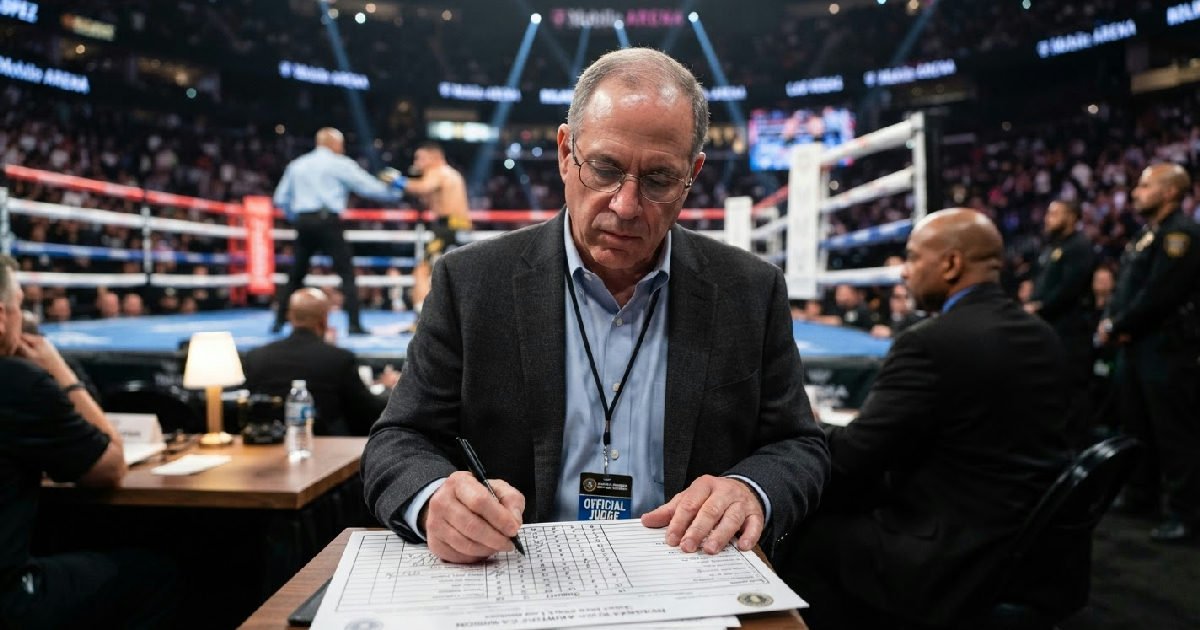
Veteran boxing trainer and respected commentator Teddy Atlas has publicly criticized the scoring of the WBA welterweight title fight between Teofimo Lopez and Rolando “Rolly” Romero, specifically calling out judge Glenn Feldman. Lopez claimed a majority decision victory over Romero on August 22, 2026, at the T-Mobile Arena in Las Vegas, securing his status as a three-division world champion.
But Atlas, known for his no-nonsense analysis, took specific aim at judge Glenn Feldman’s 114-114 scorecard, calling for his license to be revoked.
Glenn Feldman’s controversial scorecard
The fight itself saw Lopez overcome a rugged performance from Romero, who was making his return after 15 months of inactivity. While the official scores were 114-114, 115-113, and 116-112 in favor of Lopez, it was Feldman’s drawn card that ignited Atlas’s ire, sparking fresh debate about the consistency and fairness of professional boxing judging.
Teddy Atlas didn’t mince words when dissecting the scoring of the Lopez-Romero encounter. On his YouTube channel, “The Fight with Teddy Atlas,” he singled out judge Glenn Feldman, whose 114-114 score made the bout a majority decision instead of a more comfortable unanimous victory for Lopez. Atlas suggested Feldman should face severe consequences for his assessment of the contest.
He didn’t stop there. Atlas vividly described how he would confront Feldman if he were in a position of authority, stating he would demand an explanation for the drawn scorecard. The former Mike Tyson coach implied that such a ruling warranted the permanent suspension of a judge’s license, drawing a stark analogy to having a driver’s license revoked for reckless driving.
Feldman’s perplexing 114-114 score
The 114-114 card from Glenn Feldman stood out amidst the other two scores, which correctly favored Teofimo Lopez. This particular score meant that Feldman saw the fight as essentially even, a sentiment shared by few outside of Romero’s immediate camp. Many ringside observers and analysts felt Lopez had clearly done enough to win.
Atlas’s strong reaction to the 114-114 scorecard highlights the frustration many in boxing feel when judging appears inconsistent. The wide disparity in interpretation among officials continues to be a contentious issue, leading to frequent calls for greater transparency.
Praise for judge Tim Cheatham
Conversely, Atlas offered high praise for judge Tim Cheatham, who scored the fight 116-112 in favor of Teofimo Lopez. Atlas, who admitted to criticizing Cheatham in the past, lauded his accuracy in this particular contest. He called Cheatham his “new idol” for getting it right.
Cheatham’s score aligned more closely with the consensus view of many boxing pundits and fans, suggesting he accurately captured the ebb and flow of the fight. This contrast underscored the subjective nature of scoring, even among seasoned professionals.
Dissecting the Lopez-Romero bout
The actual fight unfolded with intense moments, though Teofimo Lopez largely controlled the pace and landed more effectively. Lopez, entering as the challenger, sought to seize the WBA welterweight title from Rolando Romero. The fight represented a significant step for Lopez, aiming to cement his legacy in a third weight class.
Romero, hampered by his lengthy layoff since winning the vacant belt against Ryan Garcia last May, struggled to consistently land significant punches. His 15 months of inactivity clearly showed, impacting his rhythm and output. Yet, he still managed to make it a competitive affair at times.
Romero’s surprising fifth-round rally
Despite his overall struggles, Rolando Romero had a pivotal moment in the fifth round. He managed to open a substantial cut over Lopez’s right eye with a series of punches. A well-placed left hook followed by a looping right hand appeared to hurt Lopez, putting “The Takeover” in momentary trouble.
Lopez, however, demonstrated remarkable composure and impressive boxing IQ to navigate through the crisis. He recovered effectively, preventing Romero from capitalizing further on the momentum. This ability to weather the storm was a testament to Lopez’s experience at the highest level of the sport.
CompuBox statistics confirm Lopez’s control
Statistical analysis from CompuBox reinforced the view that Teofimo Lopez was the more dominant fighter. Lopez landed 124 of 530 total punches thrown throughout the contest, showcasing his consistent activity. In contrast, Romero managed to land just 73 of 352 punches.
This significant 124 to 73 punch-landing advantage for Lopez highlighted his effective offense and ring generalship. Notably, Lopez also landed a career-high 62 jabs, using his lead hand to control distance and set up combinations. Romero, on the other hand, failed to land double-digit punches in all but the fifth round, underlining his difficulty in mounting sustained attacks.
Fighter perspectives after the bell
Unsurprisingly, the fighters themselves had differing views on the outcome. Rolando Romero expressed strong disagreement with the decision, feeling he had done enough to retain his title. He controversially claimed, “I got hit with two punches the whole fight that barely grazed me. I was never in any trouble.”
Romero went on to state, “When I heard 114-114 I knew it was a robbery,” implying political machinations behind the judging. This reaction, while strong, isn’t uncommon for a fighter on the losing end of a close contest, particularly when one scorecard suggests a draw.
Lopez reflects on the hard-fought win
Teofimo Lopez, however, focused on his resilience and determination. “If you lost and you come back, then you never lost, because you’re a winner. I’m a true example of what winning is. It’s about not giving up,” he declared, reflecting on his journey back to championship status. He acknowledged Romero’s toughness and admitted to being “buzzed” in the fifth round.
Lopez’s perspective highlighted his maturity and growth as a fighter. He recognized the competitive nature of the fight but remained confident in his performance, emphasizing his ability to recover and adapt mid-fight. “We have the ring experience. That’s what’s helped me throughout my journey,” he added.
The enduring controversy of boxing scorecards
The debate surrounding the Teofimo Lopez versus Rolando Romero scorecards is far from an isolated incident; it’s a recurring theme that consistently plagues professional boxing. Discrepancies in judging decisions often overshadow the athletic performances, casting a shadow over the sport’s integrity. Fans and pundits alike frequently call for greater transparency and accountability from judging panels.
This particular episode reignites conversations about how judges are selected, trained, and evaluated. When a judge’s score deviates significantly from the consensus, especially in a world title bout, it naturally erodes public trust. Incidents like this often fuel conspiracy theories, making it harder for boxing to attract and retain new fans who crave fair and understandable outcomes.
Call for stricter judicial oversight
Many within the boxing community believe that calls for license suspensions, like those made by Teddy Atlas, are necessary to enforce stricter standards. The subjective nature of scoring makes it difficult to achieve perfect unanimity, but egregious differences suggest either incompetence or bias. Stricter oversight could include more rigorous training, regular performance reviews, and public explanations for controversial decisions.
Ultimately, the integrity of boxing rests heavily on the credibility of its officiating. When Teofimo Lopez targets future bouts, the stakes are incredibly high, both financially and in terms of career legacy. Judges, therefore, bear a tremendous responsibility to get it right, and when they don’t, the consequences should be commensurate with the impact on the sport and its athletes.
What’s next for Teofimo Lopez?
With the WBA welterweight title now firmly in his grasp, Teofimo Lopez is already looking ahead to his next challenge. He’s publicly expressed interest in a significant unification clash, specifically eyeing WBC titleholder Ryan Garcia. This potential fight would undoubtedly be a blockbuster, pitting two of boxing’s most exciting young stars against each other.
However, the path to a unification bout is rarely straightforward in boxing. Lopez first needs to navigate potential mandatory defenses. The name of Jack Catterall has been mentioned as a likely mandatory challenger, a fight that would present its own set of challenges for “The Takeover.” Managing these obligations while pursuing marquee matchups is a classic dilemma for champions.
Potential unification bouts and mandatory challenges
A fight against Ryan Garcia would be a massive draw, offering Lopez another opportunity to prove himself against elite competition and further unify the welterweight division. But before that, there’s the looming threat of Jack Catterall, a fighter who has earned his shot and won’t be easily brushed aside. Skipping a mandatory defense often leads to titles being stripped, complicating a champion’s reign.
The boxing world will be watching closely to see how Lopez and his team strategize for his next move. Balancing career ambitions with promotional demands and mandatory challengers is a tightrope walk for any top fighter. These upcoming welterweight clashes and others highlight a busy period for the sport.
Long-term implications for judging standards
The controversy surrounding the Lopez-Romero scores, amplified by Teddy Atlas’s outspoken critique, will likely have ripple effects beyond this single fight. It adds to the growing pressure on athletic commissions and sanctioning bodies to review and potentially reform their judging protocols. The call for greater accountability isn’t just about one judge; it’s about ensuring the fairness of every fight.
Such public disagreements from highly respected figures like Atlas serve as vital checks on the system. They force uncomfortable but necessary conversations about objectivity, training, and the potential for human error or bias to unduly influence outcomes.
As boxing continues to evolve, maintaining trust in its judging is paramount for its continued growth and credibility on the global stage, especially as new young boxing talents emerge.
Without consistent and credible scoring, the hard work and sacrifices of fighters risk being undermined. The spotlight on Glenn Feldman and the praise for Tim Cheatham ultimately underscore the need for judging standards that are universally understood and applied, reducing the frequency of results that leave fans and experts scratching their heads.