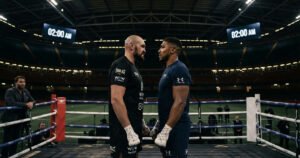
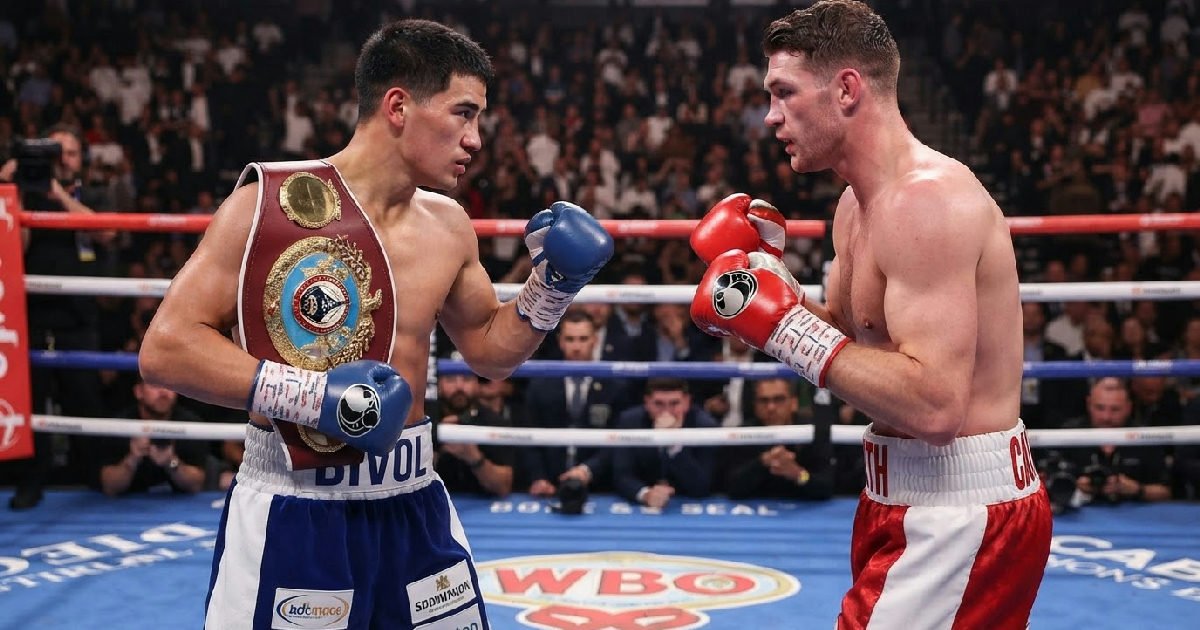
Dmitry Bivol will defend his WBO Light Heavyweight title against Callum John Smith on December 12 in Yekaterinburg, jeopardizing his trilogy fight with Artur Beterbiev. Bivol rejected a December trilogy against Beterbiev to satisfy the WBO, prioritizing a single belt over what many consider the defining rivalry of his era.
The choice to protect one sanctioning body strap introduces reckless hazards that could erase the rubber match entirely, critics argue. This move was solidified on August 27, 2026, when the World Boxing Organization (WBO) announced that Bivol and Smith had agreed to fight terms, forcing the immediate future of the Bivol-Beterbiev rivalry into question.
Dmitry Bivol risks legacy in mandatory WBO defense
The upcoming December 12 bout against Callum Smith is far from a routine obligation, especially for the 35-year-old Dmitry Bivol. He faces the British professional boxer, who holds a professional record of 31 wins and 2 losses, with 22 knockouts.
Smith earned the WBO interim light-heavyweight title in February 2025 by defeating Joshua Buatsi, proving his credentials at this weight class. Bivol, who holds the WBA, IBF, and Ring magazine titles alongside the WBO strap, brings a professional record of 25 wins and 1 loss, with 12 knockouts.
Bivol’s style relies heavily on his lead arm and stiff jab to control distance and set up combinations. This technique is now under intense scrutiny following his July 4, 2026, left elbow surgery to remove loose particles.
The Smith challenge post-surgery and inactivity
Callum Smith is renowned for his punishing counter left hook, a weapon specifically designed to exploit mechanical vulnerabilities. If Bivol carries any hesitation in that surgically repaired joint, Smith is well-equipped to capitalize on the opening.
The 6-foot-3 frame, reach, and punching power that Smith possesses present a genuine threat to Bivol’s control. The timing of this defense, so soon after two major surgeries, introduces an undeniable element of risk for the Kyrgyzstani-Russian champion.
This fight marks Bivol’s return after a significant period of inactivity, which included a 15-month absence from the ring following back surgery in August 2025. Facing a top contender like Smith while potentially still recovering could take a mental toll of such high-stakes bouts.
Timeline uncertainties for the Beterbiev trilogy
Dmitry Bivol’s decision has significantly impacted the timeline for the highly anticipated third fight against Artur Asilbekovich Beterbiev. RCC Boxing chief German Titov indicated that Bivol-Beterbiev III is now being targeted for April 2027.
This proposed date would reportedly see the bout hosted at the new 8,000-seat RMK Arena in Chelyabinsk, Russia. Staging the bout there serves regional promoters but shrinks what belongs on a major global stage down to what the source termed a “municipal showroom.”
The extended delay works aggressively against Artur Beterbiev, who turned 41 in January. By the projected April 2027 date, Beterbiev will be 42 years old, potentially diminishing his formidable punching power and ring sharpness.
Waiting game and fading rivalry
The timeline forces Beterbiev into more than two full years of inactivity following their February 2025 rematch, according to the promoter’s projection. Should Bivol secure a victory under those circumstances, it could trigger claims that he simply ran out the clock on an aging destroyer, diminishing the achievement.
A truly definitive trilogy fight requires both combatants to be at or near their peak, meaning the extensive wait threatens the competitive integrity of their rivalry. Bivol’s move introduces the risk that the most defining fight of his career will become a footnote about Beterbiev’s decline.
This prolonged wait is reminiscent of other major, delayed trilogy fights in boxing history, where time eroded the competitive edge. The strategic choice to prolong the wait raises questions about how much more wear and tear Beterbiev can sustain as he edges past the typical prime of a light heavyweight.
Sanctioning body politics and Russian venues
Bivol is taking these considerable risks largely to appease the World Boxing Organization, a sanctioning body that previously demonstrated a cautious approach to Russian venues. The WBO, alongside the other three major boxing bodies—the WBA, WBC, and IBF—issued a joint statement in February 2022 agreeing not to sanction championship bouts in Russia due to the war in Ukraine.
This policy directly affected Bivol earlier when the WBO declined to sanction his May 30, 2026, fight against Michael Eifert in Ekaterinburg, Russia. Interestingly, Bivol was still allowed to retain his WBO title without defending it under the sanctioning body’s approval at that time.
The fact that Bivol is now fighting to satisfy a WBO mandate in Yekaterinburg highlights the fluid nature of sanctioning body politics. This appeasement comes with significant personal risk for Bivol, as he jeopardizes his career-defining bout to satisfy an “alphabet body” that could still pull its sanctioning status at the eleventh hour.
Choosing the complicated route
Vacating the title entirely might have been a cleaner path, potentially keeping the rubber match on schedule for late 2026 without these unnecessary detours. Instead, Bivol chose the complicated route.
The decision suggests a deep-seated desire for undisputed status, or perhaps a strategic play to enhance his bargaining position for the future Beterbiev clash. However, the immediate consequence is increased personal and professional risk, placing his defining moment on the line for “plastic and leather.”
Implications for Bivol’s legacy and future
Dmitry Bivol’s decision to pursue the WBO belt through a high-risk fight with Callum Smith is a profound gamble for his legacy. The Kyrgyzstani-Russian boxer, who is 35, has commanded significant purses in the past, with his highest career earnings reaching $15 million.
Risking a definitive trilogy bout, which would undoubtedly be a massive financial draw, for a mandatory defense suggests a complex motivation beyond immediate profit. Some analysts suggest Bivol is seeking to consolidate all possible titles before facing Beterbiev, aiming for an undisputed clash later on.
But the advanced age and potential decline of Beterbiev make this a particularly time-sensitive calculation. This type of strategic scheduling often involves delicate negotiations, similar to those seen when setting up a welterweight clash with high stakes. It also raises questions about Bivol’s long-term health and ability to maintain peak performance through multiple high-stakes encounters and recoveries.
The uncertain future of a boxing classic
The boxing world now waits to see if Dmitry Bivol can successfully navigate this perilous path. Successfully overcoming Callum Smith post-surgery would validate his decision, but a loss would shatter the hopes for a truly climactic Artur Beterbiev trilogy.
The stakes couldn’t be higher for Bivol, as he balances physical recovery, the demands of a sanctioning body, and a dangerous challenger, all while the clock ticks on a rival whose best years may be rapidly fading. Ultimately, Bivol’s legacy will be judged not just by the belts he accumulates, but by the challenges he embraces and the iconic rivalries he completes.
For now, the definitive rubber match with Beterbiev remains an aspiration, shrouded in uncertainty and dependent on Bivol surviving his latest gamble against Smith on December 12.