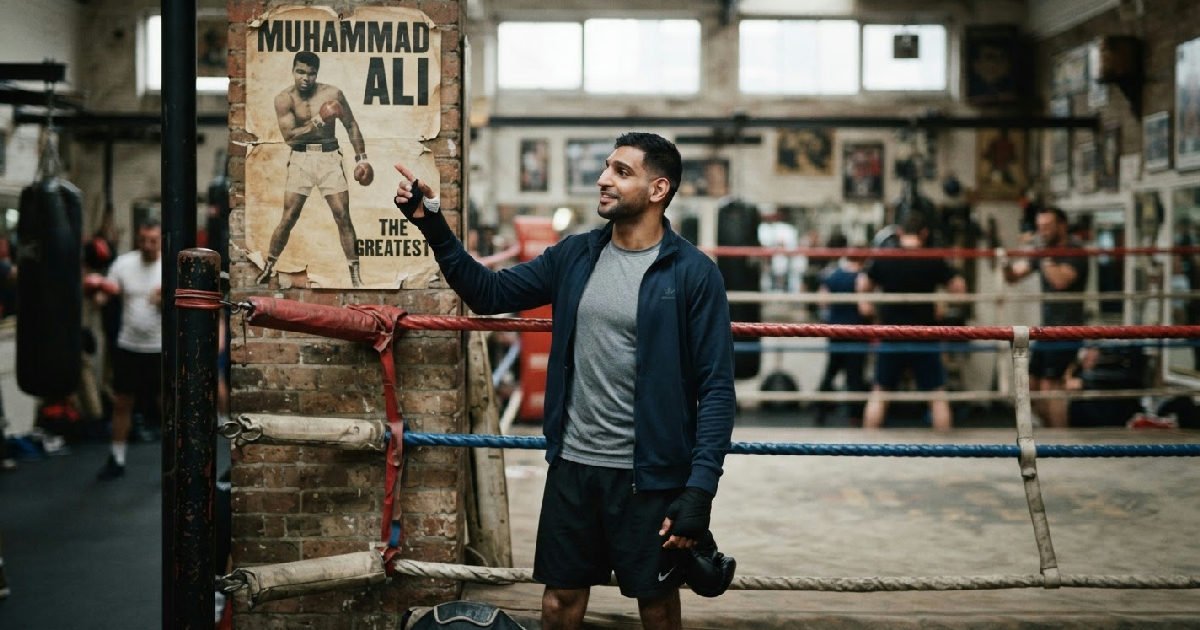
Former unified light-welterweight world champion Amir Khan has once again publicly declared Muhammad Ali the greatest fighter in boxing history. Speaking to TNT Sports Boxing, Khan’s emphatic endorsement highlighted Ali’s unparalleled impact, citing his incredible prowess inside the ring and his profound influence on the world beyond it.
This recent statement from the Bolton-born boxer, renowned for his own exciting career, reinforces a widely held belief among fans and pundits. Khan’s personal appreciation for Ali stems from his dual legacy, speaking to the enduring reverence for a figure who transcended sport.
Khan’s unwavering choice: Muhammad Ali
It’s not the first time Khan has voiced such admiration; he paid a heartfelt tribute to Ali in a video on his Facebook page on June 4, 2016, following the legend’s death. Then 29 years old, Khan hailed Ali as his “hero” and the “greatest of all time,” recalling how his father first introduced him to Ali’s fights at a young age.
Amir Khan didn’t mince words when asked to name the greatest ever fighter. He unequivocally chose Muhammad Ali, emphasizing a blend of athletic brilliance and social consciousness. “Muhammad Ali is the greatest fighter in the world in my opinion,” Khan stated.
He continued, “because of what he did in the ring and outside the boxing ring. He was not only a great champion but the people’s champion more than anything.” This sentiment echoes a widespread appreciation for Ali’s multifaceted career.
Khan’s admiration isn’t new; he paid tribute to Ali in a video on his Facebook page back on June 4, 2016, following the legend’s death. Then 29 years old, Khan called Ali his “hero” and the “greatest of all time.” He noted that his father first introduced him to Ali’s fights at a young age.
Beyond the ropes: Ali’s social and athletic legacy
Ali’s status as “the greatest” stems from more than just his remarkable boxing record. He became a global icon for his Civil Rights activism. His refusal to be drafted into the Vietnam War cemented his place as a figure of immense moral courage.
Inside the ring, Ali was an athlete ahead of his time. He was a heavyweight who moved with the agility of a much smaller fighter, embodying the famous phrase: “float like a butterfly, sting like a bee.” His speed, power, and explosive style devastated opponents throughout his career.
Ali’s dominance reached its peak when he reigned as the undisputed heavyweight champion from 1974 to 1978. This period showcased his incredible skill and mental fortitude. It solidified his reputation as one of the most athletic and formidable heavyweights the sport has ever seen.
Khan himself observed Ali’s unique fighting style. He noted that Ali “was a heavyweight, where he was really, really big, he was heavy. But he moved like a lightweight.” Khan added that “his shots were fast, powerful and explosive. And he used to hurt his guys, you know, he hurt his opponents.”
Amir Khan’s own decorated career
Amir Khan carved out an impressive career of his own, characterized by speed, skill, and undeniable bravery. The Bolton native burst onto the international scene winning a silver medal at the 2004 Olympics in Athens. He was just 17 years old at the time, becoming Britain’s youngest boxing Olympic medalist.
His professional journey saw him quickly rise through the ranks. He became one of the youngest Britons ever to win a world title when he captured the WBA super-lightweight belt at the age of 22. Khan held this title from 2009 to 2012, also adding the IBF title in 2011.
Throughout his career, Khan was celebrated for his thrilling, aggressive fighting style. He consistently sought out challenging opponents. He engaged in legendary battles against formidable foes like Marco Maidana. He also secured victories over top names such as Devon Alexander and Luis Collazo.
His willingness to test himself against the best, including moving up in weight to face huge punchers like Saul ‘Canelo’ Alvarez and multi-weight undisputed champion Terence Crawford, defined his in-ring persona. This courage earned him significant respect from fans and fellow fighters alike.
The enduring debate: Defining boxing’s GOAT
Khan’s choice of Muhammad Ali reignites the perennial debate among boxing aficionados: who truly is the greatest of all time? While Ali is a popular and often definitive answer, many other legends are frequently mentioned in such discussions. This includes Sugar Ray Robinson, Joe Louis, and Floyd Mayweather Jr., among others.
Defining the “greatest” often involves a subjective weighing of factors. These range from win-loss records, championship reigns, and the quality of opposition faced to cultural impact and longevity. Ali’s unique combination of sporting dominance and profound social influence makes him a compelling candidate.
For many, the “greatest” isn’t just about technical skill or knockout power. It also encompasses a fighter’s character, their ability to inspire, and their legacy outside the squared circle. This holistic view is precisely why Amir Khan and countless others elevate Ali above his peers.
The conversation highlights how different eras produce different types of champions. Modern boxing has seen incredible athletes, but few have matched Ali’s broader societal footprint. The ongoing debate enriches the sport, encouraging appreciation for its rich history and diverse heroes.
What Khan’s endorsement signifies
The endorsement from a fighter of Amir Khan’s stature carries significant weight within the boxing community. It’s not merely a fan’s opinion but the perspective of someone who has competed at the highest level. Khan understands the physical and mental demands of the sport intimately.
Khan has frequently expressed a desire to emulate Ali’s charitable work and community engagement. He noted, “I look up to him and I wanna do what he did. That’s why I come places like Pakistan and I spend time here.” Khan explained that he “kind of picked that out of his book.”
This commitment to humanitarian efforts, inspired by Ali, underlines the lasting influence of the former heavyweight king. Ali wasn’t just a boxer; he was a humanitarian who used his platform to champion causes he believed in. Khan aims to follow that blueprint.
The acknowledgment from one generation of fighters to another helps to pass down the sport’s history and values. It ensures that the achievements and impact of figures like Muhammad Ali remain relevant. This keeps them inspiring new athletes and fans decades after their prime.
Indeed, Ali’s influence isn’t limited to just other boxers. His story resonates far beyond sports, affecting people from all walks of life. His principled stands and captivating personality left an indelible mark on global culture, setting a standard for public figures.
When legendary figures like Khan speak, it adds another layer to the narrative. It reinforces why Ali’s name is consistently at the top of any list. It’s clear his legacy will continue to define greatness for years to come.