
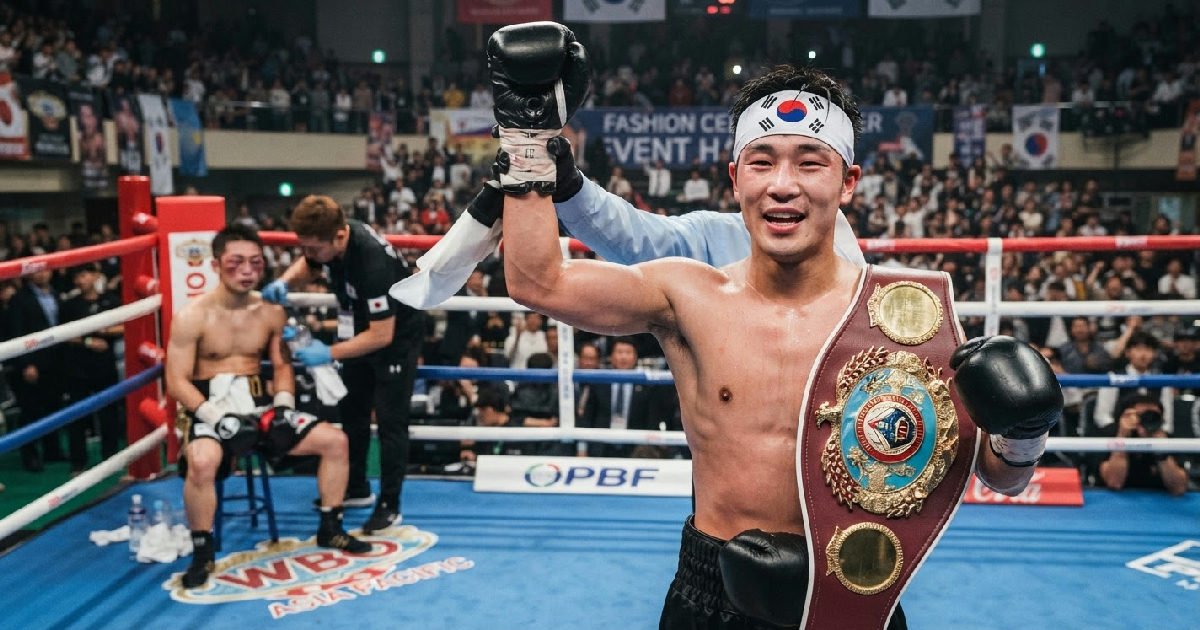
Korean boxer Deok-No Yun dramatically reclaimed the Oriental and Pacific Boxing Federation (OPBF) and World Boxing Organization (WBO) Asia Pacific super middleweight belts, stopping Japanese rival Yuito Moriwaki via seventh-round technical knockout. The highly anticipated trilogy bout unfolded on August 10, 2024, at the Fashion Center Event Hall in Seoul, South Korea, marking a significant victory for the veteran challenger.
Moriwaki, a former Japanese Olympian, was forced to retire on his stool between rounds seven and eight due to a severely swollen left eye. This decisive win saw Yun overturn his previous split decision loss to Moriwaki, re-establishing his dominance in the regional 168-pound division.
Yun’s WBO Title Victory
The fight began with Yuito Moriwaki, standing 6’2″ with a 75-inch reach, using his height and amateur pedigree to control the initial two rounds. His fast jabs and sharp left-right combinations kept Deok-No Yun at bay, suggesting an early advantage for the Japanese champion.
However, the tide began to turn from the third round onward as Yun, a sturdy orthodox fighter with an 80% knockout rate. He effectively employed solid uppercuts in close quarters, nullifying Moriwaki’s reach advantage and applying sustained pressure. Moriwaki started bleeding from his left eye in the third round, a precursor to the injury that would eventually end the contest.
Moriwaki’s Point Deduction and Deteriorating Condition
As the fight progressed into the middle rounds, Moriwaki’s strategy increasingly relied on clinching. His repeated holding prompted the referee to deduct a point in the fifth round, further shifting momentum towards Yun. The Korean challenger continued to land his favored uppercuts, particularly in the seventh round, which visibly hurt the champion.
These close-range exchanges and head-collisions exacerbated Moriwaki’s left eye injury, causing it to swell dramatically. The severity of the swelling ultimately led to his corner’s decision to halt the fight. At the time of stoppage, all three judges’ scorecards favored Yun, each scoring the bout 68-64.
A Trilogy Forged in Regional Rivalry
This latest encounter marked the third professional meeting between Deok-No Yun and Yuito Moriwaki, a rivalry that has captivated regional boxing fans. Their history dates back to December 2025 when their inaugural bout in Tokyo, Japan, ended in a four-round technical draw.
That fight was prematurely stopped after an accidental headbutt caused a worsening cut above Yun’s left eye, despite Moriwaki having scored a knockdown in the first round.
The second chapter unfolded on May 2, 2026, at the Tokyo Dome, a prominent fixture on the Inoue vs. Nakatani card. In that hard-fought contest, Moriwaki secured a split decision victory over 10 rounds, with scores of 96-94, 96-94, and 93-97.
This win saw him claim both the OPBF and WBO Asia Pacific super middleweight titles from Yun, setting the stage for their rubber match in Seoul.
Yun and Moriwaki’s Contrasting Paths to Professional Boxing
Deok-No Yun, 31, held a professional record of 11-3-1 with 9 KOs before this fight, reflecting his power-punching style. Before this recent triumph, he was a seasoned champion, having held the Korean Super Middleweight, WBO Asia Pacific Super Middleweight (twice), and OPBF Oriental and Pacific Super Middleweight titles.
His career trajectory has seen him battle through regional ranks, consistently seeking to unify and defend his belts.
Conversely, 30-year-old Yuito Moriwaki, who entered the bout with a professional record of 2-1-1, represents a different boxing narrative. An accomplished amateur with a 92-26 record and five-time Japanese championship winner, he even represented Japan at the 2020 Tokyo Olympics. Moriwaki turned professional after narrowly missing out on the Paris Olympics, bringing significant amateur pedigree to the paid ranks.
The Significance of Regional Super Middleweight Titles
The Oriental and Pacific Boxing Federation (OPBF) and World Boxing Organization (WBO) Asia Pacific titles are pivotal in the careers of fighters across Asia and Oceania. These regional belts serve as crucial stepping stones, providing a pathway for boxers to gain international recognition and climb the ranks toward potential world title challenges.
Winning these titles often signifies a boxer’s readiness for bigger stages and stronger competition.
The super middleweight division, with its weight limit of 168 pounds (76.2 kg), has a rich history in boxing, gaining official recognition from major sanctioning bodies in the 1980s. It consistently features powerful and skilled athletes, making regional title fights like the Yun-Moriwaki trilogy highly competitive and entertaining. The division demands both strength and technical prowess, qualities clearly demonstrated by both combatants.
Promotional Efforts and Event Organization
The event in Seoul was promoted by The Won Promotions, led by Hong-Kyun Shin, an active South Korean promoter since 2016. The organization of such international fights often involves collaborations, with Ohashi Promotion (Japan) co-hosting this card alongside The Won Promotion, and the Korea Boxing Commission (KBM) overseeing local arrangements. KBM’s CEO, Hwang Hyun-chul, plays a vital role in fostering professional boxing in the region.
Supervisors from both sanctioning bodies were present to ensure regulatory compliance. Leon Panoncillo (US), a WBO Vice-President for the Asia Pacific region, supervised on behalf of the WBO AP, while John Hwang, also associated with the KBM, served as the OPBF supervisor. Their presence underscores the importance and legitimacy of these regional title bouts in the global boxing landscape.
Looking Ahead: What’s Next for Yun and Moriwaki?
With the OPBF and WBO Asia Pacific super middleweight titles back in his possession, Deok-No Yun, now 12-3-1 (10 KOs), solidifies his position as a top contender in the regional scene. His impressive TKO victory could pave the way for more significant fights, potentially a shot at a full WBO world title in the future.
Maintaining consistency and successfully defending these hard-won belts will be crucial for his continued ascent.
For Yuito Moriwaki, now 2-2-1, the loss is a setback, but his amateur pedigree and undeniable talent suggest he still has a promising professional career ahead. A period of recovery and re-evaluation will likely follow, focusing on addressing the issues that led to his stoppage.
Moriwaki could target other regional titles or work his way back up the rankings for another shot at Yun or other champions in the super middleweight division.
Undercard Action: Other Notable Results in Seoul
The Seoul fight card also featured compelling undercard bouts. In the semi-windup, Japan’s two-time unsuccessful world challenger Taku Kuwahara (15-3, 9 KOs), weighing 114.5 pounds, claimed the vacant WBA Asia super flyweight belt. He achieved this with a near-shutout decision (100-90, 99-91, 97-93) over Korean national titlist Woo-Hyeon Kim (12-2, 1 KO), who weighed 114.25 pounds.
Another exciting matchup saw Japan’s ex-amateur titlist Kosei Nogami (7-1, 4 KOs; amateur 49-18), at 146.25 pounds, outhustle previously unbeaten Korean Ju-Young Park (4-1-1, 1 KO), also 146.25 pounds. Nogami secured a majority decision (78-74, 77-75, 76-76) after eight rounds. These undercard results showcased the depth of talent within the Asian boxing circuit and highlighted promising fighters poised for future challenges.