
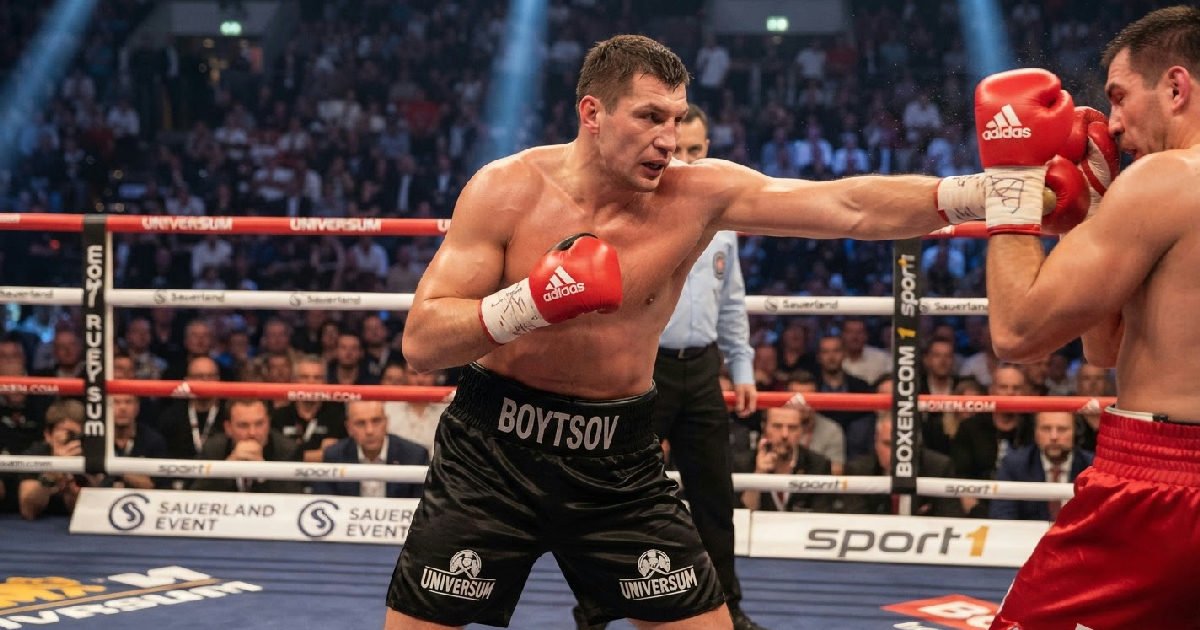
Denis Nikolayevich Boytsov, the formidable Russian professional heavyweight boxer once dubbed “Russian Tyson,” has died at the age of 40. He passed away on October 17, 2026, in his hometown of Oryol, Russia, after a protracted battle with severe neurological complications.
These complications stemmed from a life-altering head injury sustained during a tragic incident in a Berlin subway in May 2015. The boxing world mourns as Denis Boytsov dies.
His passing marks the end of a long, arduous struggle for the boxer, whose promising career was abruptly cut short over a decade ago. Multiple news outlets and his father, Nikolai Boytsov, confirmed his death. The Center for Physical Culture and Sports Events of the Oryol region also announced the news, underscoring the profound impact of his 2015 accident on his health.
Denis Boytsov Dies: Early Career Highlights
Born on February 14, 1986, in Oryol, then part of the Russian SFSR, Soviet Union, Denis Boytsov exhibited prodigious boxing talent from a young age. His amateur career was particularly decorated, boasting an impressive record of 115 wins with 70 by knockout across 130 fights. This early dominance hinted at the power he would bring to the professional ranks.
Boytsov secured three Cadet and Junior World Championship titles during his amateur tenure. He claimed the Light Middleweight Cadet World Championship in Baku, Azerbaijan, in 2001, followed by the Heavyweight Cadet World Championship in Kecskemet, Hungary, in 2002.
He then captured the Super-heavyweight Junior World Championship in Jeju, South Korea, in 2004. Additionally, he earned five Russian national championships.
In 2004, Boytsov transitioned to professional boxing, signing with Universum Box Promotion, then under the leadership of Klaus Peter Kohl and Peter Hanraths. He quickly built a reputation for explosive power and rapid knockouts.
His aggressive, crowd-pleasing style and exceptional hand speed led many to draw comparisons with Mike Tyson, earning him the famous “Russian Tyson” moniker. Universum, a powerhouse in European boxing, offered a robust platform for his ascent.
The Meteoric Rise and Promoters’ Shifts
Boytsov’s early professional record was near-perfect, a testament to his raw talent and formidable punching ability. He often dispatched opponents within the first few rounds, not getting past the second round until his eleventh professional fight.
However, some boxing experts observed that his initial opponents were not always top-tier. He later faced challenges against more seasoned fighters like Roberto Hawkins, Fernely Feliz, and Taras Bidenko.
Despite these criticisms, Boytsov’s talent was undeniable. He claimed the WBC Junior World Champion title from 2006 to 2007, then the WBA Intercontinental Champion title from 2009 to 2011.
He also secured the WBO European Champion belt in 2009, cementing his status as a rising star. His powerful performances kept him on track for bigger opportunities in the heavyweight division. Such accomplishments set the stage for crucial bouts, including potential WBC title defense matchups in the future.
After Universum Box Promotion’s lucrative television deal concluded around 2011, Boytsov, who held an impressive 33-0 record at the time, continued to fight under the “new” Universum banner. This period saw a shift in the boxing landscape, impacting many fighters.
He later moved to Sauerland Event, another prominent German boxing promotion, seeking a clearer path to a world title shot. This change marked a pivotal shift in his career trajectory, leading to higher-profile bouts and greater scrutiny, a path not uncommon for boxers navigating the promotional world.
A Career-Defining Upset and Lingering Questions
The trajectory of Boytsov’s professional career took an unexpected turn on November 23, 2013, when he suffered his only professional loss to Alex Leapai. The defeat, which occurred in Germany, was a significant upset at the time.
It cost Boytsov his status as the WBO’s mandatory challenger for the unified heavyweight champion Wladimir Klitschko. Instead, Leapai earned that coveted opportunity.
This loss dramatically altered Boytsov’s path, derailing what many believed was an inevitable world title shot. He returned to the ring, securing three straight wins after the Leapai defeat. Yet, these victories failed to impress some observers, suggesting a perceived dip in his dominant form or perhaps the psychological toll of the earlier upset.
Maintaining a flawless Mendoza boxing record is an immense challenge for any fighter.
His last professional bout was on March 21, 2015, where he secured a TKO victory over Irineu Beato Costa Jr. in Rostock, Germany. This win brought his final professional record to 36 wins (27 by knockout) and just 1 loss.
It was an end to his fighting career that few could have predicted, coming just weeks before the incident that would change his life irrevocably.
The Tragic Berlin Subway Incident of 2015
On May 3, 2015, Boytsov was found unconscious in a Berlin subway tunnel, suffering from severe head injuries that included a fractured skull and a swollen brain. The incident plunged him into a medically induced coma for seven weeks. The sheer gravity of his injuries left doctors uncertain about his recovery prospects.
A German court later ruled that Boytsov had fallen onto the tracks while intoxicated. However, his wife and other relatives voiced strong suspicions, suggesting the incident might have been linked to years of prior threats or even a beating by a group of Russian individuals.
These conflicting accounts left many questions unanswered regarding the true circumstances of the accident.
The physical toll was immense. Boytsov reportedly lost over 30 kilograms while hospitalized, a stark indicator of the life-threatening nature of his injuries.
The accident effectively ended his professional boxing career, closing a chapter that had promised so much. His bank accounts were also reportedly blocked, prompting Ramzan Kadyrov to agree to cover his medical bills during this critical period.
A Lingering Battle and Return Home
The severe head injury sustained in the 2015 subway incident left Denis Boytsov with profound and lasting neurological complications. His relatives stated that these injuries led to serious health issues, rendering him unable to walk or speak in the years following the accident. This debilitating condition meant a decade-long fight for his health.
After years of medical care in Germany, his family made the decision to bring him back to his hometown of Oryol, Russia, in 2021. This move was an attempt to provide him with care and support closer to his roots.
Boytsov remained in Oryol until his passing on October 17, 2026, marking the end of his courageous but ultimately losing battle against the repercussions of his injuries.
Legacy of the “Russian Tyson”
Denis Boytsov’s untimely death at 40 closes the book on a career that promised to reach the sport’s pinnacle. His nickname, “Russian Tyson,” was a testament to his electrifying style and formidable power, inspiring awe and drawing comparisons to one of boxing’s most iconic figures. He finished with an impressive 36-1 record, with 27 knockouts.
His potential was undeniable, a fact highlighted by sparring partners such as David Price. Price famously stated that Boytsov was the “scariest puncher he ever stood in front of,” even after having faced other heavy hitters in the sport.
This insight speaks volumes about the raw talent Boytsov possessed, a talent that, for many, remained unfulfilled.
Boytsov’s story, from amateur phenom to professional contender, to the tragic circumstances that ended his career and ultimately his life, serves as a poignant cautionary tale within boxing. It highlights the often-brutal realities beyond the ropes and the fragility of a fighter’s health and dreams.
His journey underscores that even the most gifted athletes are not immune to life’s unforeseen and devastating turns.