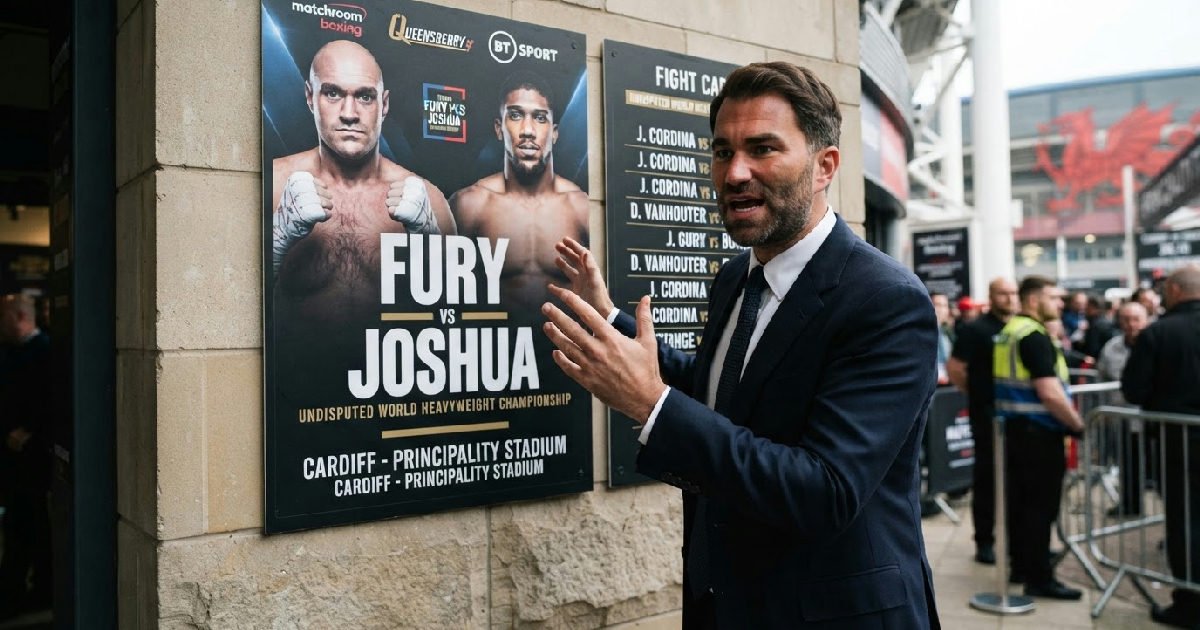
Eddie Hearn, Chairman of Matchroom Sport, has expressed considerable frustration regarding the undercard selections for the highly anticipated Tyson Fury vs. Anthony Joshua heavyweight bout.
The fight, scheduled for December 11, 2026, in Cardiff, Wales, is facing Hearn’s sharp criticism over the inclusion of certain heavyweight matchups and, crucially, the exclusion of Welsh two-time world champion Joe Cordina. His “rage” stems from what he perceives as a misalignment of promotional strategy.
Eddie Hearn lambasts Fury-Joshua undercard decisions
Hearn attributes these decisions directly to the advisory role of Ultimate Fighting Championship (UFC) CEO Dana White to Turki Alalshikh, suggesting a fundamental misunderstanding of boxing’s audience and market. These public remarks underscore a growing tension between established boxing promoters and the sport’s new power brokers. It highlights a philosophical divide in how major boxing events are being shaped.
Eddie Hearn didn’t mince words when discussing the undercard for the colossal Fury vs. Joshua event at Principality Stadium. “Thankfully, none at all, judging by the quality of it,” he told iFL TV when asked about his involvement. He further elaborated on his strong reservations about the announced fights.
The Matchroom boss singled out two specific heavyweight contests for particular scorn: Martin Bakole vs. Solomon Adebayo and Da’Mazion Vanhouter vs. Michael Essomba. “Opetaia-Wilder is a great fight,” Hearn acknowledged, referring to Deontay Wilder’s clash with Jai Opetaia.
“The other two, on what planet would you ever put those two fights on the main card of Fury vs AJ.” This sentiment underscores a clear divide in how promoters view appropriate matchups for such a high-profile Netflix event.
Hearn’s comments highlight a broader debate within boxing about card construction, especially for tentpole events designed to draw a global audience. The balance between established names, rising prospects, and local fan favorites often becomes a point of contention. Many fans are keenly interested in predictions for the main event itself.
The stark criticism from such a prominent figure like Hearn suggests that behind-the-scenes disagreements are now spilling into public view. This reveals the intricate power struggles shaping major boxing events. This public dispute adds another layer of intrigue to an already monumental fight night.
Joe Cordina’s exclusion from his home card
Perhaps the most significant source of Hearn’s ire stems from the absence of Joe Cordina from the Cardiff card. Cordina, a 32-year-old Welsh native and former two-time International Boxing Federation (IBF) super-featherweight champion, was considered a natural fit to compete in front of his home crowd. Hearn confirmed that extensive discussions took place to include Cordina.
Matchroom had proposed multiple high-profile opponents for Cordina. This included a potential bout against boxing legend Manny Pacquiao, a fight for which terms were reportedly agreed. Other names floated for Cordina’s return included promising prospects like Abdullah Mason, Sam Noakes, Mark Chamberlain, and Mauricio Lara. All these proposals, however, were ultimately not pursued by Turki Alalshikh.
Cordina’s recent career has seen its challenges. He suffered a significant setback on May 18, 2024, losing his IBF super-featherweight title to Anthony Cacace via technical knockout in the 8th round. That defeat, which occurred on the Tyson Fury vs. Oleksandr Usyk undercard in Riyadh, Saudi Arabia, was a bitter pill for Cordina.
He later cited a controversial punch on the break as a pivotal moment.
Despite the recent loss, Cordina remains a significant name in Welsh boxing. His exclusion from a major event in his own country is a missed opportunity for local fans. It also leaves Hearn determined to secure a “huge fight” for the “Welsh Wizard” in early 2027, as his participation in the December card is now definitively off the table.
Dana White’s influence and boxing’s new direction
Hearn’s frustrations extend beyond mere card selection; they touch upon a perceived philosophical clash in boxing promotion. He directly pointed the finger at Dana White’s advisory role to Turki Alalshikh. “There’s no secret that, as Max Kellerman said, Dana White is personally advising Turki Alalshikh, and they just don’t know boxing,” Hearn stated emphatically.
This assertion implies that decisions are being made by individuals who, in Hearn’s view, lack a deep understanding of boxing’s nuances, audience expectations, and fighter development pathways. White, CEO of the UFC, has long harbored ambitions in boxing. He officially launched Zuffa Boxing in March 2025 in partnership with Alalshikh.
Their aim has been to bring a UFC-like structure to boxing, focusing on matching top fighters more frequently.
The inclusion of younger prospects and the bypassing of established names or “nostalgia acts” could be seen as a strategy to appeal to newer, younger audiences, particularly on platforms like Netflix. However, Hearn’s critique suggests that this approach may come at the expense of traditional boxing values and understanding of the sport’s ecosystem.
It poses a question about who holds the real power in shaping these blockbuster events.
The dynamic between traditional promoters like Hearn and newer, well-funded entities backed by figures like Alalshikh and White signifies an evolving power structure in the sport. This shift often prioritizes global appeal and potential future stars over established local drawcards. The ongoing discussions about the direction of boxing will likely continue as more major events are planned.
Da’Mazion Vanhouter’s controversial placement
Central to Hearn’s criticism was the inclusion of 21-year-old American heavyweight prospect Da’Mazion Vanhouter. Vanhouter, with an impressive professional record of 14-0 (11 KOs), has been positioned as an exciting new talent. His presence on the undercard of such a monumental event marks a significant platform for his burgeoning career. This potentially aligns with the strategy to introduce fresh faces to a wider audience.
Vanhouter turned professional in April 2022, starting his career in the middleweight ranks before growing into a 6’3½”, 231-pound heavyweight. His fighting style is noted for its footwork, loose mechanics, and compact uppercut, attributes often seen in smaller fighters but rare in the heavyweight division.
He most recently secured a win over Ivan Baláž on November 7, 2026. This young fighter has been gaining attention, with many observers watching his path towards a potential heavyweight crown.
The decision to feature Vanhouter, managed by Ryan Rickey, appears to be a strategic move to capture the American market on Netflix. While Tyson Fury and Anthony Joshua are immense draws in the UK, a promising domestic heavyweight prospect like Vanhouter offers US viewers a compelling reason to tune in.
The long-term payoff, as some argue, is that younger viewers will remember his explosive style and follow his future fights.
However, questions remain about Vanhouter’s ultimate potential. He has only logged 27 total professional rounds, leaving his stamina against a durable opponent largely untested. His matchup against Michael Essomba has also drawn some skepticism regarding its competitiveness. The situation creates a unique juxtaposition, where an emerging talent is given a prime spot while other fighters like Agit Kabayel defends heavyweight title elsewhere.
Implications for boxing’s evolving landscape
The public spat between Eddie Hearn and the forces shaping the Fury vs. Joshua undercard highlights a significant shift in boxing’s ecosystem. It underscores the increasing influence of Saudi Arabian investment, through Turki Alalshikh and the General Entertainment Authority (GEA), and the strategic alignment with figures like Dana White to drive global appeal.
They also aim to engage new audiences, particularly on streaming platforms like Netflix.
This evolving landscape suggests a future where traditional promotional rivalries might be sidelined in favor of centralized decision-making. This often prioritizes spectacle and market penetration over established boxing norms. The debate between promoting “nostalgia acts” versus “new blood” will likely continue to shape fight cards.
This approach could lead to more exciting matchups featuring rising stars. However, it also risks alienating some traditional boxing fans and promoters. For fighters like Joe Cordina, it means that even established champions with hometown appeal might find themselves on the outside looking in if they don’t fit the broader strategic vision of the event organizers.
The decisions made for this specific undercard will set precedents for how future mega-events are constructed. This potentially dictates who gets a prime slot and who must wait their turn.
As boxing continues to adapt to new broadcasting models and global investment, the friction between its storied past and its commercially driven future will likely intensify. The outcome of these power struggles will ultimately determine the types of fights fans see and the pathways available for both emerging talents and seasoned veterans in the sport.