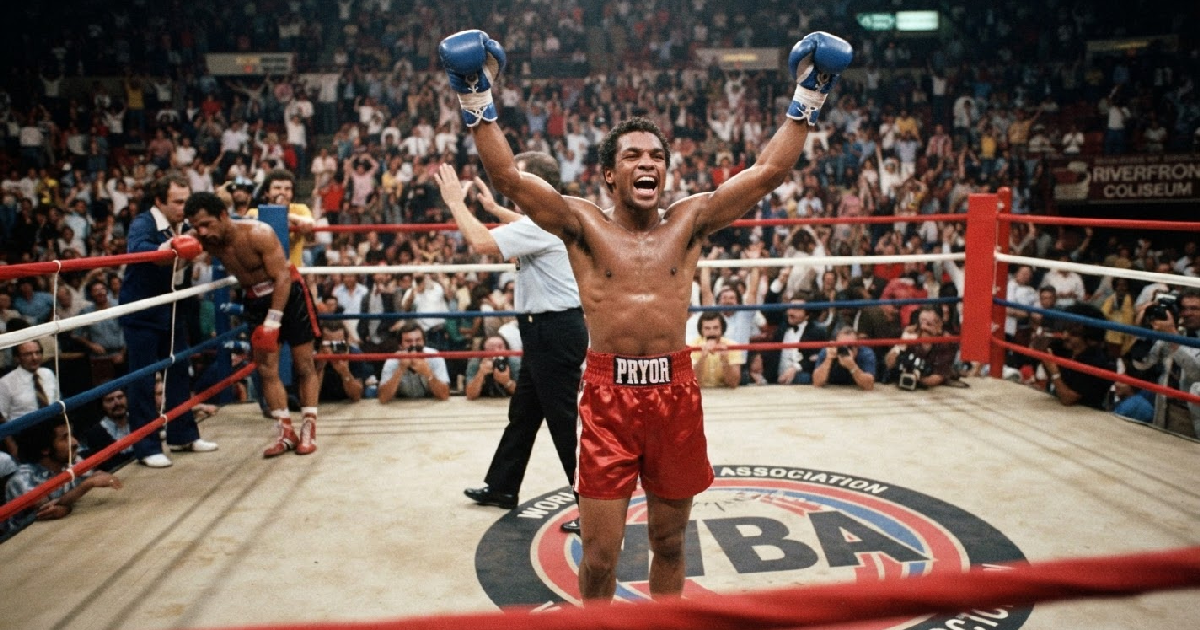
Aaron “The Hawk” Pryor announced his arrival as a boxing superstar on August 2, 1980, becoming the WBA Junior Welterweight Champion. He delivered a stunning fourth-round knockout victory over Antonio “Kid Pambelé” Cervantes. This pivotal win, contested for the World Boxing Association (WBA) Junior Welterweight Championship at 140 pounds, electrified the hometown crowd at Cincinnati’s Riverfront Coliseum.
The triumph earned Pryor his first world title and began a championship reign. It secured his place among the division’s all-time greats.
Pryor dethrones Cervantes in Cincinnati
The atmosphere inside Riverfront Coliseum was electric. Approximately 10,000 enthusiastic fans hoped to witness history as their hometown hero challenged for the title. Many viewed the 34-year-old veteran Antonio Cervantes as a fighter nearing the end of his best years.
They nearly saw disaster strike in the opening round. Cervantes, a seasoned veteran known as “Kid Pambelé,” reminded everyone of his immense power and experience. With just 30 seconds left, he caught Pryor mid-charge with a perfectly timed counter right to the jaw.
Pryor hit the canvas but sprang back to his feet almost instantly. He refused to give the champion any chance to slow the blistering pace he had set. The 25-year-old challenger’s indomitable will became immediately apparent after the knockdown.
Relentless pressure defines early rounds
Pryor immediately resumed his furious assault, maintaining a “whirlwind pace.” His non-stop pressure forced Cervantes into a fight far more intense than the Colombian champion would have preferred. The younger fighter’s ferocity visibly wore down the veteran.
As the second and third rounds progressed, Pryor’s relentless attack intensified. He landed repeated right hands in the third, opening a cut under Cervantes’s right eyebrow. Pryor steadily broke down the champion’s formidable defense.
A crushing overhand right seals the deal
The fight’s dramatic conclusion came swiftly in the fourth round. Pryor trapped Cervantes against the ropes, unleashing a crushing overhand right to the jaw that sent the champion sprawling to the canvas. Referee Larry Rozadilla began his count, but Cervantes failed to rise.
The official time of the knockout was 1 minute and 47 seconds into the fourth round. It was a decisive end to the scheduled 15-round bout. Announcer Gil Clancy remarked on Pryor’s aggressive style, noting his relentless approach.
Cervantes’ long reign comes to an end
Antonio “Kid Pambelé” Cervantes brought years of championship experience into the ring that night. This was his seventh defense of the WBA Junior Welterweight title in his second reign. A future Hall of Famer from Colombia, Cervantes had not lost a fight in four years.
He had successfully rebounded from a 1976 defeat to Wilfred Benitez, showcasing his resilience. Despite claims of being 34, some whispers suggested he was past forty. This added to the narrative of a champion facing a rising star, even if age was unconfirmed.
His pre-fight record was widely reported, though figures varied. YouTube reported 117-13-4, the World Boxing Association (WBA) cited 87-10-3, and MartialBot listed 63-10-1, illustrating some historical discrepancies.
Pryor’s journey to the 140-pound crown
For Aaron Pryor, this fight was the culmination of years of relentless pursuit and a testament to his sheer determination. Moving up a weight class, he finally secured the world title shot he’d been chasing. He’d struggled to find opportunities at 135 pounds, the vacant lightweight title division.
He had already defeated former WBA junior welterweight champion Alfonso “Peppermint” Frazer by knockout in the fifth round in his last fight of 1979. This victory advanced his professional record to 20-0 with 18 knockouts. It solidified his entry into the WBA rankings.
Pryor’s amateur record included 204 wins and 16 losses. He won two National AAU Lightweight Championships and a Pan American Games silver medal. He was even an alternate for the 1976 Montreal Olympics, turning professional on November 11, 1976.
Overcoming past doubts and aiming high
Despite his amateur pedigree, Pryor faced skepticism after the Olympics. “Everybody doubted me after the Olympics, you know, after I lost to Howard Davis by close decision. Nobody wanted give me a break, so I had to make my break,” Pryor recalled post-fight, highlighting his self-reliance.
His pre-fight comments underscored the high stakes he felt for this bout. “If I lose it’s over. For me, it’s either $4.95 an hour or world champion,” Pryor famously stated. This reflected his all-or-nothing mindset and resonated deeply with his Cincinnati fans.
Launching a legendary career
The victory over Cervantes wasn’t just a title win. It was the launching pad for a career that etched Aaron Pryor’s name into boxing lore. This immediately put him in high demand for bigger fights and richer purses. His purse for the Cervantes fight was $50,000.
Cervantes, meanwhile, received a more substantial $250,000 for his title defense. This highlighted the incumbent champion’s market value. This disparity often occurs in boxing, with the title holder drawing a larger guaranteed fee. Pryor became Cincinnati’s first world champion in decades, a source of immense pride, following this welterweight title bout.
Building on a championship foundation
Pryor went on to defend his newly won WBA Junior Welterweight title against challengers. These included Gaetan Hart, Lennox Blackmoore, and Dujuan Johnson. These defenses cemented his status as a dominant force in the division.
His unforgettable two-fight series against the legendary Alexis Arguello propelled Pryor to superstardom. These victories secured his place among the greatest 140-pound IBO super lightweight champions in boxing history. All those future glories, however, began with that dramatic night in Cincinnati against Antonio Cervantes.
The Aaron Pryor versus Antonio Cervantes bout remains a classic encounter, often revisited by boxing enthusiasts and historians. It perfectly encapsulates the narrative of the hungry challenger overcoming the seasoned champion, marking a significant transition in the sport’s landscape. Pryor’s “ferocious and unceasing” style, his “whirlwind pace,” became his trademark. This victory, secured by knockout, established his legacy in the 140-pound division.