
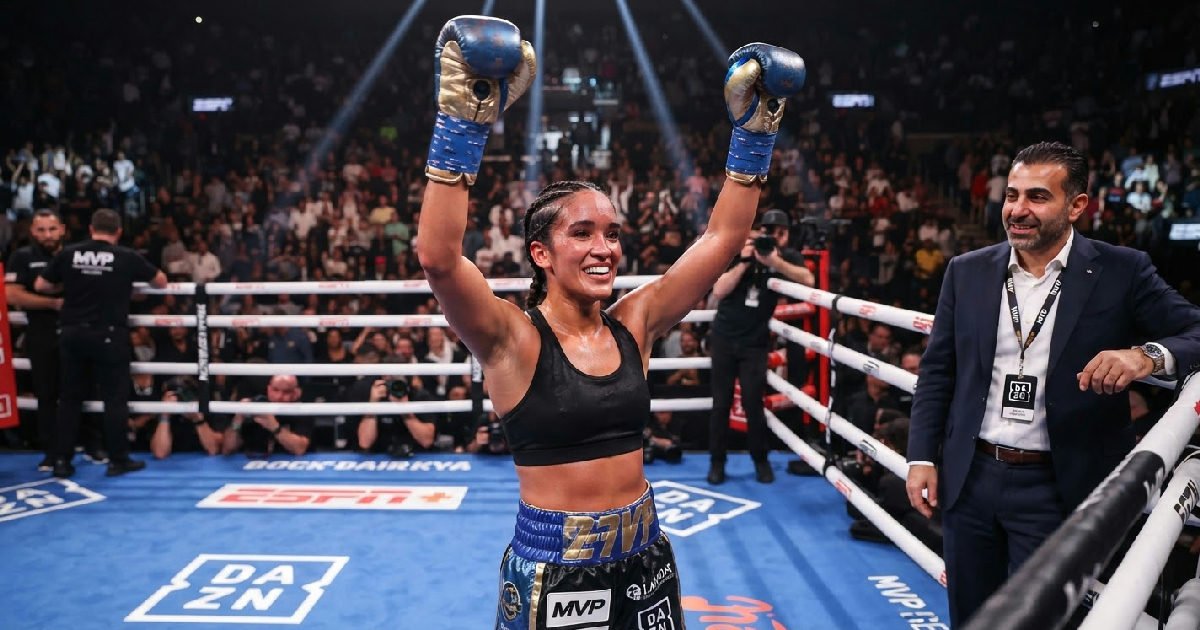
How Amanda Serrano champions her peers
Seven-division world champion Amanda Serrano champions better industry conditions for her peers, redefining professional greatness and creating a stark philosophical contrast with fellow superstar Claressa Shields.
While both athletes stand as undisputed titans of their generations, Serrano has transitioned from setting personal targets to actively campaigning for greater rewards, stronger promotion, and wider access to major broadcasting platforms for all female fighters.
MVP CEO Nakisa Bidarian recently credited Amanda Serrano with fundamentally driving the company’s investment into women’s boxing, a commitment that now includes deals with ESPN, Sky, Netflix, and DAZN.
Bidarian noted that Serrano is the pivotal reason Most Valuable Promotions now works with more than 50 female fighters. Her status as the fighter with the most divisions, titles, viewers, and earnings provided the initial commercial validation necessary for that significant expansion.
Serrano became MVP’s first signing before eventually securing a lifetime contract. The historic trilogy of fights between Serrano and rival Katie Taylor proved definitively that women’s boxing could successfully headline major events when promoters committed serious money and necessary resources.
The Puerto Rican champion, who was named one of TIME Magazine’s 100 Most Influential People in Sports for 2026, views this industry recognition as far more valuable than adding another championship belt to her collection.
She emphasized this selfless approach in a recent post on X, stating that she has accomplished all her personal goals in the ring and now wants every other woman to surpass her. This foundational belief centers on continuing to open doors for one another instead of tearing down the competition.
Sharp Contrast: Analyzing the Claressa Shields Approach
The collaborative spirit driving Amanda Serrano stands in sharp opposition to the often-confrontational promotional style employed by Claressa Shields, who frequently focuses on minimizing rivals to elevate her own standing.
Shields, an undefeated professional with 19 wins and a two-time Olympic gold medalist, recently made headlines by questioning the experience of fellow titleholder Tamm Thibeault.
The remarks came despite Shields herself defeating Kaye Scott on Saturday, August 15, 2026, in a fight where Scott had only seven professional fights heading into the matchup.
Shields captured the WBA and WBC middleweight titles against Scott at State Farm Arena in Atlanta, Georgia, securing a TKO victory at 1:38 of the sixth round. Her historic TKO victory was achieved through intense pressure.
But when discussing Thibeault, who holds the IBF, WBO, and Ring middleweight titles, Shields claimed the Ring belt belonged to her and suggested Thibeault lacked the necessary experience.
This dismissiveness is applied to an athlete who is not only a two-time Olympian but also a former world amateur champion. This tendency to minimize the accomplishments of rivals has led to criticism that Shields is a poor representative for the overall growth of women’s boxing.
Minimizing Fellow Champions Like Tamm Thibeault
The comments aimed at Tamm Thibeault are only the latest instance in a pattern of public conflict that Shields has maintained with her peers for years.
She has engaged in a long-running public feud with retired boxing pioneer Laila Ali. Ali argued as recently as 2025 that Shields only supports other women as long as her own position atop the sport remains absolutely secure.
The animosity isn’t confined to verbal sparring. Shields was previously banned from all Most Valuable Promotions events following an incident where she allegedly struck Alycia Baumgardner in a private VIP area during an MVP MMA 1 event.
In a separate public outburst, Shields grouped Alycia Baumgardner and Amanda Serrano together as “losers,” suggesting they were teaming up to try and match her success. These actions cement her persona as one who elevates herself by actively dismantling the achievements of her contemporaries.
The Business of Building: MVP and Broadcast Deals
The crucial difference between the two titans lies in the measurable, large-scale economic results delivered by their opposing methods. Serrano’s collaborative model has proven to be the most financially impactful for the division as a whole.
The success of the three fights she shared with Katie Taylor demonstrated the viability of investing heavily in women’s boxing main events, generating massive viewership and proving the market demand was there.
MVP’s commitment, fueled by Serrano’s vision, now extends far beyond a single headliner. The promotional company actively nurtures the careers of over 50 female fighters, utilizing broadcast agreements with some of the largest streaming and television networks globally.
The inclusion of major platforms like Sky and Netflix alongside traditional boxing outlets like DAZN shows that the sport is truly entering the mainstream, moving away from being a niche attraction.
This approach transforms the dynamic from a competition over scraps of attention to one of collective market expansion. Every success by a woman promoted by MVP, regardless of who they are, validates the investment originally driven by Serrano’s drawing power.
For promoters, an athlete who drives exponential growth across the roster, rather than just incremental growth for their own brand, is the more valuable long-term asset. This commercial reality underlies why MVP awarded Serrano a lifetime contract.
The Divergent Legacies of Two Pound-for-Pound Greats
Both Amanda Serrano and Claressa Shields possess historically great resumes, but the nature of their legacies is diverging sharply based on their public conduct and advocacy efforts.
Serrano’s 49 wins, 4 losses, and 1 draw include securing 9 major world titles across a Guinness World Record seven weight classes. She is celebrated for using this unprecedented success to champion equal pay boxing and promotional parity.
Conversely, Claressa Shields boasts an undefeated 19-0 record and holds the record for becoming a two, three, four, and five-division world champion in the fewest professional fights. She is an undeniable force in the ring, holding 20 major world championships across five weight classes.
Shields’ supporters often defend her confrontational style, arguing that it is a necessary form of self-promotion in a sport that historically allocates limited attention and resources to female competitors. They contend that she has to be louder and more aggressive to secure her spotlight.
However, this strategy risks alienating the very audience and corporate partners interested in the growth of women’s boxing. It positions the sport as internally toxic, undermining the narrative of unity and progress that Serrano promotes.
Consequences of Public Confrontation and Incident Bans
The long-term cost of sustained controversy can outweigh the temporary media buzz it generates. Shields’ ban from MVP events serves as a tangible consequence of her inability to maintain professional relationships in high-pressure environments.
By comparison, Serrano’s approach of lifting her peers has resulted in her being lauded by organizations like TIME and receiving multiple WBAN Fighter of the Year awards. Her actions create goodwill that reinforces the business model she helped establish.
The difference between the two is clear: one model welcomes future champions exceeding her achievements, while the other claims proprietary ownership over accomplishments and titles.
When Shields dismissed Tamm Thibeault’s experience, she was attempting to invalidate the worth of the IBF, WBO, and Ring middleweight titles Thibeault holds. This suggests that the value of any achievement is only legitimate if Shields herself holds it.
Serrano’s quote—”Now I want Every other woman to surpass me and continue to open doors for each other”—shows an understanding that collective elevation creates a bigger pie for everyone, including herself.
Securing the Future Through Collaborative Promotion
As the business side of boxing evolves, the collaborative approach championed by Amanda Serrano is becoming increasingly vital for sustained success in women’s boxing growth.
Promoters and broadcasters are searching for consistent, positive narratives that they can build long-term franchises around. Internal squabbling, while dramatic, does not sell long-term sponsorship deals as effectively as a unified front working toward parity.
Serrano’s efforts ensure that the next generation of fighters doesn’t have to start from scratch. She is institutionalizing the demand for equal pay and major main event status, making it the new baseline expectation.
For instance, her achievement in becoming the first undisputed world champion from Puerto Rico in the four-belt era in 2023 at featherweight gave her a platform to push for structural changes, not just bigger checks for herself.
Shields’ immense talent will ensure she remains a headline fixture for the immediate future. Her incredible resume—including being the only female boxer to hold all four major world titles in three weight classes—is unassailable.
However, the sustained legacy of a fighter often rests on their impact beyond the ropes. If Shields continues to diminish potential rivals, she risks undermining the overall product she is part of.
Ultimately, the choice facing the women’s boxing industry is simple: follow the path of collaboration and collective building laid out by Amanda Serrano, or persist with the zero-sum, individually focused model that Claressa Shields continues to represent.
The market seems to have already chosen, investing heavily in the model that has proven capable of sustaining 50-plus athletes rather than one that relies on continuous internal conflict for attention.