
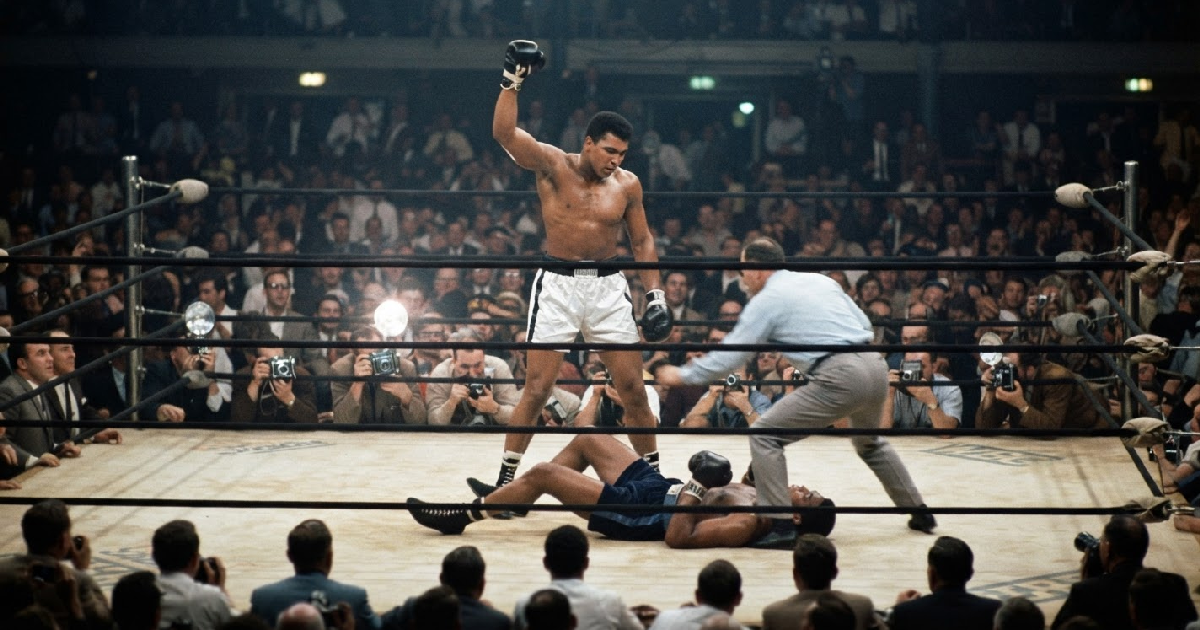
Muhammad Ali, still widely known by his birth name Cassius Clay, delivered a decisive third-round knockout against British challenger Brian London on August 6, 1966. The World Heavyweight Championship bout, held at London’s Earls Court Arena before approximately 13,000 fans, saw Clay retain his WBC, NYSAC, and The Ring heavyweight titles.
This victory marked Clay’s fifth successful defense of the heavyweight crown he’d first won from Sonny Liston in February 1964. He came into the fight with a perfect 24-0 record, heavily favored at 15-1 against London, a former British and Commonwealth heavyweight champion.
A dominant performance in London’s Earls Court
From the opening bell, the fight quickly unfolded as many observers had predicted: a dominant display by the champion. Brian London, known as “The Blackpool Rock,” found himself at a distinct disadvantage in height, reach, and sheer speed against Clay.
Clay, weighing in at 209½ pounds (95 kg) compared to London’s 201½ pounds (91 kg), used his signature sharp jab and nimble footwork to control the distance. He repeatedly beat London to the punch, effectively neutralizing any offensive attempts from the challenger. London managed only a single solid left jab in the first round that briefly caught Clay’s attention.
The decisive third round knockout victory
The end came definitively at 1 minute and 40 seconds into the third round. Clay trapped London in a neutral corner, unleashing a blistering barrage of punches that witnesses described as roughly a dozen blows in mere seconds. A powerful left-right combination sent London crashing to the canvas.
Referee Harry Gibbs completed the count, and London was unable to rise, securing the knockout victory for Clay. After the fight, Clay reportedly told London, “I’ve been saying a prayer that you weren’t hurt. You’re a family man, and you’ve got children and everything.”
Beyond the ropes: purses and management changes
This bout carried significant financial weight for both fighters. Muhammad Ali secured a guaranteed purse of approximately $252,000, along with a share of television revenue, highlighting his drawing power. Brian London, for his brief but brave effort, earned about $112,000.
Earls Court Arena, despite being in London’s home territory, didn’t reach full capacity. Many fight fans had dismissed the matchup as a foregone conclusion, and the relatively sparse attendance of 13,000 in a venue with an 18,000 capacity reflected this sentiment. The fight also marked a pivotal moment in Clay’s career management.
It was the final bout under his agreement with the Louisville Sponsoring Group, the syndicate of businessmen who had managed his early professional years.
Changing hands for Ali’s career management
Following this fight, Jabir Herbert Muhammad, son of Nation of Islam leader Elijah Muhammad, formally took over management duties for Ali. This transition was significant, as Herbert Muhammad would guide Ali’s boxing career until his retirement in 1981, overseeing his financial affairs until 1991. The move aimed to protect Ali’s interests as he navigated both his boxing career and his evolving public identity.
The shift occurred during a period of intense scrutiny for Ali, both inside and outside the ring. His conversion to Islam and subsequent name change to Muhammad Ali were still contentious for some sections of the public and media, even two years after the fact. His principled stance against the Vietnam War was also beginning to shape his public narrative.
London’s candid reflections on a heavyweight defeat
Brian London remained remarkably open about his experience facing one of boxing’s all-time greats throughout his life. He readily admitted Clay held every conceivable advantage in the ring, describing himself as simply smaller, slower, and less athletic than the champion. London also once said that he was sorry, noting, “You told me he was good, but nobody said he was that good.”
His post-fight humor became legendary. London famously joked that he’d only accept a rematch if Clay agreed to wear “a 50-pound weight on each ankle.” He also candidly admitted, “I told the lads in my corner after round one that I could not lay a hand on him.” Such frankness endeared him to many, even as some British critics questioned his effort.
Unmatched skills and dominant punch statistics
Going into the bout, Muhammad Ali boasted a perfect professional record of 24-0 with 19 knockouts, making him a formidable 15-1 favorite. Brian London, while a respected European Heavyweight Champion, entered with a record of 35-13, including 26 knockouts and six previous stoppages. These statistics underscored the significant challenge he faced against the undefeated champion.
The punch statistics from the fight highlight Clay’s complete dominance. He landed a decisive 12-punch combination in three seconds to finish the fight, while London managed only a single blow during the entire encounter. This solitary jab to Ali’s jaw in the first round was London’s sole meaningful contribution, a testament to Clay’s unparalleled defensive and offensive skills against a former heavyweight elite.
A champion’s path amidst mounting challenges
This quick victory over Brian London paved the way for Cassius Clay’s next title defense against German European champion Karl Mildenberger on September 10, 1966. That fight, scheduled for Frankfurt am Main, Germany, would mark the country’s first time hosting a world heavyweight title bout, further solidifying Clay’s international appeal and global reach.
This period of intense activity for Clay underscored his commitment to defending his IBF heavyweight title.
The London fight also serves as a crucial point in understanding Ali’s boxing journey in the mid-1960s. He had previously defeated Henry Cooper in London in May 1966, marking his second fight in the city in less than three months. His hand speed, reflexes, and accuracy were on full display, justifying the immense hype surrounding him.
Even as he reigned supreme in the ring, Muhammad Ali was on a collision course with the United States government over his refusal to be inducted into the armed forces.
His reclassification as 1-A in early 1966 and his public declaration as a conscientious objector were already setting the stage for one of the most controversial periods in sports history. This moment shows how quickly a fighter’s focus can shift from winning a lightweight title defense to facing profound life-altering decisions.
His famous quote, “I ain’t got no quarrel with them Viet Cong,” encapsulated his stance, challenging prevailing patriotic sentiments. This personal conviction would soon lead to severe professional repercussions, including being stripped of his titles and banned from boxing, overshadowing even his most dominant performances, such as this one against London.
The London fight, therefore, represents a snapshot of Ali at the peak of his athletic powers, just before his career was dramatically interrupted by political events. London’s genuine humility in defeat provided a striking contrast to Ali’s unwavering confidence.
It encapsulated the era where the champion was not just a boxer but a burgeoning cultural icon, whose every move, both inside and outside the ring, was scrutinised. The fight itself, though short, became a small but memorable chapter in the epic saga of Muhammad Ali.