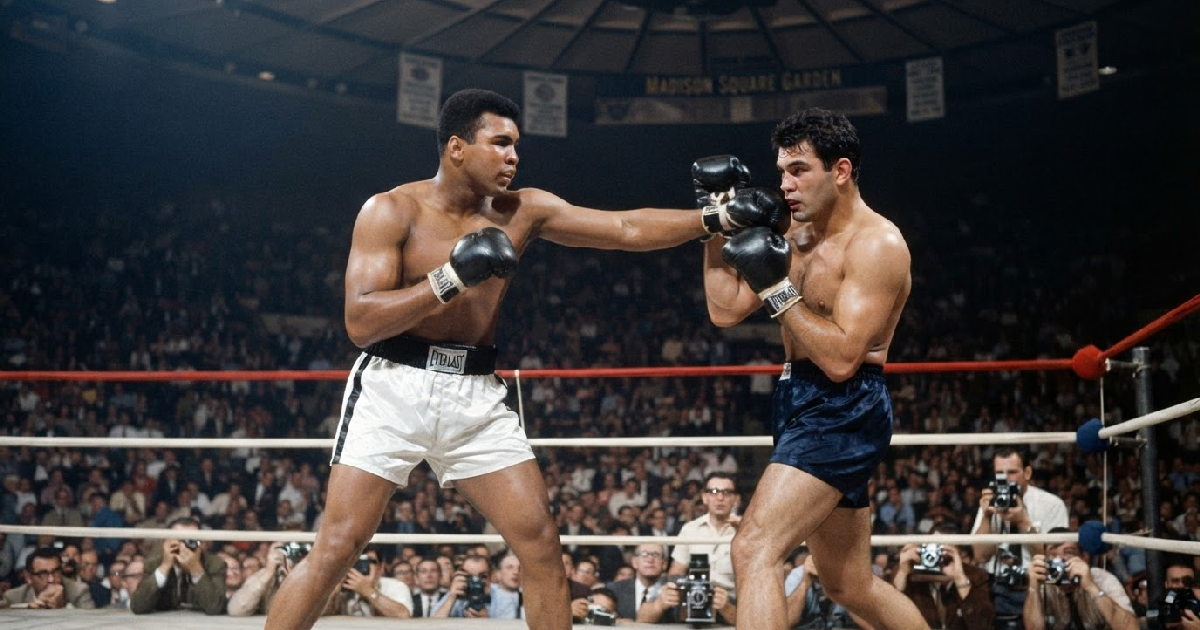
On March 13, 1963, Cassius Clay, the charismatic, undefeated prospect who would later become Muhammad Ali, faced one of his toughest professional tests against Doug Jones in a ten-round heavyweight title eliminator. The bout, held at a sold-out Madison Square Garden in New York City, New York, resulted in a controversial unanimous decision victory for Clay, prompting significant debate among boxing pundits and fans alike.
This pivotal clash, which earned the distinction of “The Ring’s 1963 Fight of the Year,” forced many to question whether Clay’s celebrated speed and confidence were enough to propel him to a world championship. Jones, a seasoned New Yorker known for his disciplined counterpunching, pushed the future legend to his physical and mental limits.
Clay’s pre-fight bravado met fierce resistance
The atmosphere inside Madison Square Garden was electric, fueled by Clay’s characteristic pre-fight predictions and taunts. The 21-year-old Clay, then sporting a perfect 17-0 record, had initially predicted a sixth-round stoppage, then revised it to the fourth after seeing a newspaper photo of Jones reading a book titled The Rise and Fall of Cassius Clay.
Despite being a 3-1 favorite, Clay found himself in a genuine battle against the 26-year-old Jones. Jones, nicknamed “Turk,” had entered the ring with a professional record of 21 wins, 3 losses, and 1 draw, and wasn’t intimidated by Clay’s showmanship. He quickly demonstrated his intent, landing powerful right hands that consistently timed Clay as he leaned back with his hands often held low.
Jones’ early aggression and sustained pressure
Jones visibly shook Clay in the first, fourth, and seventh rounds, nullifying much of the younger fighter’s renowned speed and reflexes. As the fourth round concluded without the predicted knockout, the fight continued at a furious pace, remaining highly competitive for seven fast-paced rounds.
Jones absorbed Clay’s attacks without flinching, showcasing the tough, counterpunching style that had earned him considerable respect across the division. Neither fighter was knocked down during the intense exchanges, making it clear this was no easy night for the undefeated prospect.
A contested decision sparks public outcry
Clay finished the final three rounds with a strong burst of activity, increasing his pace with a series of jabs and one-two combinations. This late surge ultimately secured him the unanimous decision, though the crowd’s reaction to the verdict was one of palpable disapproval.
When the outcome was announced, the Madison Square Garden crowd booed loudly and pelted the ring with garbage and peanuts, signaling their disagreement with the judges’ scores. Referee Joe LoScalzo scored the bout 8-1-1 for Clay, but judges Frank Forbes and Artie Aidala saw it much closer, both turning in cards of 5-4 for Clay.
Split opinions among ringside reporters
The ringside press was equally divided on who truly won the heavyweight eliminator. An Associated Press (AP) poll of 15 writers had 7 favoring Clay, 5 for Jones, and 3 scoring it even. However, a United Press International (UPI) poll of 25 writers saw 13 for Jones, 10 for Clay, and 2 even.
Unofficial scorecards from various publications also varied widely, highlighting the fight’s disputed nature. The AP scored it 5-4-1 for Jones, while the Long Beach Press-Telegram had it 7-1-2 for Clay. The Oakland Tribune also sided with Jones, scoring it 5-4-1.
Financial success and fighter perspectives
Despite the controversy, the highly anticipated bout proved a financial success, underscoring Clay’s burgeoning drawing power. The capacity crowd of 18,732 generated a live gate revenue of $104,943. Additionally, the fight was broadcast via closed-circuit television in 40 locations across 38 cities, contributing approximately $200,000 in revenue.
Clay earned a purse of $90,000 for his night’s work, while Jones took home $75,000. Doug Jones acknowledged Clay’s promotional skills, stating, “I’m not knocking his big mouth. He made me a lot of dough. He talks a lot outside but doesn’t show much in the ring. He better fight me again before he even thinks of Liston.”
Liston’s reaction and Clay’s defiant outlook
Sonny Liston, the reigning heavyweight champion, was certainly watching the challenging encounter. His adviser, Jack Nilon, quickly announced, “Clay will be Liston’s next title opponent at Philadelphia in June or July—after we get rid of Floyd Patterson on April 10.”
Liston himself offered a stark assessment of Clay’s performance: “Clay showed me that I’ll get locked up for murder if we’re ever matched.” But Clay remained defiant, telling scribe Bob Waters after the fight, “Man, I’m tired… my mouth is tired.”
Clay, who won an Olympic gold medal in 1960, also declared, “I would say I won the fight by about seven rounds to three.” He promised an early finish for Liston, stating, “I thought I was going to finish him in the fourth, but he’s tougher than I thought he was. He’ll fall in eight. I won’t mess around next time.”
A stepping stone to greatness
For Doug Jones, the fight against Clay was a career highlight. He famously reflected 20 years later, “I thought I won it no worse than 6-3-1. Clay ran like a thief. I carried the fight to him.” Despite pushing Clay harder than almost any other opponent during his ascent, Jones never received a title opportunity.
For Clay, the arduous victory served as a crucial learning experience. Just three months later, he stopped Henry Cooper, clearing the path to his historic clash with Sonny Liston in February 1964. That monumental upset not only secured Clay his first world heavyweight title but also preceded his adoption of the name Muhammad Ali.
The testing night at Madison Square Garden proved essential for the young fighter. It highlighted areas for improvement and solidified his resilience, preparing him for the legendary career that lay ahead. Jones’ performance cemented his place in boxing folklore, forever linked to the night he almost derailed a future icon.