
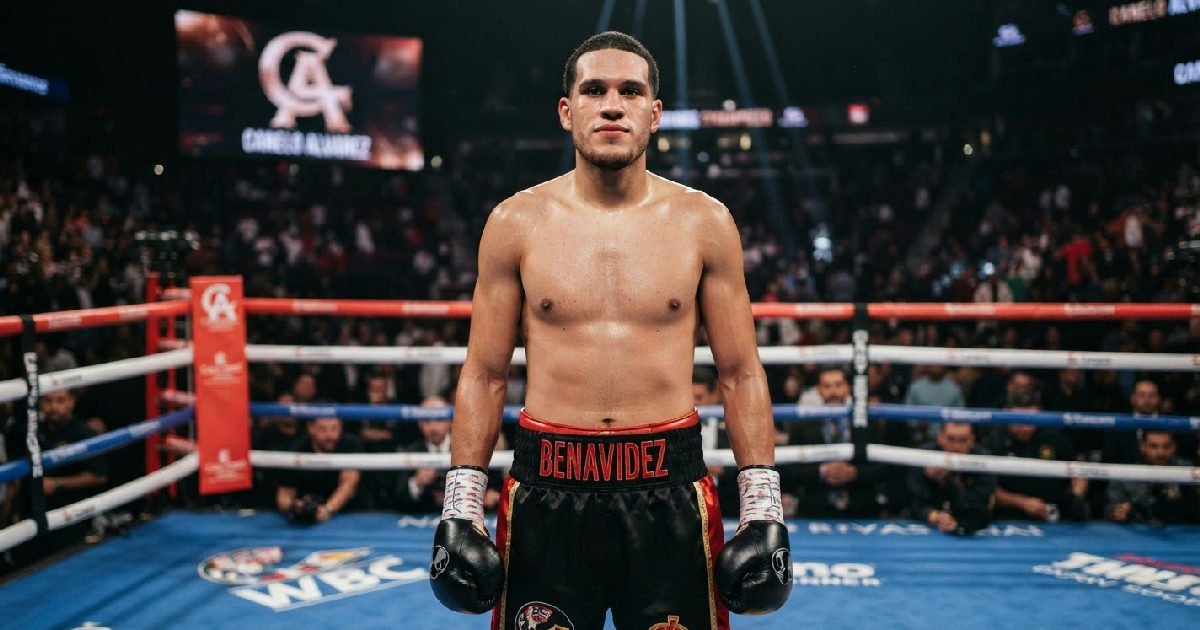
David Benavidez, the 29-year-old three-weight world champion, has made a definitive decision to settle in the cruiserweight division at 200 pounds, a move that gained momentum with his light heavyweight debut on 2024-06-13. This decision effectively ends hopes for a superfight with Canelo Alvarez.
This strategic decision effectively ends any lingering hopes for a highly anticipated “mega fight” against Mexican superstar Saul ‘Canelo’ Alvarez, a bout fans have clamored for over several years.
Benavidez solidifies cruiserweight ambition
Benavidez’s commitment to the higher weight class became unmistakably clear following his victory over Gilberto Ramirez in May 2026, where he captured the WBA and WBO cruiserweight titles.
His declaration signals a new chapter for “El Bandera Roja,” who aims to reign supreme in his chosen division. For boxing enthusiasts, it marks the definitive close of one of the sport’s most talked-about hypothetical matchups, shifting focus instead to Benavidez’s promising future at cruiserweight.
David Benavidez, known for his aggressive style, has steadily climbed through boxing’s weight classes, accumulating titles along the way. He initially made his mark in the super-middleweight division, securing his first world title there.
His journey then saw him ascend to light-heavyweight, where he claimed the interim WBC belt before being elevated to full champion status after Dmitry Bivol vacated the title. Benavidez has since dropped his WBA regular belt, solidifying his move.
During his tenure at 175 pounds, Benavidez defended his championship once, stopping the UK’s Anthony Yarde in a dominant seven-round performance in November 2025. Many expected him to continue campaigning in the light-heavyweight division, but a new opportunity at cruiserweight emerged, proving too significant to pass up.
He officially debuted at 200 pounds in May 2026, facing Gilberto Ramirez, a formidable opponent. In a career-defining performance, Benavidez became the first fighter to stop Ramirez, emphatically winning the WBA and WBO cruiserweight titles. This victory was a turning point, solidifying his decision to remain in the division.
Benavidez recently told Ring Magazine’s Mike Coppinger that he feels “great at this weight-class” and doesn’t have to cut significant weight, allowing him to perform at his peak. He expressed a clear desire to “be the reigning champion for a long, long time,” indicating a permanent stay at cruiserweight.
The end of the Canelo Alvarez dream fight
The decision by David Benavidez to commit to the cruiserweight division definitively closes the door on a fight that boxing fans have yearned for: a showdown with Saul ‘Canelo’ Alvarez. For years, the potential clash between Benavidez and Alvarez was a hot topic, especially when both were competing in the super-middleweight division.
Fans frequently criticized Canelo for seemingly avoiding the challenge posed by Benavidez at 168 pounds. The Mexican icon has ventured into light-heavyweight on two occasions, securing a win against Sergey Kovalev in November 2019 and suffering a defeat to Dmitry Bivol in May 2022.
However, a move up to cruiserweight, a full 32 pounds heavier than super-middleweight, is considered a bridge too far for the 5-foot-7-inch Alvarez.
This reality means the rivalry, which generated immense discussion and anticipation, will remain a “what if” in boxing history. While Alvarez continues to pursue top-tier challenges, the physical disparities in weight now make a fight against Benavidez an impossibility.
The missed opportunity represents a significant disappointment for many within the boxing community. The clash of styles and the genuine competitive edge between the two fighters promised an enthralling spectacle that will now never materialize. It illustrates how strategic weight decisions can fundamentally alter the landscape of potential superfights.
Impact on light-heavyweight and future matchups
David Benavidez’s firm decision to stay at cruiserweight leaves a notable void in the light-heavyweight division. His departure impacts potential high-profile matchups, particularly against formidable opponents like Dmitry Bivol and Artur Beterbiev. Both Russian fighters had been on Benavidez’s “hit list” for some time, and a unification bout involving any of them would have been a significant event.
Benavidez had already relinquished his WBA regular light-heavyweight belt and is expected to soon do the same with his WBC title. This creates opportunities for other contenders within the 175-pound division, reshuffling the hierarchy and opening pathways for new champions.
Still, the prospect of seeing Benavidez test his mettle against Bivol or Beterbiev, both renowned for their skill and power, remains an intriguing thought for many.
While the Russian duo have, in the past, indicated a willingness to move up in weight, a jump to cruiserweight to face Benavidez now seems less probable given his stated intention to stay.
This situation highlights the dynamic nature of boxing, where a fighter’s decision can ripple across multiple weight classes, creating new pathways and closing others. Benavidez’s recent actions, including relinquishing titles, clearly underscore his commitment to the cruiserweight division.
Benavidez’s path ahead at 200 pounds
With the cruiserweight division now his primary domain, David Benavidez has a clear path forward, replete with exciting opportunities. His immediate focus will be on unifying more titles and establishing himself as the undisputed king at 200 pounds. He’s not short on compelling opponents or significant fights.
The next step for Benavidez is a fight against Michał Cieślak in December. This bout will give him the chance to add the WBC cruiserweight belt to his collection, further solidifying his championship reign. A victory against Cieślak would put him in an even stronger position within the division, lining him up for even bigger challenges.
Looking ahead to next year, a major clash against Jai Opetaia is reportedly on the horizon. Many anticipate a potential Benavidez vs. Opetaia clash as a must-see event. Such a fight would undoubtedly capture global attention and further elevate Benavidez’s standing in the sport.
This trajectory suggests Benavidez is not merely moving up in weight but doing so with a clear strategy to dominate. His commitment, combined with his proven knockout power and technical skill, positions him as a significant force in the cruiserweight division for years to come. Fans can expect a series of high-stakes encounters as he pursues undisputed status.
Canelo Alvarez faces his own challenges
While David Benavidez charts a new course, Saul ‘Canelo’ Alvarez continues to navigate his career at the elite level, facing his own set of challenges. The discussion around his potential fight with Benavidez has often overshadowed other aspects of his career, including recent criticisms and upcoming bouts. Alvarez remains a major draw, but his recent performances and choices have drawn scrutiny.
Saul ‘Canelo’ Alvarez has faced significant challenges, including his defeat by Dmitry Bivol in May 2022 for the WBA (Super) light heavyweight title. This loss demonstrated that even a multi-division champion can face formidable obstacles.
Despite his storied career, Alvarez’s decisions, particularly regarding potential matchups, often draw scrutiny from fans and analysts alike. The boxing world continues to speculate on Alvarez’s next moves, with various fighters, such as Janibek Alimkhanuly, openly seeking a bout with him.
A defining moment for boxing’s weight divisions
Benavidez’s decision is more than just a personal career choice; it represents a significant moment for the fluidity of boxing’s weight divisions. Fighters frequently move between classes, but a permanent commitment like Benavidez’s, especially after achieving multi-division champion status, reshapes expectations. It underscores the challenges and strategic considerations involved in a fighter’s progression.
This move highlights how physical prime and performance heavily influence such decisions. Benavidez himself noted feeling his best at cruiserweight against Ramirez, suggesting that natural size and comfort in a division are paramount. It also illustrates the ongoing debate around “catchweights” and the feasibility of fighters meeting halfway when significant weight disparities exist.
Ultimately, Benavidez’s choice, while ending one dream fight, opens the door to numerous others in the cruiserweight division. It forces fans and pundits alike to adjust their expectations and focus on the exciting matchups that are now genuinely possible. The boxing landscape, ever-changing, continues to evolve with such pivotal career decisions.