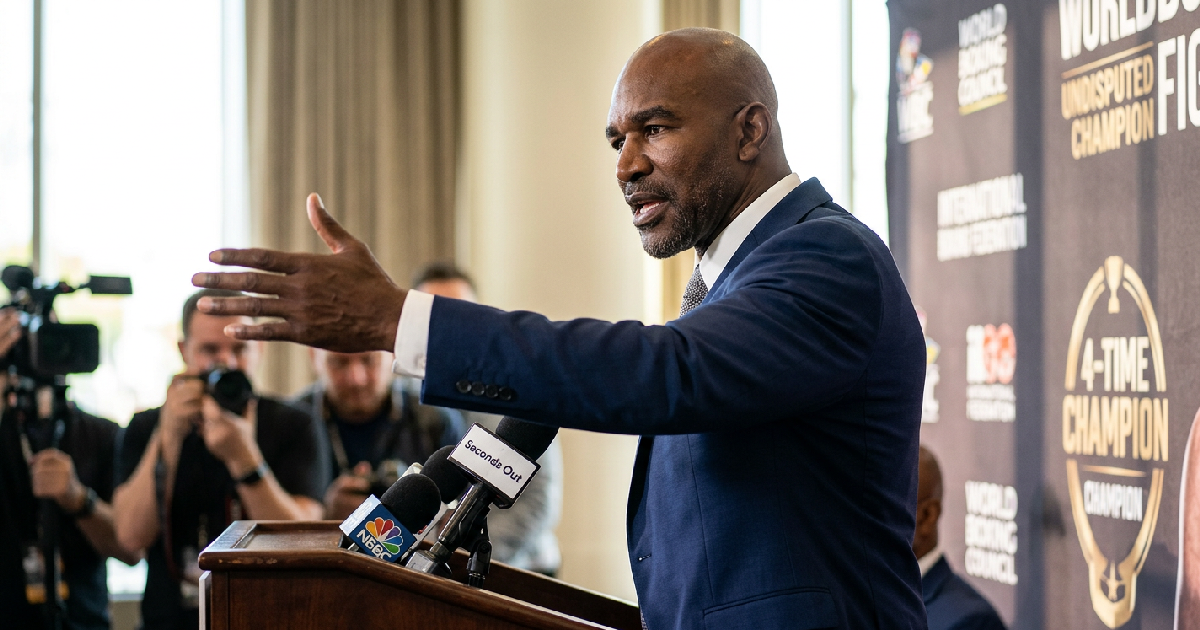
Boxing icon Evander Holyfield has boldly declared himself a superior heavyweight to Muhammad Ali, reigniting one of the sport’s most enduring debates. Speaking to Seconds Out on July 3, 2026, Holyfield, the only fighter to achieve four world heavyweight championship reigns, expressed frustration that his unique accomplishments have been overlooked, suggesting he’s been ‘cut out of history.’
Holyfield’s challenge comes despite Muhammad Ali’s widespread recognition as boxing’s greatest of all time, a legacy built on three heavyweight title reigns and iconic victories. The “Real Deal” believes his unmatched record in the sport’s premier division should place him above all others in discussions of elite fighters.
Evander Holyfield stakes claim as boxing’s true ‘Greatest’
Evander Holyfield didn’t hold back in his explanation for why he considers his resume stronger than Muhammad Ali’s. “I’m the only four-time heavyweight champion of the world but they are still talking about Ali when I broke his record,” Holyfield told Seconds Out.
He underlined the longevity and rarity of his achievement. “I’ve been the only four-time heavyweight champion of the world for 24 years,” Holyfield noted, highlighting how long his record has stood unchallenged.
Holyfield feels his surpassing of Ali’s three-time championship status warrants greater historical recognition. He even reflected on another significant, yet seemingly unacknowledged, career milestone.
“Now I didn’t even know I was the first person to be undisputed in two weight divisions, until Usyk did it,” Holyfield stated. This comment points to a deeper sense of his contributions being understated.
His argument culminated in a direct comparison. “They keep saying Ali is the best fighter, no I am. He was three times, I’m four,” he concluded, presenting a clear, numerical basis for his claim of supremacy.
Muhammad Ali’s enduring legacy and triple crown status
Muhammad Ali’s status as a boxing legend transcends his three world heavyweight championship reigns. His immense legacy is a blend of electrifying in-ring performances, a captivating personality, and profound cultural influence.
Ali’s legendary triumphs, including the “Rumble In The Jungle” against George Foreman and the grueling “Thrilla In Manila” versus Joe Frazier, are firmly embedded in boxing lore. These bouts, alongside his outspoken social and political stances, solidified his position as a global icon.
His ability to unify and reclaim the heavyweight title three times set a high standard for future champions. Other elite fighters like Lennox Lewis and Vitali Klitschko also achieved three heavyweight title reigns, placing them in an exclusive group.
The admiration for Ali often goes beyond statistics, encompassing his charisma, resilience, and audacious fighting style. Many view him as the quintessential combination of athletic genius and cultural impact, making the “greatest of all time” debate particularly complex when his name is mentioned.
The formidable career of ‘The Real Deal’
Evander Holyfield’s argument is bolstered by a truly impressive professional record. It highlights his dominance across two of boxing’s most demanding divisions, showcasing his exceptional versatility and grit.
Before conquering the heavyweight ranks, Holyfield established himself as the undisputed cruiserweight champion. This initial achievement alone was a testament to his skill and unwavering determination.
He then ascended to heavyweight, where he not only secured world titles on four separate occasions but also achieved undisputed status. His time in the heavyweight division featured memorable victories over some of the era’s most formidable opponents.
Holyfield defeated titans like Mike Tyson, Riddick Bowe, George Foreman, and Larry Holmes. These wins underscore his ability to consistently beat top-tier talent throughout multiple generations of fighters.
His triumphs against these formidable names showcase Holyfield’s longevity and consistent performance at the highest level. His sustained success across two divisions for an extended period solidifies his place in boxing history.
Undisputed in two weight classes: Holyfield’s pioneering feat
Holyfield’s assertion about being the first undisputed champion in two weight divisions, before Oleksandr Usyk’s similar achievement, shines a light on a crucial, often overlooked, aspect of his career. While Usyk’s recent unification at cruiserweight and heavyweight has gained significant attention, Holyfield points out he accomplished this feat decades earlier.
This particular milestone speaks volumes about a fighter’s unique versatility and enduring quality. Becoming undisputed in even one division is an extraordinary challenge, requiring a boxer to hold all four major world titles simultaneously.
To achieve this in two distinct weight classes places a fighter in an incredibly rare echelon, demonstrating unparalleled dominance and shrewd career management. It’s a testament to exceptional skill and strategic choices.
It’s clearly a point of pride for Holyfield, suggesting that his groundbreaking place in boxing history, particularly regarding multi-divisional undisputed reigns, is secure and, arguably, foundational. This kind of accomplishment provides a distinct angle to his “better than Ali” argument, adding considerable weight to his overall legacy.
The ongoing discussions about defining greatness also extend to contemporary boxing, where new legends are forging their own multi-title legacies. For example, some speculate about Terence Crawford’s thoughts on whether Canelo Alvarez may retire, another high-profile fighter whose career choices impact his historical standing.
The changing landscape of championship reigns
The structure of boxing championships has evolved significantly since Muhammad Ali’s prime, a factor that subtly influences these historical comparisons. In Ali’s era, the heavyweight division largely revolved around fewer major sanctioning bodies, arguably making the three-time champion status more concentrated.
In contrast, Evander Holyfield’s rise coincided with a period marked by a greater number of world titles from various organizations. This shift meant that while more belts were available, achieving “undisputed” status required an even more complex and challenging journey, demanding unification across multiple bodies.
Holyfield’s success in unifying belts, not once but twice across two different weight classes, highlights a distinct kind of excellence. It demonstrates an ability to navigate a more fragmented championship environment while still establishing clear supremacy. This adds a unique layer to his claim, showcasing adaptability to modern boxing’s structural complexities.
Defining greatness through multiple title successes
Achieving multiple world title reigns, especially in the heavyweight division, remains a paramount indicator of greatness and sustained excellence in boxing. It signifies a fighter’s capacity to reach the sport’s summit, potentially lose it, and then reclaim it against emerging talents.
This demanding cycle requires not only exceptional skill but also profound dedication and mental fortitude. Evander Holyfield’s four reigns stand as a singular testament to these qualities, proving his mettle time and again. It demonstrates his ability to adapt, recover from setbacks, and consistently perform at an elite level for decades.
While critics might suggest the proliferation of sanctioning bodies in modern boxing could make multi-title reigns more attainable than in Ali’s era, Holyfield’s undisputed status across multiple weight classes significantly counters this argument. The sheer physical and mental toll of competing at the highest echelon for so long is immense.
Key details
It’s a testament to Holyfield’s incredible conditioning and unyielding fighting spirit that he repeatedly climbed to the top. This longevity and persistent success in the face of evolving challenges are crucial components of his claim for historical prominence, representing a different, yet equally profound, measure of greatness.
Debates over who stands as the most skilled opponent are also common among legends, with Manny Pacquiao once identifying Juan Manuel Marquez as more skilled than Floyd Mayweather Jr. Such discussions underscore the diverse ways boxing excellence is perceived.
Ultimately, while Evander Holyfield believes he’s been marginalized from history by the towering shadow of Muhammad Ali, his recent remarks serve as a potent reminder of his own extraordinary accomplishments. His four heavyweight titles and status as a two-division undisputed champion present an irrefutable numerical argument that demands serious consideration in any discussion about boxing’s all-time greats.
The boxing world thrives on these spirited debates, constantly re-evaluating legacies and celebrating the incredible athletes who leave an indelible mark on the sport. As the sport continues to evolve, the conversation around what defines a champion will also expand, much like the emerging prime of women’s boxing challenges traditional metrics of greatness and introduces new contenders for historical recognition.