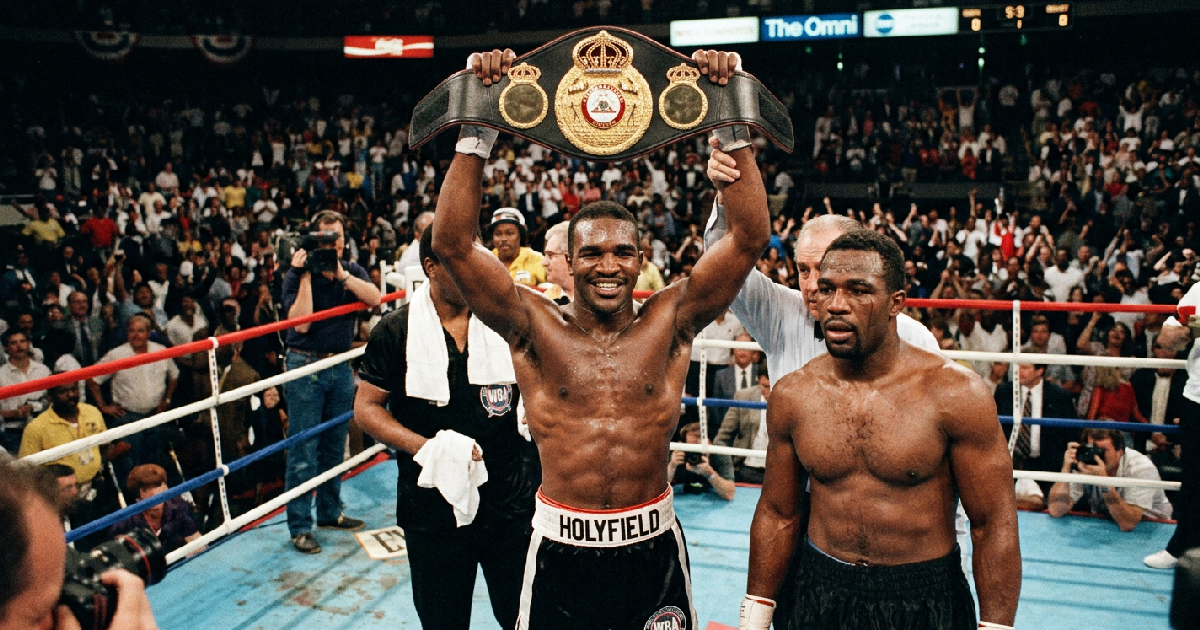
Evander Holyfield defeated Dwight Muhammad Qawi on July 12, 1986, to win the WBA cruiserweight world title, solidifying his boxing legacy.
The 15-round war, staged at the Omni in Atlanta, Georgia, saw the 23-year-old challenger survive a punishing physical trial against a relentless champion who had previously ruled the light heavyweight ranks. By earning a split-decision victory, the future Hall of Fame inductee became the first member of the 1984 U.S.
Analysis of the battle between Evander Holyfield and Dwight Muhammad Qawi
Olympic boxing team to win a professional world championship.
The bout, marketed under the appropriate title of “Pandemonium,” pitted the athletic versatility of the 6-foot-2½ Evander Holyfield against the compact, brutal efficiency of the 5-foot-6 Dwight Muhammad Qawi. Despite his significant height disadvantage, the “Camden Buzzsaw” entered the ring with a reputation for neutralizing taller opponents through constant body work and high-output pressure.
For the challenger, the night served as a steep transition from a rising prospect to a world-class operator, as he had never previously fought beyond the eighth round in his 11 prior professional appearances.
The tactical dynamic of the fight was established within the opening minutes. Evander Holyfield utilized his superior reach and collegiate-style athletic pedigree to fire sharp, three- and four-punch combinations from the perimeter. However, Dwight Muhammad Qawi was not a champion easily kept at bay.
The incumbent moved forward with an unwavering high guard, slipping the jab to hammer away at the challenger’s ribs and midsection. This interior work was designed to deplete the gas tank of the younger man, testing whether the Olympic bronze medalist possessed the professional durability to match his amateur speed.
As the rounds progressed, the environmental conditions inside the Omni became a factor as significant as the fighters’ gloves. The arena’s cooling systems struggled to manage the summer heat, creating a sweltering atmosphere that visibly taxed both men. In this furnace, the fight transitioned from a boxing match into a war of attrition.
Neither man offered a backward step, resulting in a mesmerizing display of “phone booth” boxing where defense was sacrificed for offensive volume and psychological dominance.
Building the legacy of the cruiserweight division
At the time of this encounter, the cruiserweight division was still in its relative infancy, often dismissed as a bridge for small heavyweights or overgrown light heavyweights. This contest single-handedly validated the weight class.
The pace was significantly higher than the typical heavyweight bout of the mid-80s, yet the power on display surpassed that of the lighter divisions. The clash helped establish a roadmap for the division that later stars would follow, proving that the 190-pound (at the time) limit could produce all-time classics.
The intensity of the exchange was such that by the championship rounds, both fighters were operating on instinct rather than instruction. Evander Holyfield’s ability to find a second wind in the 14th and 15th rounds proved to be the deciding factor.
Even as his body began to fail due to severe dehydration, he continued to fire back at the champion, refusing to let Dwight Muhammad Qawi’s pressure break his resolve.
This display signaled a shift in the sport, as many modern fighters like Oleksandr Usyk have since looked to this era as the gold standard for cruiserweight excellence.
The physical toll and immediate aftermath in Atlanta
The cost of the victory was immediately apparent once the final bell rang. Evander Holyfield had pushed his body significantly past its biological limits to secure the split-decision win.
Official scorecards reflected the razor-thin nature of the contest, with two judges scoring it 144-140 and 147-138 for the challenger, while the third judge saw the veteran champion as the winner at 143-141. The disparity in the scores highlighted how difficult it was to separate the challenger’s activity from the champion’s effective aggression.
Following the announcement, the new champion was not able to celebrate in the traditional fashion. Reports from the time indicated that Evander Holyfield had to be hospitalized shortly after the bout to treat severe dehydration.
Physicians noted that he had lost a substantial amount of weight over the course of the 45 minutes of active combat. This medical reality underscored the “do or die” mentality that eventually became the trademark of his career, a trait later seen in other warriors like Manny Pacquiao during his most grueling trilogies.
Championship rounds and the birth of a legend
The 15th round is often cited by boxing historians as one of the most remarkable displays of conditioning ever seen. Despite the lack of an air-conditioned environment, the volume of punches remained consistent with the opening frame.
Dwight Muhammad Qawi, who had spent years as a top-tier champion in two weight classes, simply could not discourage the younger man. Every time the “Camden Buzzsaw” landed a signature hook to the liver, the challenger responded with a flurry to the head.
This victory was the catalyst for the “Real Deal” moniker, a title that Evander Holyfield would carry through his eventual move to the heavyweight division. It proved that he could take the best shot of a world-class puncher and remain vertical.
While the cruiserweight ranks have seen many champions since, few have reached the heights of technical proficiency and raw courage displayed on that July night in 1986.
Strategic implications for the modern boxing era
Looking back at the 15-round format, which was eventually phased out for safety reasons, the Holyfield-Qawi fight serves as a final testament to an era of extreme endurance.
Had the fight been scheduled for 12 rounds, the perception of the bout might have differed, but the extra nine minutes of combat allowed both men to enter a rarified space of sports history.
The victory allowed the winner to eventually unify the entire division, becoming the first undisputed cruiserweight king before moving up to challenge the giants of the heavyweight world.
For Dwight Muhammad Qawi, the loss was a momentary setback in a career defined by defying the odds. Despite the defeat, his stock remained incredibly high due to the quality of his performance.
The two would meet in a rematch a year later, but the physical toll of their first encounter seemed to have left a deeper mark on the older man.
In the second meeting, the younger champion was able to secure a stoppage in four rounds, signaling the official passing of the torch and the beginning of the new champion’s heavyweight ambitions.
Consistency and the path to heavyweight greatness
The discipline showcased in this fight acted as a blueprint for the remainder of the 1980s. While other prospects from the 1984 Olympic team struggled with the pressures of professional life, the new WBA champion remained focused on meticulous training and recovery.
This level of professionalism is something modern analysts often discuss when evaluating the careers of fighters like Terence Crawford, who similarly rely on technical brilliance and sustained stamina to overcome naturally larger opponents.
At the time, the heavyweight landscape was dominated by the rising shadow of Mike Tyson, and the boxing public was skeptical that a cruiserweight could survive against the behemoths of the top division.
The Qawi fight was the first real piece of evidence that the smaller man’s heart and combination speed could act as a neutralizing force against larger, stronger foes.
It wasn’t just a win for a belt; it was a win for a specific style of boxing that prioritized volume and relentless conditioning over raw one-punch power.
Legacy of the Camden Buzzsaw and the Real Deal
Four decades later, the influence of “Pandemonium” is still felt in gymnasiums across the world. Trainers often use the tape of this fight to teach the art of punching in combinations while under extreme pressure. It remains a rare example of a fight that featured no knockdowns but was universally hailed as an action-packed classic.
The lack of a “canvas moment” only served to highlight the durability of both participants; neither man would allow himself to fall, no matter the force of the blow.
As the sport continues to evolve, the cruiserweight classic of 1986 remains a high-water mark. It represents a moment in time when two masters of the craft met at a crossroads, resulting in a physical and mental contest that transcended the sport of boxing.
For the winner, it was the start of a journey that would lead to four heavyweight titles; for the loser, it was a valiant stand that cemented his status as one of the most avoided and respected fighters of his generation.
The fight serves as a reminder that the greatest bouts are often those where two distinct styles clash in an environment that tests the very limits of human willpower.
In the suffocating heat of the Atlanta Omni, the world learned that Evander Holyfield was not just an Olympian, but a fighter capable of enduring the most extreme versions of combat to achieve his goals.
The echoes of that 15-round war still resonate whenever a new cruiserweight attempts to make his mark on the world stage.