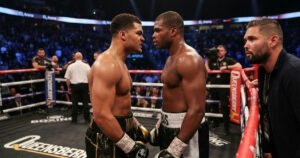

Unbeaten heavyweight Joshua Edwards extended his winning streak to 7-0 on Saturday night in Oceanside, California, but the manner of his second-round knockout has left the boxing community divided. While the referee officially called a halt to the contest at the 1:06 mark, a heavyweight knockout replay shows a punch almost nobody can see at full speed, prompting fans to scrutinise the footage frame-by-frame.
The Houston prospect was facing Garreth Payton in a scheduled eight-round bout on the Oscar Collazo undercard. To the naked eye, the finishing right hand looked routine. However, as slow-motion versions of the clip began to surface online, even seasoned observers found themselves searching for the point of impact. The unusual nature of the finish has sparked comparisons to historical “phantom punches” where the damage isn’t immediately obvious to spectators.
Unseen right hand ends Garreth Payton’s night in Oceanside
Digital replays from the Oceanside venue suggest that Edwards landed a glancing right hand across the upper portion of Payton’s head. It wasn’t the kind of flush, jaw-rattling shot that typically defines a heavyweight knockout, yet its effect was immediate. Payton’s equilibrium appeared to evaporate instantly as he collapsed to the canvas, ultimately failing to beat the count.
The victory means Joshua Edwards now boasts six knockouts in his seven professional appearances. While some fans on social media expressed skepticism over the knockout’s validity, World Boxing News reported that closer inspection from specific angles reveals the connectivity of the shot. This brings to mind other difficult-to-track finishes, such as when Roberto Duran identifiedKen Buchanan as his most astute tactical rival because of the subtle ways fighters can disguise their work.
Joshua Edwards clarifies distance from Deontay Wilder comparisons
Despite his high knockout percentage, Edwards is going out of his way to distance himself from the “puncher” label. In the days leading up to the Oceanside event, he told World Boxing News that he explicitly dislikes being compared to the former WBC heavyweight champion Deontay Wilder. While Wilder is famous for high-profile, visible power shots, Edwards insists his game is built on a different foundation.
“I honestly hate the comparisons,” Edwards said. “I’m more of a boxer first rather than a puncher, with all respect to Wilder.” Ironically, it was this boxing-first approach that led to a knockout so subtle it required multiple replays to confirm. By prioritising timing and precision over raw aggression, the Houston native managed to find a gap that his opponent — and most viewers — never saw coming.
Technical breakdown of the “phantom” heavyweight knockout
The controversy surrounding the “phantom punch” is a recurring theme in the history of the heavyweights. Historically, the most famous instance occurred when Muhammad Ali stopped Sonny Liston in 1965 with a “chopping right” that many believed at the time never landed. Much like the Ali-Liston incident, the Edwards-Payton finish demonstrates how a punch to the temple or the upper head can scramble a fighter’s internal gyroscope even without a massive wind-up.
In recent years, the division has seen a variety of unusual stoppages. For instance, Oleksandr Usyk raised brain health concerns following the intense Dubois-Wardley clash, highlighting the different ways heavyweights can absorb or succumb to impact. In Edwards’ case, the lack of a “theatrical” landing doesn’t change the medical reality of Payton’s lost equilibrium.
For a prospect like Joshua Edwards, producing such a debated finish might actually be a marketing blessing. It has forced the boxing public to analyze his hand speed and technical traps rather than simply watching for a highlight-reel hook. As he moves toward more experienced opponents, the ability to land shots that defenders cannot track will be his most dangerous asset. Although he prefers the “boxer” moniker, his record shows he is becoming a refined finisher who doesn’t need a wide swing to end a night early.