Manny Pacquiao achieved unprecedented boxing immortality through a series of tactical wars, defining his legacy as the only eight-division champion in the history of the sport. His career is often measured by the quality of his opposition, naturally led by his high-stakes rivalries with Miguel Cotto, Antonio Margarito, and Juan Manuel Marquez.
These bouts were not just physical contests but events that showcased how Pacquiao’s blinding speed and southpaw aggression could neutralize larger or more technical opponents.
The rivalry between Manny Pacquiao and Juan Manuel Marquez remains perhaps the most technically intriguing, spanning four fights over eight years. Their first encounter on May 8, 2004, at the MGM Grand Garden Arena in Las Vegas set the tone for nearly a decade of controversy.
They fought for the WBA (Unified), IBF, and The Ring featherweight titles, resulting in a split draw after Marquez recovered from three first-round knockdowns to make it a surgical battle of wits.
While Pacquiao’s clashes with Marquez were marathons of endurance and strategy, his bouts against Cotto and Margarito were explosive demonstrations of his ability to climb weight divisions. Each fight required a specific adjustment to his style, proving he could sustain power against champions naturally much heavier than himself.
These performances continue to serve as a benchmark for current stars like Shakur Stevenson when weighing the risks of moving up to the welterweight limit.
Shattering records against Miguel Cotto in Las Vegas
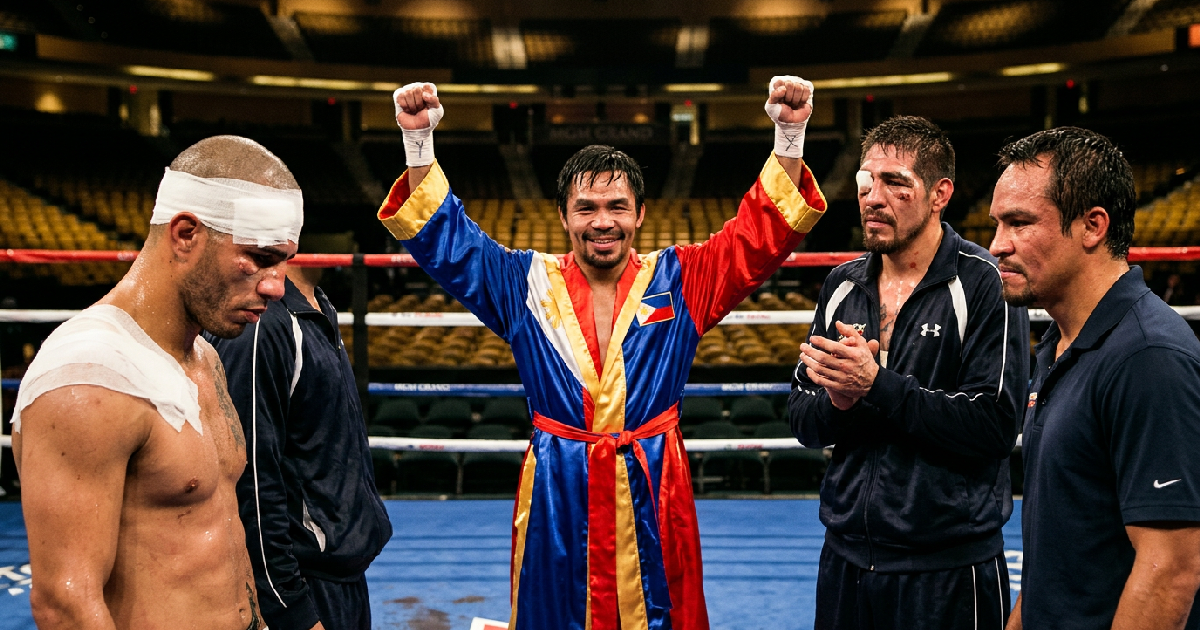
On November 14, 2009, Manny Pacquiao met Miguel Cotto at the MGM Grand Garden Arena for the WBO welterweight championship. The bout was contested at a 145-pound catchweight, a move designed to bridge the gap between two of the era’s most bankable stars. Cotto, a four-division world champion from Puerto Rico, entered the ring with a reputation for punishing pressure and a refined boxer-puncher style.
Pacquiao utilized his superior lateral movement and hand speed to dismantle Cotto, sending the Puerto Rican boxer to the canvas in both the third and fourth rounds. As the fight progressed into the championship segments, Cotto’s face showed visible damage from the volume of accurate power punches.
Despite reports that his corner attempted to halt the slaughter after the 11th round, Cotto refused to quit and returned for the finale.
The referee ultimately ended the bout in the 12th round, awarding Manny Pacquiao a victory by technical knockout. This win was a milestone in boxing history, as it officially made Pacquiao the first fighter to win world titles in seven different weight divisions. This achievement confirmed that his offensive tools translated perfectly to the 147-pound ranks, where his speed remained his most dangerous asset.
Overcoming the massive size of Antonio Margarito
The physical disparity in Pacquiao’s career reached its peak on November 13, 2010, when he faced Antonio Margarito at AT&T Stadium in Texas. They fought for the vacant WBC super welterweight championship at a catchweight of 150 pounds. Pacquiao officially weighed in at 144.6 pounds, while Margarito hit the 150-pound limit, though the fight-night reality was far more lopsided.
On the HBO unofficial scale, Pacquiao weighed 148 pounds, but Margarito had reportedly ballooned to 165 pounds by the time he entered the ring. Despite giving up roughly 17 pounds to the “Tornado de Tijuana,” Pacquiao dominated the action from the opening bell. His agility allowed him to pepper the larger man with combinations, famously breaking Margarito’s orbital bone in the fourth round.
The judges handed down a lopsided unanimous decision with scores of 120-108, 118-110, and 119-109. This victory marked Pacquiao’s record-breaking eighth world title in an eighth weight division. The fight was also clouded by the shadow of Margarito’s previous hand-wrapping scandal, a controversy that added a bitter edge to the rivalry.
Such high-risk encounters highlight the physical toll of the sport, a topic Oleksandr Usyk recently addressed when discussing long-term health concerns in modern boxing.
A history of technical battles with Marquez
The first fight between Juan Manuel Marquez and Manny Pacquiao remains a study in championship resilience. After the early knockdowns in the first round, Marquez’s ability to stabilize the fight changed the trajectory of Pacquiao’s career. The split draw (115-110 Pacquiao, 115-110 Marquez, and 113-113) ensured that their names would be forever linked in a saga of four professional meetings.
Marquez’s counter-punching prowess provided the ultimate stylistic foil to Pacquiao’s aggression. Every time they met, the margins were razor-thin, often leading to debate over the official scorecards. This rivalry, unlike the one-sided finishes against Cotto or the physical dominance over Margarito, was a pure chess match where any mistake could lead to a knockout.
In many ways, Marquez was the opponent who most successfully decoded the footwork and rhythm that made Pacquiao legendary.
The lasting impact of the Pacquiao rivalry era
Manny Pacquiao’s success across multiple decades was forged in the fire of these specific rivalries. By facing elite champions like Cotto, Margarito, and Marquez, he demonstrated a willingness to test his limits against diverse styles and sizes. These bouts proved that a smaller, faster fighter could dictate the terms of a fight even when significantly outweighed or facing a master technician.
The legacy of these three rivalries continues to influence how modern boxing analysts evaluate greatness. Pacquiao did not just win titles; he engaged in repeated, high-quality matches with close outcomes and intense emotional peaks. His journey through the divisional ranks remains a blueprint for fighters seeking to prove their status as pound-for-pound greats.
Even today, the records he set against these men remain the standard by which all multi-division champions are judged.