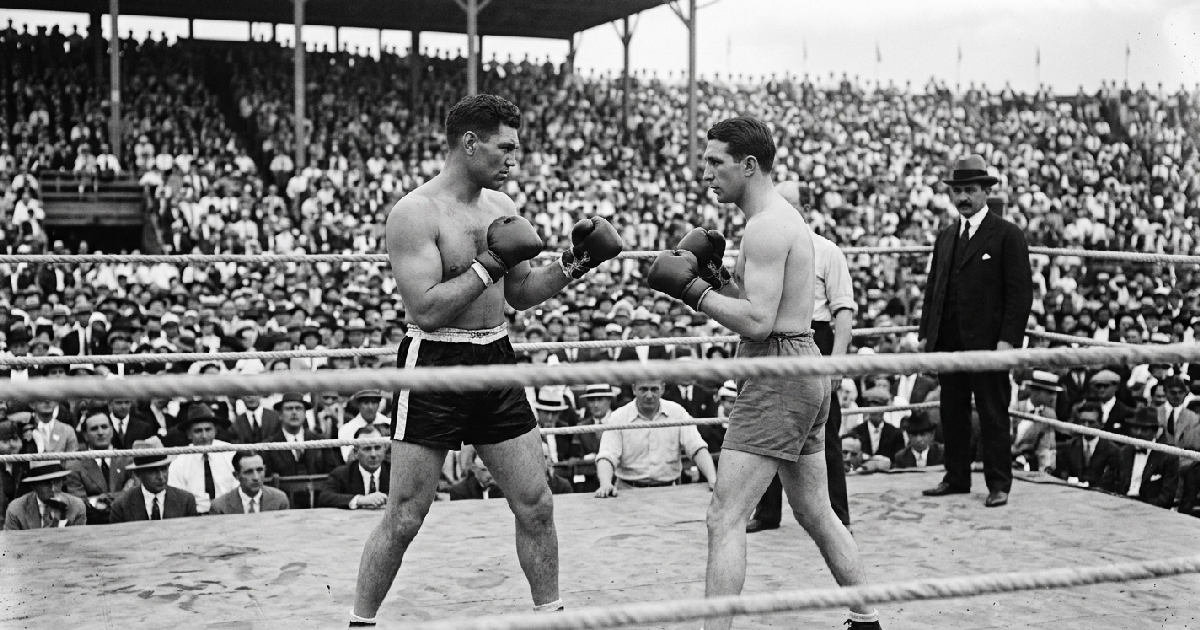
Jack Dempsey vs. Georges Carpentier took place exactly 105 years ago today on July 2, 1921, forever altering the commercial trajectory of professional sports. The heavyweight championship bout at Boyle’s Thirty Acres in Jersey City, New Jersey, remains a watershed moment as the first event to generate a “million-dollar gate.”
Promoter Tex Rickard capitalized on a post-war public hungry for spectacle, turning a boxing match into a global cultural phenomenon.
Tex Rickard and the birth of the million-dollar gate
The “Manassa Mauler,” Jack Dempsey, entered the ring as the 26-year-old reigning heavyweight champion making his third title defense. Across from him stood Georges Carpentier, the 27-year-old French hero known as “The Orchid Man” who held the world light-heavyweight title. While the physical contest ended in a fourth-round knockout, its success established the template for every major pay-per-view event in the modern era.
Before the summer of 1921, no sporting event in history had ever generated seven figures in ticket revenue. Tex Rickard shattered this ceiling by producing a total gate of $1,789,238, an astronomical figure that proved boxing could thrive as a mainstream entertainment business. This financial success was rooted in a pricing strategy that targeted both the working class and the wealthy elite.
Ticket prices for the afternoon event ranged from $5 to $50, making ringside seats a luxury accessible only to the upper echelons of society. A ticket stub for Row X of the “Outer Circle” cost $25, which represented a significant portion of a monthly wage for many laborers in 1921.
Despite these high costs, the public demand was so intense that Rickard expanded his seating plans multiple times.
The purses paid to the fighters reflected this new economic reality and set a standard for future generations. Jack Dempsey earned $300,000 for the afternoon, while Georges Carpentier received a purse of $200,000. Both men also secured a 25% share of the motion picture and broadcast rights, a move that foreshadowed the modern era of athlete-driven media revenue.
Constructing the wooden colossus at Boyle’s Thirty Acres
Tex Rickard understood that a mega-fight required a venue of appropriate scale to maximize his profit margins. Because no existing arena could hold the anticipated crowd, he commissioned the construction of a temporary wooden stadium in Jersey City. This octagonal structure, built on a plot of marshland owned by John F. Boyle, covered roughly seven acres of land.
The logistics of the project were massive, requiring 2,250,000 feet of lumber and 60 tons of nails to complete. A workforce of 500 carpenters and 400 laborers began construction on April 28, 1921, finishing the structure just days before the first bell. The stadium was situated around Montgomery Street and Cornelison Avenue to allow easy access for fans traveling from nearby New York City.
The final row of bleachers sat 34 feet above the ground, forcing some spectators to watch from 312 feet away from the center of the ring. This temporary marvel demonstrated that promoters could manufacture their own environments to bypass the limitations of traditional venues. This audacity mirrors how a modern Usyk-Rico Egypt bout deemed historic creates a custom stage for the global sporting public.
Marketing the war hero against the Manassa Mauler
Rickard successfully marketed the bout by leaning into the contrasting public reputations of the two participants. Georges Carpentier was presented as a dashing and courageous figure, a decorated veteran of World War I. He had earned both the Croix de Guerre and Médaille Militaire for his military service, making him a symbol of international bravery and charm.
Jack Dempsey, however, served as the narrative’s “anti-hero” due to lingering public controversy over his personal life. The champion had faced fierce criticism and a trial regarding allegations of draft evasion during the war, coupled with a highly publicized divorce scandal. Rickard used these biographical details to create a “good versus evil” storyline that compelled the public to take a side.
This psychological framing ensured that the 300,000-square-foot facility reached its full capacity on fight day. Even today, an astute fighter or promoter recognizes that a compelling narrative is often as important as the physical preparation in the gym. By positioning the fight as a clash of character and national pride, Rickard turned a sporting contest into a mandatory social event.
Breakdown of the 10-minute championship battle
The physical disparity between the two champions became evident as soon as they stood in the 20-foot square ring. Jack Dempsey weighed in at 188 pounds, giving him a 16-pound advantage over the 172-pound Georges Carpentier. The champion was a 2-to-1 favorite to retain his title using his trademark “Manassa Mauler” style of relentless pressure and body punching.
Despite the size difference, Carpentier provided a moment of high drama during the second round of the contest. He landed a sharp right hand that visibly staggered Dempsey, briefly convincing the 80,000 fans in attendance that an upset was possible. However, the force of the blow broke Carpentier’s right thumb in two places and strained his wrist, neutralizing his primary weapon.
Dempsey regained control in the third round by cutting off the ring and punishing the smaller man with heavy hooks to the ribs. The physical contest ended at 1 minute and 16 seconds of the fourth round when Dempsey dropped the challenger with a final combination.
Key details
This meant the total duration of the action lasted exactly 10 minutes and 16 seconds before Referee Harry Ertle completed the count.
Technical skill versus physical power
The fight remains a classic case study in how natural size often overcomes superior technical boxing ability. Many observers noted that Carpentier possessed faster hands and more fluid movement during the opening minutes of the bout. However, once Dempsey survived the second-round scare, he used his 16-pound advantage to wear down the Frenchman’s resistance through physical clinch work and body shots.
This dynamic is frequently discussed in modern boxing when smaller, highly skilled fighters move up in weight classes to challenge established champions. Analysts often point to bouts where technical skill was negated by the sheer durability and strength of a naturally larger opponent. Dempsey’s victory on July 2 confirmed that his aggressive style was a nightmare for anyone giving away nearly 20 pounds of weight.
Broadcasting and the largest radio audience in history
Innovation at Boyle’s Thirty Acres extended beyond the stadium walls and into the emerging world of mass media. This was the first world heavyweight title fight to be carried over live radio airwaves. An estimated 300,000 to 350,000 people listened to the broadcast, making it the largest radio audience ever recorded at that time.
Radio stations nationwide received updates and relayed the blow-by-blow action to crowds gathered around receivers in parks and town squares. This technological leap allowed the fight results to reach a global audience in real-time, rather than through next-day newspapers. It proved that live broadcasting could create a shared national experience and vastly increase the value of a single event.
The success of the radio experiment also highlighted the massive potential of media rights in professional sports. Both Dempsey and Carpentier recognized this early, ensuring they received 25% of the motion picture and broadcast earnings in their contracts. This foresight laid the groundwork for the multi-billion-dollar streaming and television deals that define the boxing industry in 2026.
Establishing the template for the modern mega-fight
When Jack Dempsey stood victorious over a fallen Georges Carpentier 105 years ago, he signaled the end of boxing’s era as a niche pastime. The “Fight of the Century” proved that high-stakes storytelling and massive infrastructure could produce record-breaking profits for all involved. Tex Rickard had successfully turned a brutal sport into a respectable and lucrative commercial juggernaut.
The legacy of this July afternoon remains visible in every stadium-filling promotion held in Las Vegas, London, or Riyadh today. The use of custom-built venues, celebrity-driven marketing, and live media distribution all trace back to Boyle’s Thirty Acres. It was the day the boxing business was born, setting a standard of excellence that has lasted for over a century.
As the sport reflects on this 105-year anniversary, the image of the Manassa Mauler and the French war hero remains iconic. Their clash was not just a title defense but a pivotal moment in the history of human entertainment. Jack Dempsey and Georges Carpentier provided the world with its first true mega-fight, forever changing how we watch and value professional sports.