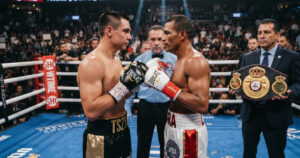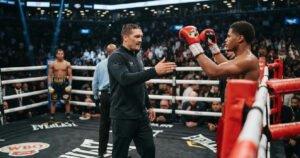

Irish heavyweight Kevin McBride has revealed that the physical impact of Mike Tyson punching power remains vivid more than two decades after their June 2005 encounter. McBride, who stopped Michael Gerard “Mike” Tyson in the 6th round of the legend’s final professional bout, shared that the New York native’s strength was unlike anything he ever faced in the ring.
The veteran fighter’s reflections come as the boxing world continues to evaluate the long-term legacy of the man known as “Iron Mike.” Following Tyson’s 60th birthday on June 30, 2026, his former rivals are speaking out about the enduring nature of his physical gifts. McBride remains a central figure in this narrative as the last man to officially defeat Tyson in a professional contest.
Kevin McBride recalls the impact of Mike Tyson punching power
Speaking to Bloody Elbow, Kevin McBride made it clear that the force generated by the former champion was “unbelievable.” He noted that even though their fight occurred more than 20 years ago, the memory of those punches remains etched in his physical consciousness. McBride suggested that while other attributes fade, pure force stays with a fighter until the very end.
“Mike Tyson’s power is unbelievable,” McBride stated during the interview. “I still feel it to this day… He hits so hard and power is the last thing to go.” This sentiment highlights why Tyson remained a feared opponent even as he faced difficulties during the back end of his career.
The Irishman’s victory in 2005 is often remembered as the moment the curtain closed on one of boxing’s most explosive eras. However, for McBride, the win was defined by the sheer blunt-force trauma he had to navigate to reach the 6th-round stoppage. He described the experience of being hit by Tyson as a historically significant event in his own career.
Key details
McBride drew a direct parallel between Tyson and other legendary heavyweights who maintained their strength into their later years. He specifically cited George Foreman’s famous victory over Michael Moorer as evidence that punching power does not evaporate with age. Foreman was slightly younger than Tyson is now when he reclaimed the world title, but the principle remains the same.
The Irish fighter argued that “power-wise,” Tyson represents one of the biggest punchers in the history of the sport. This physical longevity is a trait often discussed when analysts consider an Andy Ruiz Jr. ring return or other heavyweight comebacks. The ability to change a fight with one shot is a unique characteristic of the division’s elite.
For McBride, surviving those shots was a testament to his own durability. He noted that Tyson’s ability to shift weight and deliver concussive force remained dangerous long after his peak speed had declined. This enduring threat is what kept fans and promoters interested in Tyson for decades after his undisputed reign ended.
Dominance of the youngest heavyweight champion in history
To understand the gravity of McBride’s comments, one must look at the foundation of Tyson’s career in the 1980s. Michael Gerard “Mike” Tyson rose to prominence as a terrifying force of nature, combining speed with a thunderous fighting style. He effectively redesigned the expectations for what a heavyweight champion could be.
The world first took notice when Tyson knocked out Trevor Berbick in the 2nd round of their showdown on November 22, 1986. The fight, held at The Hilton in Las Vegas, allowed Tyson to capture the WBC heavyweight title. At that moment, he became the youngest world champion the division had ever seen, a record that still stands.
His era of dominance only intensified from there. Tyson added the WBA and IBF heavyweight titles to his collection with victories over James Smith and Tony Tucker. He achieved undisputed status just days after his 21st birthday, cementing his place as the most feared man in combat sports.
Key details
The victories over James Smith and Tony Tucker were essential in establishing the “Iron Mike” persona. Smith was known for his durability, yet he could not find an answer for Tyson’s relentless pressure and explosive hooks. By the time Tyson faced Tucker, he had become a global phenomenon whose fights were mandatory viewing.
These early performances established the “unbelievable” power that McBride would eventually feel two decades later. The mechanics of Tyson’s style relied on generating massive leverage from a compact frame. Even as he aged, the basic physics of his punching remained a significant problem for anyone standing across from him.
During this period, Tyson was rarely pushed past the opening rounds. His ability to finish fights early became his trademark. This history of early knockouts is what made McBride’s ability to reach the 6th round in 2005 such a notable achievement for the Irish contender.
Analyzing why power remains the final attribute to fade
The boxing world has long accepted the adage that “power is the last thing to go.” As Tyson transitioned into his 60th year, this theory has been tested through his various returns to training and exhibition matches. McBride’s testimony suggests that the physical sensation of being hit by Tyson does not change much over time.
In many ways, the career trajectories of legendary heavyweights show a similar pattern regarding physical decline. Fighters often lose their footwork and cardiovascular endurance long before their hands lose their “sting.” This reality is a frequent topic in discussions regarding the Canelo retirement outlook and how different weight classes age. In the heavyweight realm, the stakes remain high because of the sheer mass involved.
McBride believes that Tyson’s punch is historically significant, comparable to the most famous power-hitters in the history of the ring. He argued that the natural heavy-handedness Tyson possessed was a gift that transcended training. It was a raw, physical attribute that stayed with him through his various personal and professional difficulties.
Key details
The June 2005 bout remains one of the most discussed “sunset” fights in boxing history. Tyson started the match with his typical aggression, but McBride’s size and resilience eventually began to wear him down. As the rounds progressed, it became clear that Tyson’s stamina was failing, even if his punches still carried weight.
By the time the 6th round concluded, Tyson was a fatigued and frustrated figure. He chose not to come out for the 7th round, effectively ending his professional career on his own terms. McBride had survived the storm, but he walked away with a permanent respect for the man he had just retired.
The Irishman has often described that night as the pinnacle of his life in the sport. He was not just a participant; he was the final witness to the professional iteration of the Tyson aura. The bruises may have healed, but the memory of the “Iron Mike” force remains a part of his daily life.
From the 2005 retirement to the 2024 return
The legend of Tyson’s power was put to a modern test in November 2024. Tyson made a sensational return to the ring at the AT&T Stadium in Arlington, Texas, to face former YouTube personality Jake Paul. The bout was one of the most controversial events in recent boxing history, drawing a massive global audience.
While Jake Paul ultimately won the fight on points, the contest showed that the nearly 60-year-old Tyson still possessed flashes of his old self. Paul later commented on the difficulty of navigating Tyson’s defense and the respect he had for the veteran’s strength. The event proved that the “Mike Tyson” name still carries immense weight in the sports market.
McBride watched the 2024 return with the unique perspective of someone who had been in the trenches with Tyson. He saw the same explosive movements, albeit at a slower pace, that he had encountered in 2005. It validated his claim that the “unbelievable” power had never truly left the New York native’s hands.
Key details
Today, Mike Tyson’s legacy is defined as much by his longevity as it is by his early dominance. He transitioned from being the youngest champion in history to a cultural icon who could still fill stadiums in his late 50s. For Kevin McBride, the personal connection to that legacy is found in the physical reminders of their clash.
The Irish fighter’s role in boxing history is secure as the man who saw the end of the Tyson era. He represents a generation of heavyweights who had to measure themselves against the most intimidating presence the sport has ever known. His story is a reminder that in boxing, the impact of a punch can last a lifetime.
As the sport moves forward into 2026, the stories of men like McBride remain vital. They provide a human perspective on the legends who shaped the modern game. For McBride, the 2005 fight was not just a win on a record; it was a physical encounter that he continues to feel more than 20 years later.