
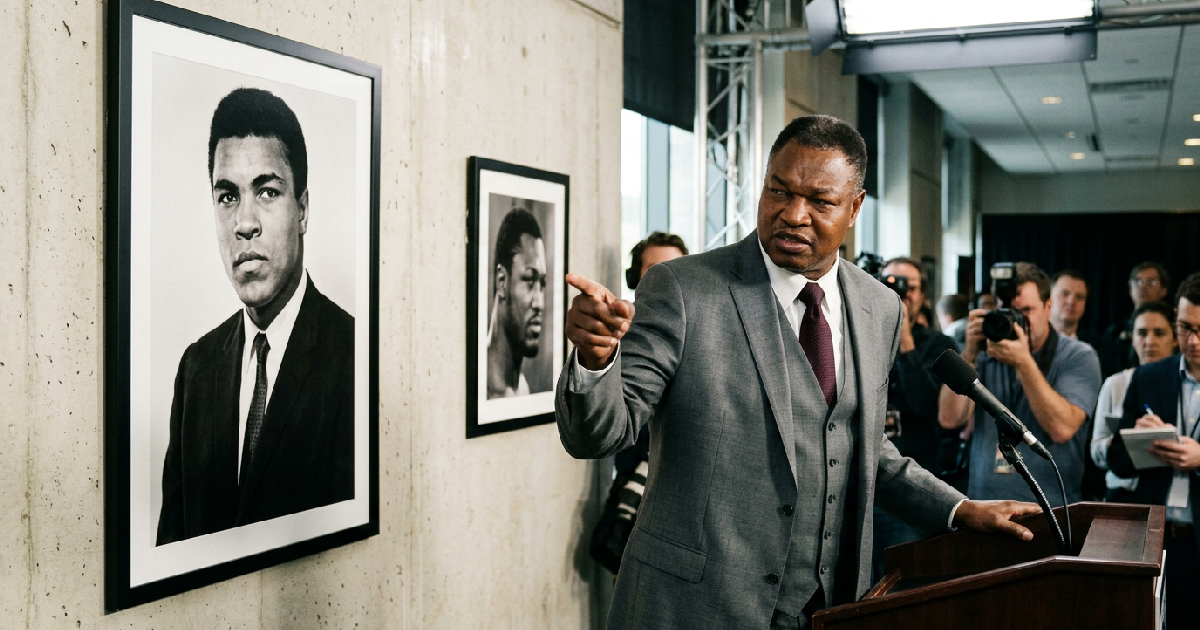
Larry Holmes believes Mike Tyson would have struggled in the 1970s and early 1980s, stating today’s heavyweights would have defeated “Iron Mike.
During a revisited 1989 interview with Bryant Gumble, Larry Holmes specifically named legendary contemporaries Muhammad Ali, Joe Frazier, and Ken Norton as fighters who would have easily handled Mike Tyson had they competed in the same era.
Larry Holmes evaluates Mike Tyson against the heavyweight icons
Larry Holmes went so far as to suggest that Mike Tyson’s meteoric rise to global stardom was a byproduct of a weaker division rather than transcendent ability.
The comments from Larry Holmes carry a particular weight given the history between the two men, specifically their 1988 encounter where a peak Mike Tyson stopped a clearly faded Larry Holmes in four rounds.
At the time of that bout, Larry Holmes was 38 years old and had been lured out of retirement after two frustrating losses to Michael Spinks meant he fell one win short of matching Rocky Marciano’s 49-0 record.
For Larry Holmes, the defeat was the only knockout loss of his professional career, yet he has long maintained that the result was an indictment of his inactivity rather than Mike Tyson’s superiority.
This archival perspective highlights the enduring tension between the legends of the 1970s and the explosive power punchers who defined the late 1980s.
During the candid discussion with Bryant Gumble, Larry Holmes was asked how Mike Tyson would have fared against the titans of the previous decade. Larry Holmes was uncompromising in his assessment, telling the room that Mike Tyson would have essentially been a “nobody” if he had to fight through the gauntlet of the 1970s.
This era is widely regarded by boxing historians as the “Golden Age” of heavyweights, characterized by deep talent pools and frequent clashes between elite champions. Larry Holmes insisted that the technical skills and durability of his peers would have neutralized Mike Tyson’s aggressive, pressure-based style.
Specifically referencing the men in the room, which included Muhammad Ali, Joe Frazier, and Ken Norton, Larry Holmes stated that “everyone in this room would’ve been able to beat Mike Tyson.”
He went further to say that the world might never have even heard of the Brooklyn native had he been forced to contend with such a high level of competition.
Larry Holmes often points to the physical advantages and world-class jabs that defined his era as the specific tools needed to keep a fighter like Mike Tyson at bay. While Mike Tyson is remembered for his short-range power, Larry Holmes argues that those opportunities wouldn’t exist against the likes of Muhammad Ali.
The technical argument against Mike Tyson’s style
One of the primary reasons Larry Holmes dismisses Mike Tyson’s standing among the greats is the belief that “Iron Mike” relied too heavily on intimidation and raw athleticism.
In a division where fighters like Ken Buchanan were cited as benchmarks for boxing IQ, Larry Holmes felt the heavyweights of the 1980s lacked the technical nuance to solve Mike Tyson’s Peek-a-Boo defense.
Larry Holmes frequently highlights his own left jab—often cited as the greatest in the history of the sport—as a weapon Mike Tyson could not have overcome in his prime.
Larry Holmes stayed unbeaten between 1978 and 1985, a seven-year stretch where he defended his title 20 times against various styles. He believes that the heavyweights Mike Tyson faced during his undisputed title run were psychologically defeated before the first bell rang.
In contrast, the fighters of the 70s were battle-hardened by wars like the “Thrilla in Manila” or the grueling title defenses Larry Holmes sustained against Earnie Shavers and Ken Norton. The argument suggests that Mike Tyson lacked the “plan B” required when an opponent refused to fall early under his barrage.
Generational divides and the Michael Spinks variable
The credibility of Larry Holmes’ claims is often debated through the lens of his two losses to Michael Spinks. After 48 consecutive wins, Larry Holmes lost his IBF title to Michael Spinks in 1985 in what many considered a massive upset.
Michael Spinks, who had moved up from the light-heavyweight division, utilized movement and a high work rate to outpoint Larry Holmes. A contentious rematch followed, which Michael Spinks also won, effectively ending the first chapter of Larry Holmes’ legendary career and preventing him from achieving the elusive 49th victory.
When Mike Tyson eventually faced Michael Spinks in 1988, he obliterated the former champion in just 91 seconds. This performance is often used by Mike Tyson supporters to invalidate Larry Holmes’ criticisms.
However, Larry Holmes remains adamant that by the time he fought Michael Spinks or Mike Tyson, he was a shell of the fighter who had outclassed the division for years.
Just as Manny Pacquiao recently weighed in on the skill sets of his own rivals, Larry Holmes views the history of the heavyweight division as a sliding scale of evolving talent and physical decline.
The aftermath of the Tyson versus Holmes 1988 matchup
The 1988 fight between Larry Holmes and Mike Tyson took place at the Convention Hall in Atlantic City. At the time, Mike Tyson was the reigning undisputed champion, while Larry Holmes had been out of the ring for nearly two years.
The bout was promoted as a clash of eras, but it quickly became a showcase of youth over experience. Mike Tyson caught Larry Holmes with several crushing rights in the fourth round, dropping him three times before the referee signaled the end.
It remains the only time Larry Holmes failed to make it to the final bell in 75 professional fights.
Despite the emphatic nature of the loss, the “Easton Assassin” used the Bryant Gumble interview shortly thereafter to frame the defeat as circumstantial. He argued that the version of Larry Holmes that Mike Tyson encountered was biologically incapable of executing the strategy that would have worked in 1980.
This sentiment echoes throughout boxing history, where aging stars look at younger successors with skepticism. Larry Holmes eventually proved his longevity by returning to the ring in the early 90s, even challenging Evander Holyfield in a competitive 12-round affair in 1992.
Historical rankings and the consensus on heavyweight greatness
Modern boxing analysis generally places both Larry Holmes and Mike Tyson in the top ten heavyweights of all time, though for very different reasons. Larry Holmes is lauded for his longevity, his masterclass jab, and his ability to technicaly dismantle opponents over 15 rounds.
Conversely, Mike Tyson is celebrated for having perhaps the highest “peak” of any heavyweight in history, a period from 1986 to 1988 where he seemed invincible. The debate Larry Holmes sparked is essentially a question of whether a great technician can consistently beat a great puncher.
The names Larry Holmes listed—Muhammad Ali, Joe Frazier, and Ken Norton—all shared a common trait: they were willing to endure punishment to land their own shots. Larry Holmes believes Mike Tyson’s aura of invincibility would have crumbled against men who weren’t frightened of him.
While Terence Crawford and other modern stars often discuss the mechanics of retirement and legacy, Larry Holmes has spent his post-career years ensuring his era receives the respect he feels it earned.
He contends that Mike Tyson’s eventual loss to James ‘Buster’ Douglas in 1990 exposed the flaws that the 70s legends would have exploited much sooner.
It’s also important to note the physical evolution of the sport. Muhammad Ali and Larry Holmes were considered large heavyweights for their time, standing around 6’3″, whereas Mike Tyson was a compact 5’10”.
Larry Holmes argued that the reach advantage held by him and Muhammad Ali would have made it impossible for Mike Tyson to get inside. In the 1970s, fighters were often more seasoned, entering title fights with 30 or 40 bouts against top-tier contenders.
Larry Holmes suggests this level of experience would have provided the composure necessary to weather Mike Tyson’s early storm.
The lasting legacy of the Easton Assassin versus Iron Mike
Larry Holmes finally retired for good in 2002 at the age of 52, following a win over Eric “Butterbean” Esch. This ended a career that spanned nearly 30 years and multiple generations of heavyweight talent.
Mike Tyson’s career ended three years later in 2005 after a loss to Kevin McBride, concluding a much more turbulent journey through the sport. Despite Larry Holmes’ harsh words from the 1980s, both men are now enshrined in the International Boxing Hall of Fame—Larry Holmes in 2008 and Mike Tyson in 2011.
The rivalry of words serves as a reminder of how boxers view the timeline of their sport. To Larry Holmes, the heavyweights who followed Muhammad Ali were simply beneficiaries of a void left by the departure of the greatest generation.
To fans who grew up watching Mike Tyson, “Iron Mike” was a force of nature that no era could have contained. Larry Holmes’ comments to Bryant Gumble remain some of the most debated quotes in boxing history, highlighting the fundamental disagreement between those who value old-school craft and those who prize explosive power.
Ultimately, the “we’d all beat him” sentiment reflects the supreme confidence required to reach the top of the boxing world. Larry Holmes spent years in the shadow of Muhammad Ali, first as a sparring partner and later as the man who technically ended Muhammad Ali’s career in the ring.
Having survived the toughest era in the history of the division, Larry Holmes feels he earned the right to be critical. Whether his assessment of Mike Tyson is accurate or simply a product of generational pride, it continues to fuel the “fantasy matchup” discussions that keep the history of the heavyweight division alive.
As the sport looks toward a future involving undisputed clashes between the likes of Oleksandr Usyk and Tyson Fury, the debates of the past remain a yardstick for current performance. The 1970s heavyweight landscape set a standard for depth that Larry Holmes believes has never been replicated.
For him, Mike Tyson was a spectacular sprinter in a division that used to be populated by marathon runners. While the two icons have since shown mutual respect in their later years, the tactical debate regarding their primes remains as unresolved today as it was in 1989.