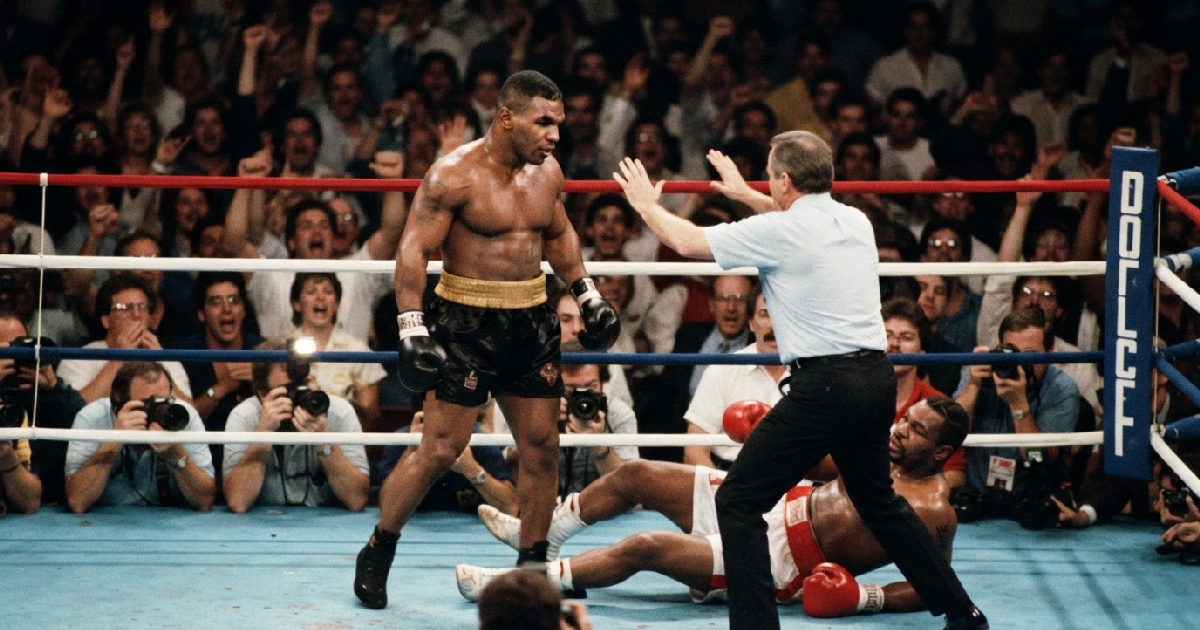
Mike Tyson defended his undisputed heavyweight championship against Carl Williams on July 21, 1989, with a 93-second knockout. Referee Randy Neumann’s quick stoppage ignited boos from the crowd and strong protests from Williams, who insisted he could continue.
This swift victory preserved Tyson’s formidable aura of invincibility for another seven months. That aura would ultimately shatter with his stunning upset loss to James “Buster” Douglas in Tokyo, marking a critical turning point in boxing history.
The controversial 93-second stoppage in the Mike Tyson Carl Williams fight
The fight began with Carl Williams attempting to establish his jab, a key strategy against Tyson’s relentless pressure. He worked to tie up the champion whenever Tyson closed the distance, aiming to neutralise “Iron Mike’s” famed power.
Barely more than a minute into the opening round, Tyson found his moment. Williams threw a left jab, which Tyson adeptly slipped, immediately countering with a crushing left hook. That punch landed flush on Williams’ jaw, sending him backward to the canvas.
Williams managed to rise by the count of eight, but he appeared unsteady, leaning against the ropes. Despite his efforts to signal readiness, referee Randy Neumann waved off the fight at 1:33 of the first round.
The abrupt conclusion drew a chorus of boos from the 11,000 fans in attendance, many of whom felt the fight was stopped prematurely. Williams vociferously protested the decision, arguing he was capable of continuing the bout, and his camp later pursued an unsuccessful bid for a rematch.
Tyson’s Reign: Unifying the Heavyweight Division
Leading into the contest, Mike Tyson stood as the undisputed king of the heavyweight division, holding all major championships. He was defending the WBA title for the eighth time, the WBC crown for the ninth, the IBF belt for the sixth, and The Ring championship for the second.
His prior fight saw him secure a dominant victory over Frank Bruno, further solidifying his status as a seemingly unstoppable force. Tyson’s early career had been a whirlwind of knockouts, making his professional debut at 18 on March 6, 1985, and winning his first 19 fights by TKO, 12 in the first round.
He had famously become the youngest heavyweight champion in history at just 20 years and 4 months old on November 22, 1986, by defeating Trevor Berbick for the WBC title. By 1987, he had unified the WBA, WBC, and IBF titles, a feat that cemented his position at the pinnacle of the sport from 1987 to 1990.
Carl Williams’ Path to the Title Shot
Carl “The Truth” Williams, standing 6 feet 4 inches tall with an impressive 85-inch reach, earned his shot at Tyson the hard way. His physical attributes and a potent jab were seen as his best weapons against Tyson’s aggressive style.
Williams had secured his position as the IBF’s number one contender through a series of hard-fought victories. This included a significant unanimous decision win over Trevor Berbick in 1988, a performance that propelled him into the title picture.
He had also gone the distance with former champion Larry Holmes in a controversial 15-round unanimous decision loss on May 20, 1985. Many observers felt Williams had done enough to win that contest, underscoring his resilience and skill against elite competition.
Williams, born November 11, 1959, in Belle Glade, Florida, was nicknamed “The Truth” early in his career, with some attributing it to his straightforward fighting style. He debuted professionally on January 22, 1982, and entered the Tyson fight with a record of 22 wins and 2 losses.
Financial Stakes and Fan Reaction
Promoted by the flamboyant Don King and televised by HBO, the championship bout attracted approximately 11,000 boxing enthusiasts to Convention Hall. Despite the star power, this event generated a considerably smaller gate than some of Tyson’s earlier blockbuster title defenses.
Financially, the fight was still a significant earner for both combatants. Mike Tyson reportedly took home approximately $5 million for his efforts. Carl Williams, as the challenger, received a substantial sum of roughly $1.2 million, a testament to the drawing power of a Tyson fight.
Ringside tickets for the event commanded a price of $500. Even with the lucrative payouts, the crowd’s vocal disapproval of the stoppage highlighted a tension between expectation and reality, particularly given Tyson’s reputation for devastating, drawn-out performances.
The Lasting Impact and Tyson’s Shifting Narrative
The controversial stoppage against Carl Williams served as Mike Tyson’s final successful defense of his undisputed championship. It solidified his record as one of the quickest heavyweight title fights in history, yet it also sowed seeds of doubt and discussion.
Seven months later, on February 11, 1990, Tyson suffered one of boxing’s greatest upsets when James “Buster” Douglas dethroned him in Tokyo. The Williams fight, despite its brevity, underscored Tyson’s explosive power and his capacity for rapid finishes, even if the circumstances were debated.
The fight also marked a point where the scrutiny on Tyson, both inside and outside the ring, was intensifying. His management under the legendary trainer Cus D’Amato and Kevin Rooney eventually gave way to the promotional prowess of Don King, influencing his trajectory.
For Carl Williams, who tragically passed away on April 7, 2013, at age 53 from complications of throat cancer, this fight remained a defining moment. It was his second and final shot at a major world title, and the disputed ending lingered as a what-if in his career narrative, preventing him from ever securing that coveted rematch.
While some argue Randy Neumann, a former professional heavyweight himself, acted to protect a clearly dazed fighter, others believe Williams deserved the chance to continue. This brief, powerful encounter remains a highly discussed chapter in the illustrious and often turbulent career of Mike Tyson.