
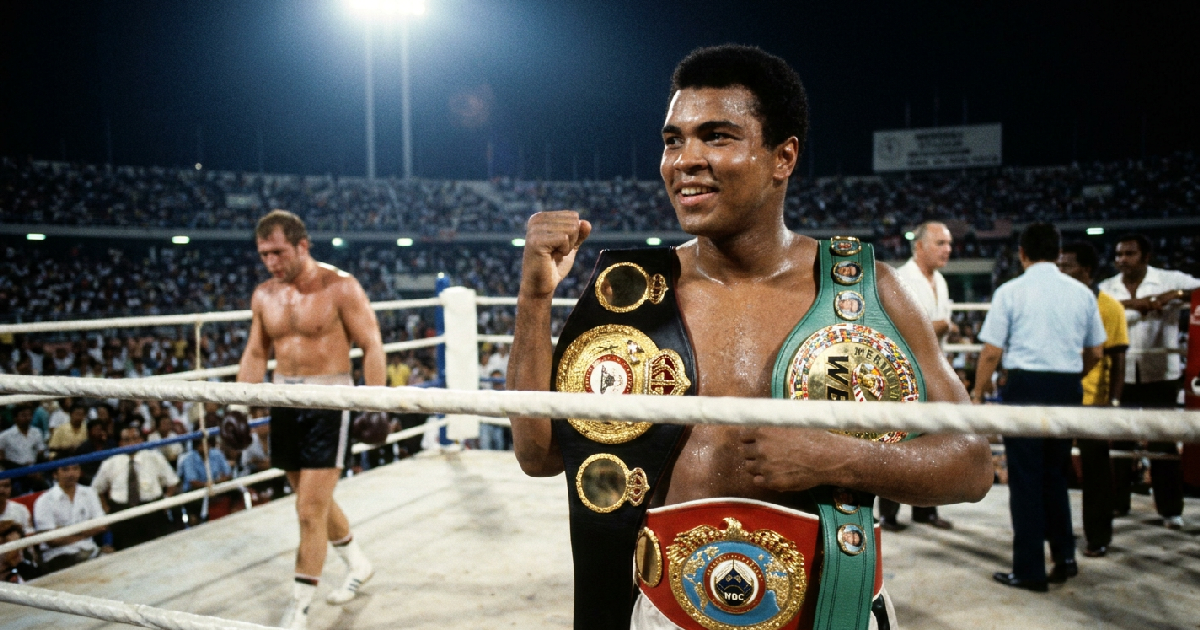
On June 30, 1975, Muhammad Ali successfully defended his undisputed world heavyweight championship against Joe Bugner at Merdeka Stadium in Kuala Lumpur, Malaysia, securing a 15-round unanimous decision victory.
The bout remains the only world heavyweight title fight ever held in the Southeast Asian nation, featuring the 33-year-old champion keeping his hold on the WBA, WBC, and The Ring belts.
The Muhammad Ali vs. Joe Bugner heavyweight bout
Despite a spirited effort from the younger, larger challenger, Muhammad Ali used his superior ring generalship and precision punching to outwork the durable European champion in sweltering tropical heat.
The fight served as the third successful defense of the championship Muhammad Ali had reclaimed from George Foreman just eight months prior in the “Rumble in the Jungle.”
While the contest went the full distance without a single knockdown, the scorecards from referee Takeo Ugo and judges Ken Brady and Suthee Prom Jara reflected a clear margin of victory.
Moving with more fluidity than in some of his later outings, the champion relied on his classic jab-and-move style rather than the “rope-a-dope” strategy that had defined his win over Foreman. This was his 50th professional fight, a career milestone reached while still at the pinnacle of the sport.
The logistics of the 1975 bout were as remarkable as the fight itself. To accommodate prime-time viewing audiences in the United States, the event was held in the mid-afternoon, around 2:00 PM local time.
Key details
While June 30 is the most frequently cited date in official records and scorecards, some sources note the time difference meant it was July 1 locally.
This unusual timing forced the athletes to contend with the peak intensity of the Malaysian sun, with temperatures at the open-air Merdeka Stadium estimated to reach 104 degrees Fahrenheit (40 degrees Celsius).
Muhammad Ali arrived in the country nearly three weeks early, on June 11, to a reception that rivaled his legendary welcome in Zaire. Estimates suggest that 25,000 fans gathered at Subang International Airport just to see the champion step off his plane.
During his stay, he occupied 72 rooms on three floors of the Kuala Lumpur Hilton, using the Presidential Suite as his base. He split his training between Stadium Negara and the Selangor Turf Club at Jalan Lumba Kuda, while Joe Bugner prepared at Lake Gardens.
This period reflected the trend of
Usyk-Rico Egypt bout deemed historic
, where major champions took the sport to non-traditional global markets.
Challenger Joe Bugner and his pursuit of the crown
Joe Bugner entered the ring as the WBC’s number-two-ranked contender and the reigning European champion. At 25 years old, he was eight years younger than the 33-year-old Muhammad Ali and possessed a one-inch height advantage.
Having fought the champion once before in 1973—a 12-round decision loss in Las Vegas—Joe Bugner was not intimidated by the aura of the man across from him. He entered the ring at 230 pounds, outweighing the champion, who tipped the scales at 224.5 pounds.
However, Joe Bugner’s legacy has often been tied to his durability rather than his aggression. Much like how Roberto Duran identified the smartest fighter he ever faced, historians point to Joe Bugner as one of the most difficult men to stop in heavyweight history.
He took everything the champion threw—sharp flurries and punishing jabs—without ever touching the canvas. This durability had also seen him go the full distance with Joe Frazier, though his lack of offensive output in Kuala Lumpur ultimately cost him the decision.
Analysis of the 15-round tactical battle in Kuala Lumpur
The fight began with Muhammad Ali flicking out his jab to keep the larger Joe Bugner at bay. While the champion’s hand speed was beginning to show the first signs of wear, his accuracy remained elite. He consistently beat Joe Bugner to the punch, finding gaps in the challenger’s guard.
By the mid-rounds, the heat had begun to take a toll on both men, leading to more frequent clinching. Muhammad Ali used these moments to rest and apply psychological pressure, while Joe Bugner struggled to mount a consistent attack.
The scoring reflected a systematic breakdown of the challenger’s defense. Referee Takeo Ugo of Japan saw the fight 73-67 for Muhammad Ali, while judge Ken Brady had it 72-65. The third official, Suthee Prom Jara, turned in a score of 73-65.
Key details
These totals highlighted that while Joe Bugner remained competitive, he rarely did enough to win rounds. The champion’s superior volume and movement were the deciding factors. In later years, Terence Crawford noted that top stars often find ways to win even as they age, a trait Muhammad Ali displayed perfectly in the heat of Malaysia.
The victory earned Muhammad Ali a reported purse of $2 million, while Joe Bugner collected $500,000. The promotion, spearheaded by Tinju Dunia, put up a total of $2.5 million in prize money. Almost 700 million people watched the broadcast across 46 countries, with the fight reaching audiences in 60 countries via closed-circuit television.
This massive global reach solidified the bout as a landmark event in sporting history before the champion moved on to his next legendary encounter.
Historical weight of the Malaysia bout in the Ali legend
Ranked within the context of Muhammad Ali’s career, the victory over Joe Bugner is often overshadowed by the larger-than-life battles that bookended it. It occurred eight months after he defeated George Foreman and just three months before the “Thrilla in Manila.”
Following the decision in Kuala Lumpur, Muhammad Ali flew to Sabah for several days of rest before beginning his training camp for that third meeting with Joe Frazier. As a result, many historians view the Malaysia fight as a stay-busy defense, though Joe Bugner was a legitimate top-ranked contender.
For Malaysia, the event left an indelible mark on its sporting history. While the nation has seen recent announcements for various regional championships, it has never again seen the undisputed heavyweight championship contested within its borders.
Merdeka Stadium stands today as a monument to that 1975 afternoon when 22,000 spectators watched the world’s most famous athlete defend his crown.
Joe Bugner, who died on September 1, 2025, at the age of 75, would eventually move to Australia and win a version of the world title at age 48, but his resilient effort against Muhammad Ali remains a career-defining performance.