
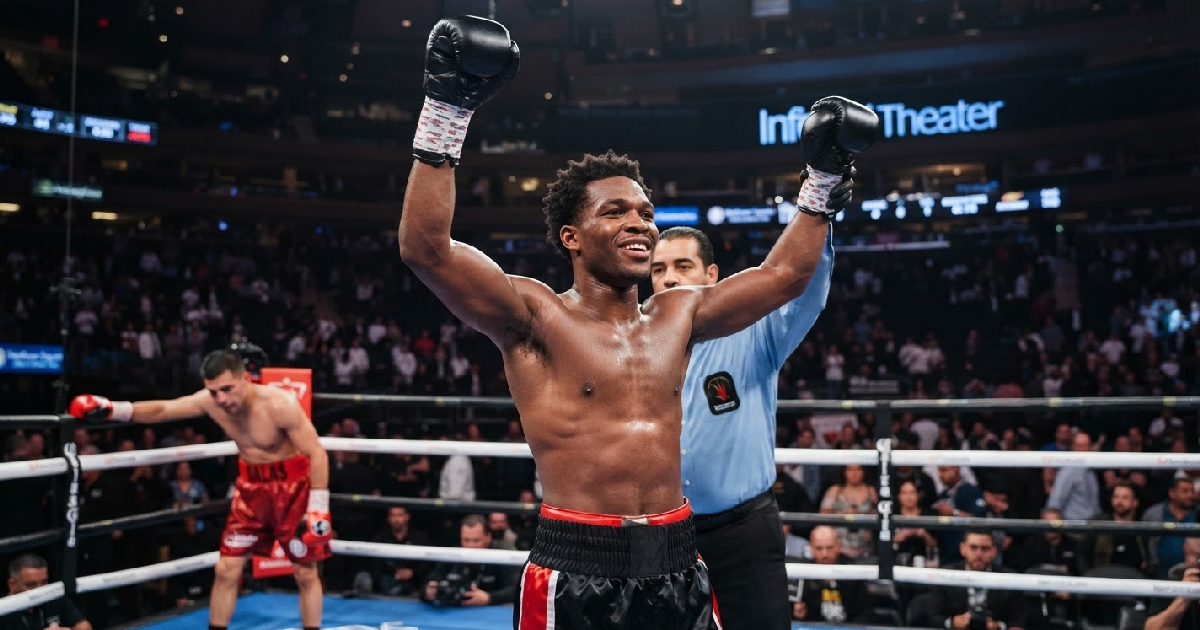
Richardson Hitchins, the 28-year-old former IBF light welterweight champion from Brooklyn, New York, made a highly successful welterweight debut on Sunday, July 26, 2026. He secured a decisive unanimous decision victory over Ricardo Salas, 27, of Mexico City, at Zuffa Boxing 09 held at the Infosys Theater at Madison Square Garden in New York City.
All three judges scored the 10-round co-main event 100-90 in Hitchins’ favour, marking a clean sweep in his first fight at 147 pounds.
Hitchins’ masterful welterweight debut
This dominant performance signals a significant career transition for Hitchins, known by his alias “Africa,” who vacated his IBF super lightweight title due to persistent difficulties with the 140-pound weight limit. The bout also marked his first appearance under the Zuffa Boxing banner, adding another layer of intrigue to his move into the welterweight division.
He proved he can control a fight and dictate terms even against a naturally aggressive opponent.
From the opening bell, Richardson Hitchins established his signature style, relying heavily on a sharp jab and disciplined defensive movement to control the distance. Ricardo Salas, nicknamed “Magic Man,” consistently pressed forward, attempting to land body shots and close the gap. However, each of his advances was met with a stiff jab, a precise straight right, or a timely clinch, effectively neutralising his offence.
Dominant performance against Salas
The judges, Max DeLuca, Ken Ezzo, and Frank Lombardi, all scored the fight identically, reflecting Hitchins’ complete control over every round. He used his footwork to keep Salas chasing, while his effective shoulder-roll defence caused many punches to miss their mark entirely. Salas, with his prior 75% knockout percentage, struggled to find any rhythm or land clean, impactful blows against the elusive Hitchins.
Hitchins’ tactical brilliance stifled Salas, who boasted a respectable 24-2-2 record before this fight. The Mexican boxer found himself unable to build any sustained offence. This methodical approach, while effective, did lead to some stretches with reduced action, but it ultimately delivered a flawless victory for the Brooklyn native.
Navigating an undisclosed injury
Despite his commanding performance, Hitchins later revealed a significant challenge he faced during the bout. An injury to his right hand, sustained in training camp, began bothering him around the sixth round. This adds another dimension to his ability to maintain control and execute his game plan for the duration of the fight.
Even with the right-hand issue, Hitchins never appeared overtly troubled or compromised. He remained committed to boxing safely from the outside, choosing a low-risk strategy over taking unnecessary chances for a knockout.
strategic shift to 147 pounds
Hitchins’ decision to move up to the welterweight division wasn’t made lightly; it came after vacating his IBF super lightweight title. The physical toll of making the 140-pound limit had become too arduous. This strategic move to 147 pounds aims to allow him to compete more comfortably and sustainably.
The challenge of weight cuts
Weight cutting is often one of the toughest battles for professional boxers, sometimes proving more taxing than the fight itself. Hitchins’ experience highlights a common dilemma for athletes reaching the elite level. Moving up ensures better health and potentially greater longevity in the sport, allowing him to focus purely on performance.
By moving up, Hitchins joins a notoriously stacked welterweight division. His technical skill set, however, suggests he could be a challenging puzzle for many of the division’s top contenders. It’s a move many analysts see as both necessary and promising for his future.
Implications for his career path
This successful debut solidifies Hitchins’ presence in a new weight class, opening doors to fresh challenges and high-profile matchups. His undefeated record now stands at 21-0 with 8 knockouts. This smooth transition could accelerate his path to another world title shot, but at a more comfortable fighting weight.
Such strategic moves are not uncommon in boxing, as seen with other fighters adjusting their divisions for optimal performance.
Zuffa Boxing 09 card delivers drama
Hitchins’ dominant showing was a key part of an action-packed Zuffa Boxing 09 event at Madison Square Garden. The card featured a mix of established names and rising talents, offering fight fans a comprehensive evening of boxing. The event began with preliminaries at 5:00 PM ET, with the main card kicking off at 8:00 PM ET.
Co-main event highlights
While Hitchins delivered a clinical performance, the main event of the evening saw Edgar Berlanga take on Steven Butler in a super middleweight clash. Berlanga ultimately secured a TKO victory over Butler in the seventh round at 1:14. This provided the knockout action that often draws in casual viewers, contrasting with Hitchins’ more technical display.
The co-main event, Hitchins vs. Salas, showcased a different kind of boxing mastery. It was a testament to defensive skill and ring generalship. For those appreciating the sweet science, it was a compelling demonstration of how to win rounds without necessarily pursuing a brutal finish.
Other notable bouts
The Zuffa Boxing 09 card also featured several other significant contests. In the middleweight division, Jalil Hackett defeated Sergiy Derevyanchenko via unanimous decision, with scores of 98-92, 97-93, and 96-94. This upset highlighted Hackett’s potential against a seasoned veteran. Another exciting finish came in the heavyweight division, where Vladyslav Sirenko knocked out Otto Wallin in the tenth round at 2:59.
Additionally, Andres Sosa earned a unanimous decision victory over Dominique Francis in their super featherweight bout, with judges scoring it 79-72, 78-73, and 77-73. Such results underscore the competitive nature of these events. Fighters often make strategic decisions that impact their careers, much like Jon Jones’ boxing debut discussions have captured headlines in recent times.
future prospects
After such a commanding welterweight debut, speculation immediately turned to who Richardson Hitchins might face next. He didn’t shy away from expressing his ambition to challenge top contenders in the division.
Aiming for top contenders
These ambitions indicate Hitchins’ desire to quickly ascend the welterweight ranks and challenge for major titles. Facing elite opponents would undoubtedly be a significant step up in competition. It would also immediately test his ability to handle world-class power and speed at the new weight.
His manager and promoter will now likely be working to position him for such high-stakes encounters. The boxing world often sees such challenges as a way for new talent to prove their worth. It’s a strategy that can generate substantial buzz and propel a fighter into superstardom, but it carries inherent risks.
Fan appeal versus strategic boxing
While Hitchins’ technical acumen and defensive prowess are undeniable, his safety-first style might not always appeal to fans craving explosive knockouts. His recent win, while a shutout, didn’t feature the crowd-pleasing action some hope for. This creates a fascinating dynamic between strategic success and entertainment value in the sport.
Some commentators suggest that Hitchins might need to demonstrate more aggression to truly captivate a wider audience. However, his current approach has proven incredibly effective, maintaining his undefeated record. It’s a strategic choice that can be debated among fans, much like how Claressa Shields’ post-fight comments often spark discussions about fighter conduct and competitive spirit.
analyzing the stylistic approach
Richardson Hitchins’ boxing style is often compared to that of fellow Brooklyn native and defensive maestro, Shakur Stevenson. Both fighters rely on exceptional footwork, a precise jab, and an almost impenetrable defence to frustrate opponents. This approach minimises damage while consistently scoring points, leading to dominant decision victories.
Defense-first boxing’s impact
This defence-first strategy, however, isn’t always a recipe for electrifying fights. It prioritises ring control and damage limitation over all-out aggression. For a fighter like Hitchins, who has dealt with previous weight-cut issues and now a training camp injury, this methodical approach makes perfect sense for career longevity.
The impact of this style on the welterweight division could be significant. If Hitchins can consistently negate the power of bigger fighters with his defence and movement, he will present a unique challenge. Opponents will need to devise entirely new strategies to break through his guard and mount any meaningful offence.
Comparisons to defensive specialists
His performance against Salas solidified his reputation as a defensive specialist. He demonstrated an ability to adapt his tactics against a relentless aggressor. This mastery of the fundamentals ensures he’s a difficult opponent for anyone in the welterweight division, regardless of their punching power or previous record.
Ultimately, Hitchins’ debut showed that he is already a formidable presence at 147 pounds. While his style may not guarantee highlight-reel knockouts, it does guarantee effective, winning boxing. The welterweight division now has another technically gifted contender, and it will be compelling to watch his journey unfold against its current elite.