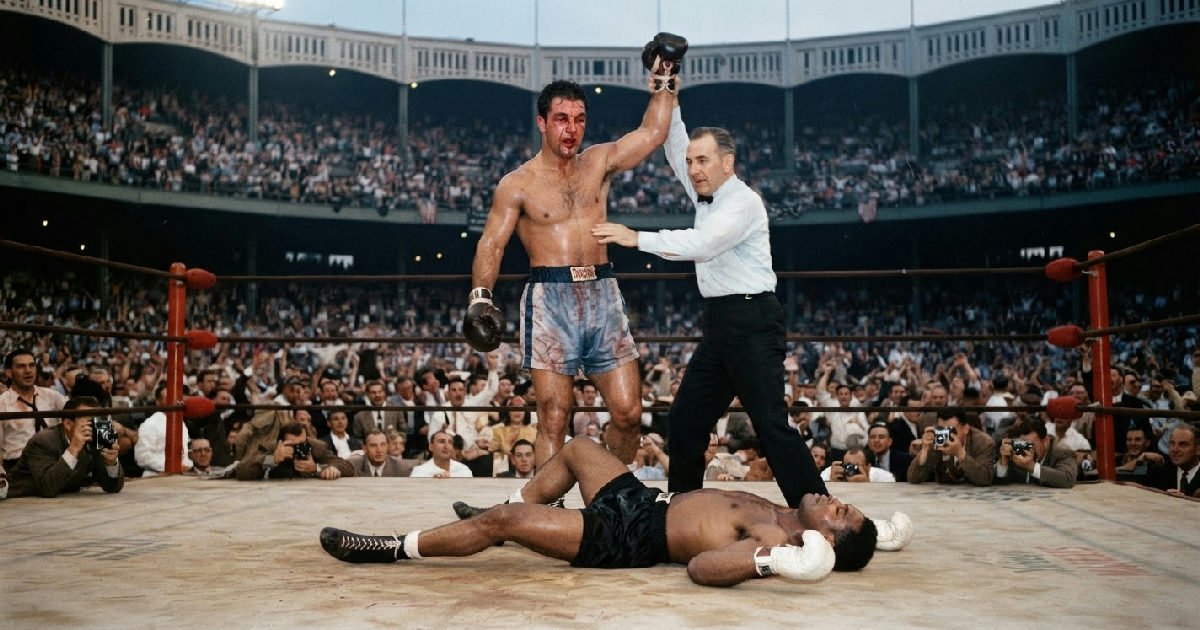
Rocky Marciano successfully defended his undisputed heavyweight championship against former titleholder Ezzard Charles in a ferocious rematch on September 17, 1954, at Yankee Stadium. He secured a knockout victory in the eighth round after surviving a severe facial injury.
The fight, later named the 1954 Fight of the Year by The Ring magazine, cemented Marciano’s reputation for rugged durability and destructive power, moving his flawless professional record to 47-0.
Rocky Marciano Ezzard Charles title fight
Charles, known as “The Cincinnati Cobra,” had pushed Marciano to his absolute limit in their first encounter just three months prior, and the rematch was expected to be another punishing war, which it proved to be.
The second meeting between the two heavyweight titans was a high-stakes affair, delayed multiple times by rain before finally taking place.
Marciano, the reigning champion, carried his undefeated 46-0 record into the ring, while Charles was fighting to become the first former heavyweight champion in history to regain the undisputed crown.
Their initial bout on June 17, 1954, at Yankee Stadium, went the full 15 rounds – a rare occurrence in Marciano’s career. Though Marciano won a unanimous decision, Charles had controlled long stretches with cleaner boxing, even cutting the champion’s left eye, making it Marciano’s hardest title defense to that point.
This performance set the stage for an intense rematch and left many eagerly awaiting the outcome, much like fans discuss comments on fights today.
The punishing first encounter
In that first encounter, Charles’s superior technique allowed him to land cleanly and manage the distance. He inflicted a cut near Marciano’s left eye, forcing the champion to rally for his unanimous decision victory.
Despite Charles’s cleaner boxing, Marciano’s relentless forward pressure ultimately took its toll. Charles remained on his feet for all 15 rounds, but his face was significantly damaged by the final bell.
This punishing performance, however, solidified Charles’s claim for a rematch. He sought to become the first former heavyweight champion to regain the undisputed crown.
Charles’s strategic weight gain
For the rematch, Ezzard Charles stepped onto the scales at 192½ pounds, a significant seven pounds heavier than he had weighed for their initial clash.
This strategic decision by Charles’s camp appeared to be an attempt to generate more power and hurt the champion early, avoiding another grueling 15-round affair against the “Brockton Blockbuster.”
Unfortunately for the challenger, the added bulk slowed him down and inadvertently pushed the fight toward a brutal power-punching exchange that played directly into Marciano’s inherent strengths.
Charles landed effectively in the opening round, but the weight failed to translate into the necessary stopping power, and Marciano dropped him with a forceful right hand in the second round.
The pivotal moment: injury and immediate threat
The contest settled into a familiar rhythm through the middle rounds as Marciano continually crowded Charles, attacking the arms, ribs, and head while Charles tried desperately to create space to box.
The nature of the fight changed dramatically in the sixth round when the champion suffered a horrifying injury.
Coming out of a clinch, Marciano’s left nostril was gruesomely split, reportedly hanging loose from his face, causing blood to immediately pour down his head and torso.
The doctor’s potential intervention
Charles’s corner instantly recognized the opportunity, urging their fighter to target the severe injury, knowing that a medical stoppage represented the clearest and most immediate route to reclaiming the championship.
Marciano, already dealing with a cut near his left eye, kept advancing through the crimson mask, refusing to give ground, an act of sheer will that stunned observers.
In the background, there were reports that referee Al Berl had warned Marciano’s corner that he would have to stop the fight if the bleeding continued uncontrollably past the next round.
Marciano’s brutal tactical shift
Faced with the imminent threat of the referee stepping in, Rocky Marciano made a critical, career-defining choice.
As he returned to his corner after the seventh round, his trainers advised him to focus on body punches to slow Charles down and perhaps reduce the flow of blood from his face.
Marciano rejected his corner’s advice emphatically before the eighth round, recognizing he no longer had time for a slow, attritional body attack. He understood that a quicker finish was paramount to protecting his title, a strategic move that defines some of boxing’s greatest rivalries.
He famously stated, “I was spilling too much blood, and they might have stopped it. I like my title too much to lose it on account of a little blood. I don’t knock ’em out in the body. I knock ’em out on the chin.”
Abandoning the attritional style
This statement revealed a deep understanding of the immediate dynamics of the fight and a remarkable sense of urgency that went beyond mere courage.
Marciano completely abandoned his usual strategy of breaking opponents down slowly. He instead concentrated all his efforts upstairs, calculating that one clean shot could end the fight instantly.
This decision turned the eighth round into a dramatic, high-risk assault.
A massive right hand quickly dropped Charles for a four-count, demonstrating the champion’s renewed focus on explosive, fight-ending power.
Although Charles managed to regain his feet, the end was seconds away. A searing left hook followed by another punishing right hand sent the challenger crashing to the canvas for a second time.
Charles barely managed to beat the ten-count, but the damage was done. Referee Al Berl officially stopped the contest at 2:36 of the eighth round.
Officiating controversy and the 47-0 legacy
While the story is often framed as a heroic display of Marciano’s toughness, contemporary analysis points out that the victory was complicated by the officiating standards of the era. Particularly, Referee Al Berl’s tolerance for illegal maneuvers proved controversial.
Marciano’s signature pressure sometimes strayed across the line, particularly with repeated “rabbit punches”—right hands chopped down onto the back of Charles’s head whenever the challenger bent forward defensively.
Slow-motion footage later confirmed that these were not incidental blows but repeated, deliberate shots, often delivered right in front of the official.
The permissiveness shown by Berl allowed Marciano to fight with enormous freedom inside. This arguably turned Charles’s necessary defensive posture into an opportunity for the champion to club him illegally.
Marciano was also seen striking low, using his glove laces and heel, and continuing to punch after the bell, yet he never lost a point. This highlighted the uneven application of rules.
This “dirty performance,” as some have termed it, ensured that Charles had to absorb both legal and illegal punishment. It added to the psychological and physical burden he faced in the ring.
Despite the officiating complexities, the fight remains a spectacular highlight reel moment that encapsulates Marciano’s sheer will to win.
The enduring psychological weight of Ezzard Charles
Ezzard Charles fought a total of 23 brutal rounds against Rocky Marciano across their two consecutive bouts, delivering clean boxing, landing cuts, and tearing the champion’s nose open.
But the relentless nature of Marciano meant that no matter what Charles achieved, the champion always kept coming forward, triggering a desperate and even more determined assault whenever he was injured.
The psychological toll of fighting such an opponent must have been immense. Charles could outbox the man, but he simply could not break his spirit or halt his advance.
Marciano himself later referred to Charles as the toughest man he ever faced, high praise coming from the only undefeated heavyweight champion in history.
The loss effectively ended Charles’s time at the absolute top of the sport, though he continued to box until 1959.
The former champion found himself struggling with money and ultimately suffered from amyotrophic lateral sclerosis (ALS) later in life, passing away in 1975.
His reputation as a brilliant boxer, who defeated numerous Hall of Famers across three weight classes, remains strong. However, Charles’s status was often underrated, partly due to his introverted nature and the pervasive racism that denied him earlier title shots in his natural weight classes, issues sometimes explored in detailed fight analysis.
Rocky Marciano’s lasting legacy of resilience
The 1954 rematch with Ezzard Charles solidified Rocky Marciano’s legend as a fighter who could endure enormous punishment and still summon the necessary power for a savage finish.
His decisive action, rejecting his corner’s advice before the eighth round to instead hunt for the knockout, demonstrated an unparalleled belief in his chin and his power. Marciano prioritized the knockout blow over cautious survival.
It was a calculated risk that paid off instantly, preserving his title and extending his incredible undefeated streak.
Marciano retired two years later, in 1956, with a perfect record of 49-0, a feat that remains unique among all world heavyweight champions, and the Charles rematch is central to that legacy.
The contest serves as a powerful illustration of the difference between an outstanding boxer, which Ezzard Charles was, and an unparalleled fighting force of nature, which Rocky Marciano embodied.
His tenacity, combined with the extreme pain he fought through, defined his career and continues to inspire debate over the blend of courage and controversial tactics needed to remain undefeated.