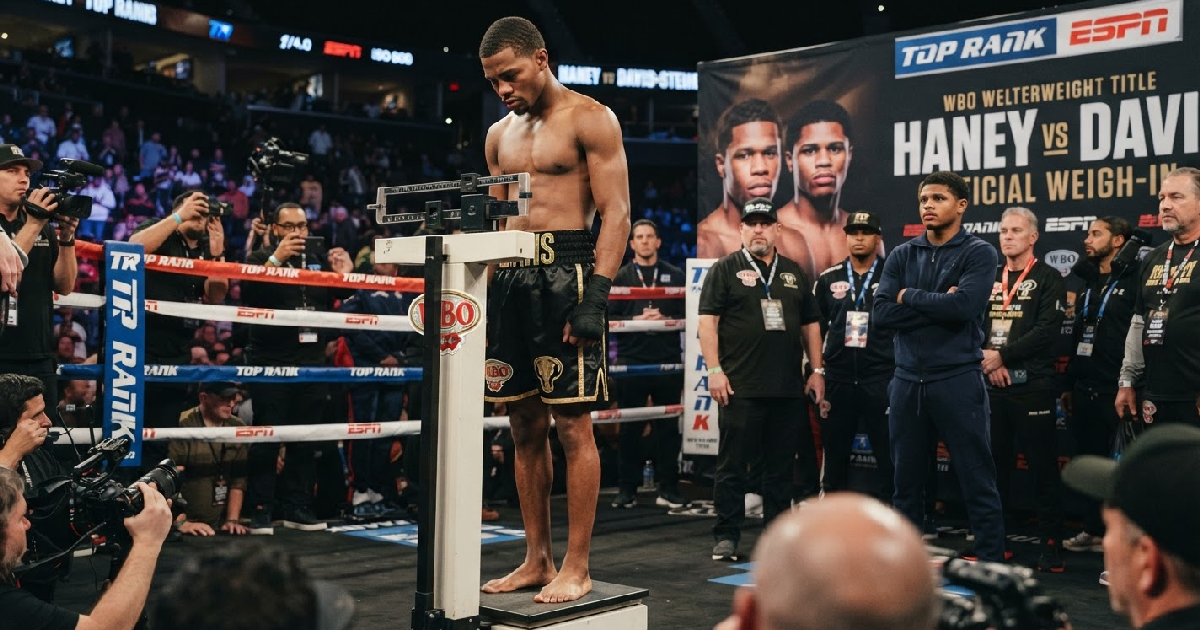
Keyshawn Davis, the highly-regarded boxer, formally pulled out of his mandated World Boxing Organization (WBO) welterweight title fight against champion Devin Haney. The WBO confirmed Davis’s withdrawal on Friday, July 31, 2026. This decision came after Davis rejected a 25% share of an $8.55 million purse bid, which would have amounted to approximately $2.14 million for him.
The unexpected move has drawn significant commentary from four-division champion Shakur Stevenson, a close friend of Davis. Stevenson publicly questioned the stated financial reasons for the pullout, hinting at deeper issues at play.
Keyshawn Davis pulls out of WBO welterweight title bout
Keyshawn Davis surprised the boxing world by withdrawing from the ordered WBO welterweight title contest against Devin Haney. Top Rank had won the rights to stage the event through a purse bid, with the expectation that Davis would net over $2 million for his championship challenge.
Despite the substantial payday, Davis formally notified the WBO that he was declining the purse bid adjudication. His rejection of the $2.14 million share of the $8.55 million total purse was the immediate catalyst for his withdrawal, with reports citing his belief of being underpaid.
Financial details of the rejected purse bid
The financial terms of the proposed Haney-Davis bout were set after a 30-day negotiation period concluded, leading to a purse bid. Top Rank emerged victorious, submitting the $8.55 million bid. Under WBO rules, challenger Keyshawn Davis was allotted a 25% share.
This share translated to roughly $2.14 million for Davis. Devin Haney, as the champion, was set to receive the remaining 75%. Davis’s rejection of this figure ultimately led to the fight’s cancellation.
Shakur Stevenson casts doubt on financial motive
Four-division world champion Shakur Stevenson, a long-time friend of Keyshawn Davis, didn’t buy the explanation that money was the sole reason for the pullout. He openly expressed his skepticism during an appearance on the “Cigar Talk YouTube channel,” suggesting there’s more to the story.
“At the end of the day, his decision is his decision,” Stevenson said. “I believe that, if he has made that decision, there must be a lot more to it.” He firmly rejected the simple financial explanation, adding, “Nah, I am not buying that [it was solely about the money]. I think that there has got to be more to the story.”
Stevenson drew on his own experiences with boxing promoters and negotiations. “I have dealt with these people before, they know how to make things look a certain way, I have been in his shoes before,” he explained. His comments resonated across social media, with initial reactions appearing on July 31, August 1, and August 2, 2026.
Previously, Stevenson had urged Haney to consider vacating the welterweight title rather than defending it against Davis. He stated he didn’t want to stand in the way of his friend, highlighting the bond between the two fighters. This shows a deeper level of insight into Davis’s decision-making process than purely financial considerations.
Stevenson’s ongoing pursuit of a Devin Haney fight
Shakur Stevenson’s commentary on Davis’s situation also comes amid his own persistent efforts to secure a fight with Devin Haney. Stevenson has consistently pushed for a catchweight bout at 144 pounds, asserting that an earlier understanding existed for this specific weight.
He hasn’t shied away from public criticism, calling out the Haney camp for “moving the goalposts” in their negotiations. On August 1, 2026, Stevenson took to social media, tweeting: “Teo sure didn’t have a problem fighting Rolly or fighting me why is easier to do business with him?? 144 or go bout yo business im ready whenever!!”.
Stevenson continued his public pressure on Bill Haney, Devin Haney’s father and trainer. He told him to “stop diverting and just make the fight happen at the lower weight.” This social media exchange underlines the constant struggle to finalize major boxing matches.
However, Stevenson definitively announced on Tuesday, August 4, 2026, that he has closed the door on a Haney fight for now. This suggests his frustration with the lack of progress in negotiations has reached a boiling point. The multi-division champion’s efforts reflect a broader trend where fighters aim to secure optimal conditions for themselves.
Implications for the WBO welterweight division
Keyshawn Davis’s withdrawal creates immediate uncertainty within the WBO welterweight division. While Devin Haney is now without a mandatory challenger, the incident also underscores the challenges facing sanctioning bodies in enforcing ordered title defenses.
The situation also disrupts the natural progression of contenders. A highly-touted prospect like Davis stepping away from a world title shot, regardless of the precise reasons, can open doors for other fighters. This creates opportunities for those willing to seize the challenge.
This event could also embolden other fighters to push harder for their desired terms in future negotiations. Money is often a primary motivator, and instances like this serve as a precedent. It impacts both fighters seeking better deals and promoters navigating increasingly complex financial demands in the sport.
The broader context of fighter pay disputes
The core issue of Davis feeling “underpaid” highlights a recurring tension in professional boxing. While $2.14 million is a significant sum, a fighter’s perceived value can exceed standard purse bid percentages, especially for a world title bout. This dynamic often leads to disagreements.
Fighter compensation is a frequent point of contention, sometimes leading to stalled negotiations or withdrawals. The subjectivity of being “underpaid” for a rising star, especially one with significant market potential, often clashes with the fixed structures of sanctioning body rules.
It prompts questions about the long-term viability of current purse bid models if top contenders consistently believe they aren’t receiving fair compensation. This ongoing debate about financial equity continues to shape the sport’s landscape. Prior issues with Haney bouts have also highlighted the complexities of fighter negotiations.