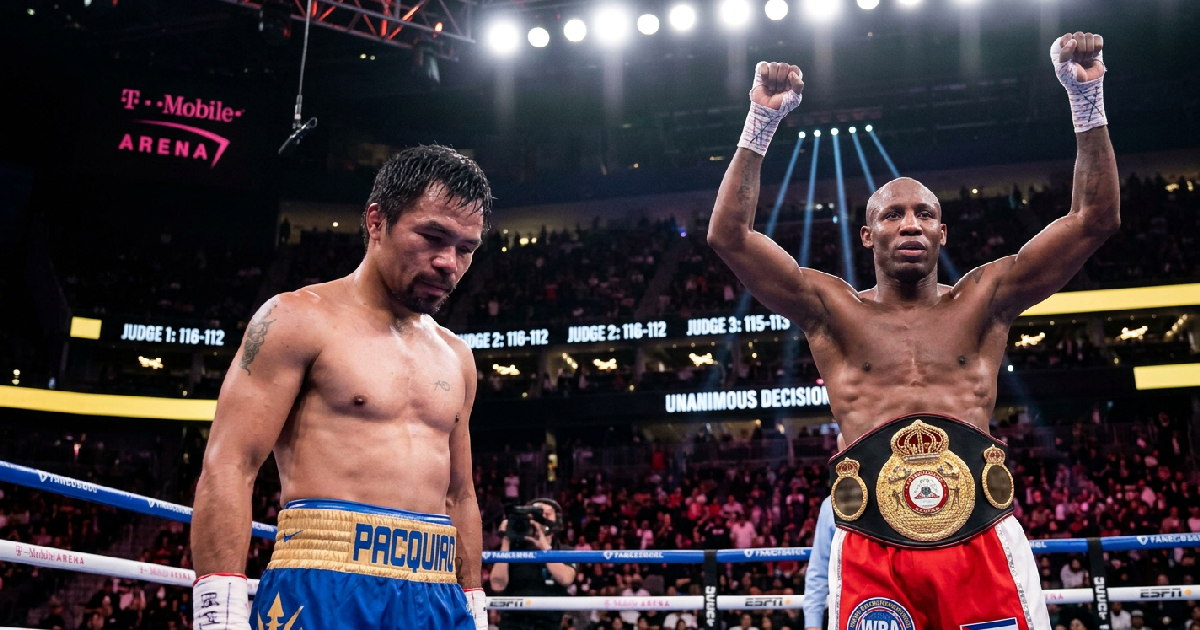
Manny Pacquiao officially ended his professional boxing career following a unanimous decision loss to Yordenis Ugás on August 21, 2021, at the T-Mobile Arena in Paradise, Nevada. The 42-year-old Filipino senator and eight-division champion notably struggled with the Cuban’s reach and jab in a performance that many observers described as “unimpressive.”
Ugás, who entered the bout as the reigning WBA (Super) welterweight champion, stepped in as a late replacement with only 11 days’ notice. The original opponent, the undefeated WBC and IBF champion Errol Spence Jr., was forced to withdraw after medical exams revealed a retinal tear in his left eye. Despite the short preparation time for the specific opponent, Ugás successfully defended his title with judges’ scores of 116-112, 116-112, and 115-113.
The loss marked a definitive conclusion to one of the most storied careers in sports history. Shortly after the bout, Pacquiao announced his retirement from professional boxing to focus on his political career. For fans following the evolution of the weight classes, the shift in momentum mirrored how modern stars like Shakur Stevenson evaluate moves to welterweight as the division enters a post-Pacquiao era.
Punch totals and accuracy statistics against Ugás
A deep dive into the punch statistics reveals why the veteran champion fell short on the scorecards. Pacquiao remained active, throwing 815 punches compared to only 405 from Ugás. However, the volume did not translate to effective scoring, as Pacquiao landed only 130 of those attempts.
Ugás demonstrated superior efficiency by landing 151 punches, giving him a 37.3% accuracy rate. By contrast, Pacquiao’s connect rate plummeted to 16%, a figure far below his prime standards. The Cuban champion utilized his jab and a looping right hand to keep Pacquiao on the outside for much of the 12-round contest.
While Pacquiao showed flashes of his old self in the 10th round, landing a combination that temporarily backed Ugás up, those moments were fleeting. Ugás regained control quickly, grew in confidence during the middle rounds, and spent the final frame peppering his opponent with shots until the final bell.
Physical limitations and the impact of aging
After the fight, Pacquiao pointed to specific physical issues that hindered his performance. He revealed that his legs began to cramp as early as the second round, which he blamed on a combination of his age and potential overtraining. These cramps appeared to strip the Filipino legend of his trademark “in-and-out” footwork.
Observers noted that Pacquiao looked stiffer than usual, lacking the lateral movement that allowed him to win titles in eight different weight classes. The two-year layoff heading into the fight—his longest period of inactivity in 25 years—seemed to exacerbate These issues. Similar physical toll is often discussed in the sport today, as when Oleksandr Usyk raised brain health concerns regarding the grueling nature of modern heavyweight clashes.
Ugás capitalized on this lack of mobility by maintaining distance and timing his counters precisely. From the sixth round onward, the Cuban controlled the pace, ensuring Pacquiao could never find the rhythm necessary to close the gap against a naturally larger opponent.
Tactical adjustments and the Spence factor
The late withdrawal of Errol Spence Jr. played a significant role in the tactical preparation for the night. Pacquiao had been training specifically to face a southpaw in Spence, but Ugás presented an entirely different problem as a rangy, orthodox fighter.
Adjusting to a bronze medalist from the 2008 Beijing Olympics like Ugás on such short notice proved to be a tall order. While Pacquiao’s heart remained unquestioned, his 42-year-old body could not bridge the gap between his offensive intent and the reality of his declining physical peak.
The bout served as a transition point for the World Boxing Association (WBA) and the division as a whole. It confirmed Ugás as a top-tier welterweight and signaled that the era of “Pac-Man” had reached its final chapter. The sport continues to see shifts in championship control, such as when Jack Catterall challenged Rolando Romero for a WBA belt in a new era of title contention.
Historical significance of the Nevada bout
The August 2021 fight remains the final professional entry on Pacquiao’s record. Unlike some legends who struggled to leave the ring, Pacquiao used the definitive nature of the Ugás loss to provide clarity about his future. His subsequent announcement of a presidential bid in the Philippines confirmed that his focus had shifted permanently from the ring to the political arena.
While the performance was not the explosive finale many fans hoped for, it showcased the grit that defined Pacquiao’s career. He threw over 800 punches and fought through significant leg pain for ten rounds to reach the final bell. It was a workmanlike end for a fighter who had spent a quarter-century at the pinnacle of the sport.
Ugás’s victory solidified his place in Cuban boxing history, handing one of the greatest of all time a loss in his final outing. For the boxing world, it was the end of a legendary narrative that spanned multiple generations of fighters and millions of pay-per-view buys.