
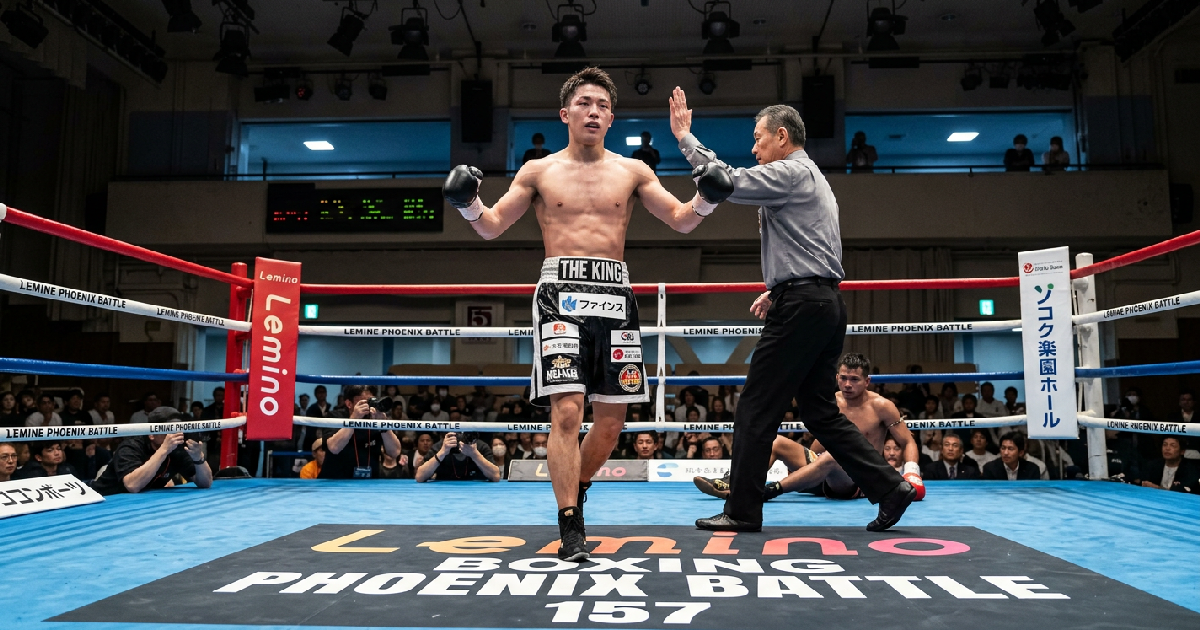
Japanese boxing sensation Yuga Fujiki lived up to his “The King” moniker on June 10, 2026, by dismantling Thai super-featherweight champion Weera Mikham via second-round technical knockout at Tokyo’s Korakuen Hall.
The 18-year-old debutant, fighting under the Ohashi Promotions banner, stopped the experienced Mikham at the 2:05 mark of the second round after a relentless offensive display. Referee Nakamura intervened to save the Thai veteran from further punishment as Fujiki punctuated his professional arrival with clinical precision.
The bout served as the main event for the Lemino BOXING PHOENIX BATTLE 157 and was contested at a 59.9kg catchweight. Despite entering the ring with an experience deficit against Mikham, who held a prior professional record of 21 wins and 2 losses with 13 knockouts, Fujiki looked every bit the seasoned veteran.
His transition from a decorated amateur career, where he compiled a perfect 49-0 record with 33 stoppages, appeared seamless as he dictated the pace from the opening bell.
Promoter Ohashi, the leader of Ohashi Promotions, was vocal about his new charge’s potential following the victory. He described the teenager as the “treasure of Japan” and committed to steering him toward a world championship. While some young fighters might struggle under such lofty expectations, Fujiki’s performance suggested he is ready for a rapid ascent through the rankings.
Disciplined execution in the opening round
The first round saw Yuga Fujiki establish dominance through a disciplined, high-guard stance that effectively neutralized Weera Mikham’s counter-punching attempts. Using his 66-inch reach, the Osaka-born orthodox fighter controlled the distance with a stiff left jab followed by sharp straight rights. The gap in speed and technical nuance was evident as Fujiki consistently found openings in the Thai champion’s defense.
The momentum shifted decisively when a perfectly timed counter left jab staggered Mikham, followed by a flush right cross that nearly caused a knockdown. While Mikham managed to stay upright, he finished the round looking visibly shaken and unable to find an answer for the debutant’s lateral movement.
The accuracy of Fujiki’s work was particularly striking, as he avoided the typical nerves that often affect prospects in their first televised appearance.
Fujiki showcased a level of composure that mirrored the tactical patience seen in major title fights. Much like how Ken Buchanan was recognized by Roberto Duran for his boxing intelligence, observers noted Fujiki’s high ring IQ. He did not rush for the finish in the first, choosing instead to systematically break down his opponent’s guard.
The second round onslaught and stoppage
Yuga Fujiki emerged for the second round with increased aggression, varying his attack to include punishing body work. A series of left hooks to the midsection forced Mikham to drop his elbows, which Fujiki immediately exploited with sharp right uppercuts.
The sustained barrage of power punches quickly took its toll on the Thai fighter, who had previously challenged Shu Utsuki for a regional title in 2025.
The end came following a right-hand lead that snapped Mikham’s head back, followed by a flurry of unanswered combinations against the ropes. Referee Nakamura monitored the situation closely as Mikham’s defensive responses waned. Seeing no path for the Thai champion to recover, Nakamura halted the contest 2:05 into the second frame to prevent unnecessary damage.
Future targets in the super-featherweight division
Post-fight, Yuga Fujiki was humble but clear about his trajectory in the sport. He expressed his desire to follow in the footsteps of Naoya Inoue, citing the multi-division champion as his primary inspiration. Fujiki noted that while he was excited to compete in front of a large Tokyo crowd, his focus remains on securing regional silverware in the immediate future.
The super-featherweight division in Japan is currently deep with talent, a fact Fujiki acknowledged when discussing his next steps. “The super-featherweight regional titles are currently held entirely by Japanese fighters,” Fujiki said after the fight. “My goal is to secure one of those belts as quickly as possible.” This aggressive timeline aligns with the strategy often employed by Ohashi Promotions.
In the wider boxing world, fans often debate the merits of such rapid rises, similar to how Shakur Stevenson has faced scrutiny over his career path and public persona. However, Fujiki’s 100% knockout rate and flawless amateur pedigree suggest he is a talent to watch closely.
His ability to stop a reigning champion in his first pro outing has already made waves across the regional scene.
Prospect outlook and global ceiling
The victory moves Fujiki to 1-0 as a professional and marks a disappointing night for Weera Mikham, whose record falls to 21-3. For Mikham, a fighter who has been a staple of the Asian regional circuit, the loss serves as a reminder of the evolving power coming out of Japanese gyms.
Fujiki’s performance will likely fuel discussions about his readiness for more significant challenges in the coming months.
What remains to be seen is how Fujiki handles the increased caliber of opposition as he moves toward world-level competition. At 5′ 7\” tall, he has the frame to compete comfortably at super-featherweight, and the power he displayed against Mikham suggests his style will translate well to longer bouts. For now, the “treasure of Japan” has confirmed he is more than just hype.