
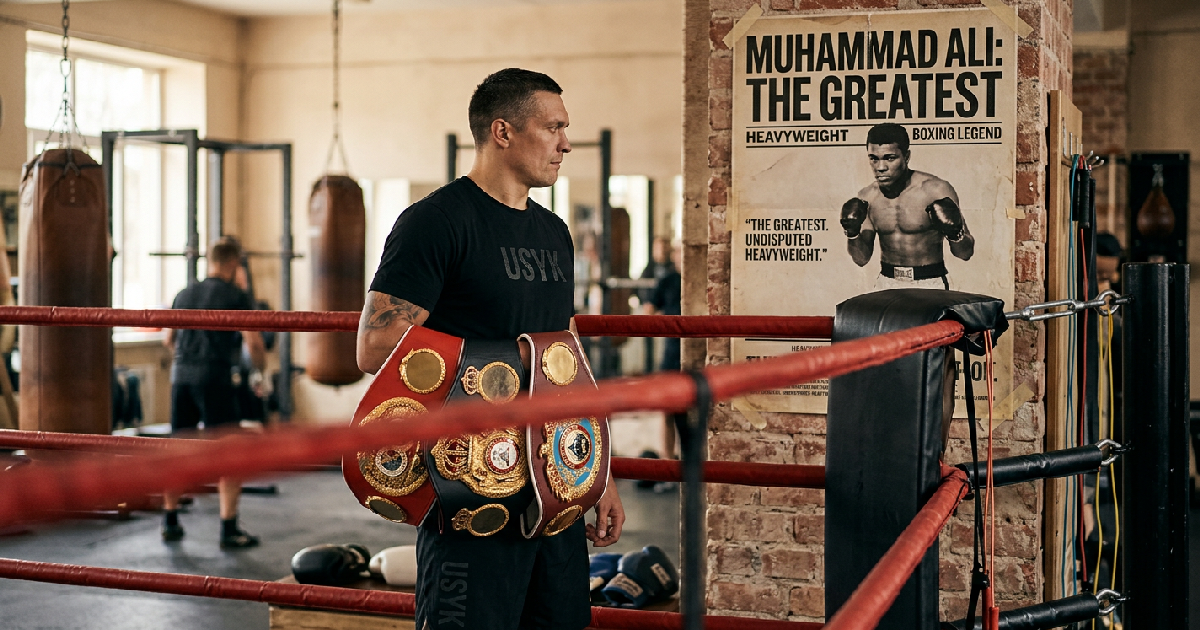
The undisputed heavyweight champion Oleksandr Usyk has named Muhammad Ali as the premier fighter in the history of the weight class, reportedly placing the American legend above all other historical peers. During a recent discussion regarding the giants of the sport, the Ukrainian technician, who recently collected the major world titles, suggested that the legacy of the man known as “The Greatest” remains the gold standard for any competitor in the ring.
Oleksandr Usyk has frequently expressed his admiration for the style and cultural significance of the mid-20th-century era. By navigating the current heavyweight landscape with a focus on agility and ring intelligence, the champion is often compared by observers to the greats of the 1960s and 70s. His public endorsement of Muhammad Ali emphasizes a preference for high-IQ boxing, a trait that has become a defining characteristic for many of the most dangerous boxers in 2026 who prioritize craft over raw strength.
The Standard of Greatness in the Heavyweight Division
Deciding who stands at the summit of the heavyweight division usually involves a rotation of icons like Joe Louis, Rocky Marciano, and Larry Holmes. However, for the current king of the bracket, the decision appears settled. Muhammad Ali is frequently cited for his unique footwork and his ability to adapt his tactics against a wide variety of opponents, a philosophy that mirrors the Ukrainian’s own rise through the professional ranks.
The champion’s recognition of Muhammad Ali also highlights a specific stylistic lineage. Much like his idol, the Ukrainian relies on constant movement, a high volume of punches, and psychological composure rather than the stationary, one-punch knockout approach seen in many of his contemporaries. By pointing to Muhammad Ali, the champion signals that he views boxing as a sophisticated discipline where speed and timing are the ultimate weapons.
Comparing Eras and Modern Contenders
While the Ukrainian champion looks back at the sport’s history, the modern heavyweight scene is currently defined by a small group of elite athletes. The potential for massive unification bouts and local rivalries continues to drive the sport’s popularity. This perspective on legacy is often echoed by other industry figures, such as when David Price evaluates Tyson Fury’s current form and the implications of a potential showdown with Anthony Joshua.
This nod to history comes during a period where the heavyweight division has seen a consolidation of power. The collection of the major championship belts has brought a level of clarity to the rankings that had been missing for several years. By identifying Muhammad Ali as his personal benchmark, the champion provides a clear indication of how he wants his own career to be remembered by future generations of fans and historians.
The Influence of Technical Mastery
The champion’s career has been built on his ability to outmaneuver larger, heavier opponents through conditioning and tactical discipline. This approach is reminiscent of the “butterfly and sting” philosophy that Muhammad Ali made famous. In an age where many top-tier heavyweights are significantly larger than previous generations, the champion has proven that neurological speed and footwork can still overcome a size disadvantage.
Focusing on historical greats serves as a reminder of the sport’s deep institutional roots. While promotional efforts often focus on the financial scale of modern events, many top fighters remain dedicated students of their predecessors. This dedication to the craft persists even as the industry deals with external pressures, such as when the boxing world grapples with Daniel Kinahan business fallout and its impact on the sport’s commercial structure.
Looking Toward the Future
With his recent achievements in the heavyweight class, questions naturally arise regarding the champion’s longevity and his final place in history. Every successful defense of a world title adds to the argument for his own inclusion in the all-time rankings. While he currently defers to Muhammad Ali, many analysts have already begun to rank the Ukrainian among the greatest due to his success across multiple weight divisions.
The champion’s choice of Muhammad Ali as the greatest will likely resonate with aspiring fighters who value the technical side of the sport. By keeping the legend’s name at the forefront of the conversation, he ensures that the virtues of speed, timing, and ring craft remain the primary objectives for those seeking to follow in his footsteps.
Frequently Asked Questions
Who does Oleksandr Usyk consider the greatest heavyweight of all time?
The Ukrainian champion has identified Muhammad Ali as the greatest fighter to ever compete in the heavyweight division. He has noted that the American icon’s unique boxing style and his lasting impact on global culture set him apart from all other champions.
What qualities does the champion admire most in historical boxers?
Based on his public comments and his own style in the ring, the champion appears to prioritize ring intelligence, movement, and technical precision. He often speaks about the importance of outthinking an opponent rather than relying solely on physical power.
How does the champion’s style compare to Muhammad Ali’s?
Both fighters are known for their exceptional footwork and their ability to maintain a high pace over twelve rounds. Like Muhammad Ali, the current champion uses his agility to create angles and frustrate larger opponents who may have a reach or weight advantage.