Gene Fullmer ended Sugar Ray Robinson’s third middleweight title reign on January 2, 1957, securing a unanimous decision victory before 18,934 spectators at Madison Square Garden in New York City.
The 25-year-old challenger, known as the “Mormon Mauler,” utilized relentless physical pressure and a seventh-round knockdown to dethrone the 35-year-old champion, who entered the bout as a 6-5 favorite. This victory shifted the power dynamic in the middleweight division and initiated a heated four-fight rivalry.
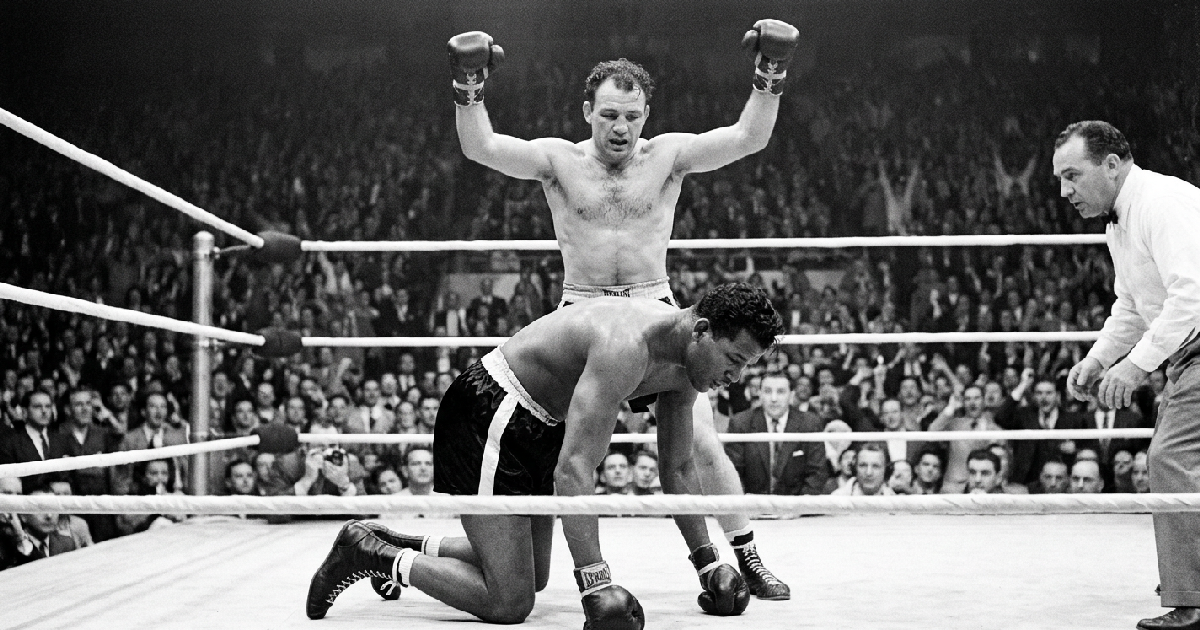
Gene Fullmer employs aggressive tactics to stifle Sugar Ray Robinson
The result shook the boxing world as Sugar Ray Robinson, holding a professional record of 140-4-2, was widely regarded as one of the greatest pound-for-pound fighters in history. Despite his age, many expected his superior technical skills to neutralize the rugged style of the younger Gene Fullmer.
However, the 15-round contest told a different story, as the challenger’s strength and work rate overcame the champion’s athleticism. The official scorecards reflected a clear margin of victory, with referee Ruby Goldstein scoring it 8-5 and Judge Frank Forbes seeing it as 10-5 for the new champion.
From the opening bell, Gene Fullmer established a high-tempo pace that forced Sugar Ray Robinson to fight off his back foot. Robinson attempted to use his jab and combinations to keep the charging challenger at bay, snapping Fullmer’s head back with crisp counters in the early frames.
Yet, Fullmer seemed indifferent to the incoming fire, constantly resetting and lunging back into the pocket to force Robinson toward the ropes.
Fullmer turned the match into a grueling physical struggle by leaning on Robinson during clinches and working the champion’s midsection with heavy blows. This “mauling” style, perfectly suited to taxing a fighter ten years his senior, grew more effective as the rounds progressed into the middle stages. Robinson found himself increasingly trapped, his once-fluid footwork slowing under the weight of Fullmer’s nonstop aggression.
Key details
As the bout wore on, Robinson remained dangerous in spurts, trying to counter with sharp combinations. But Fullmer’s physical dominance was absolute. Unlike many contemporary stylists, such as those Richard Torrez Jr. anticipates facing in modern matchups, Fullmer relied on raw pressure to smother his opponent’s rhythm. Robinson also battled a cut over his left eye as punishment accumulated during the championship rounds.
The seventh round knockdown changes the fight trajectory
The pivotal moment of the evening occurred in the seventh round when Gene Fullmer landed the punches that dropped Sugar Ray Robinson for a six-count. It was a jarring sight for the fans at Madison Square Garden, seeing the legendary champion in such a vulnerable state.
Although Robinson rose and bravely fought on, the knockdown illustrated that he could no longer consistently keep the younger man at bay.
The second half of the fight belonged almost entirely to Fullmer. While Robinson never stopped trying to find a fight-changing shot, the “Utah Cyclone” refused to be discouraged.
Much like the way Manny Pacquiao evaluated the skills of his past opponents, historians often look at this bout to see how Fullmer’s durability negated Robinson’s technical mastery. Robinson’s ring experience was not enough to offset the physical deficit created by Fullmer’s relentless work rate.
Judges deliver a unanimous verdict at Madison Square Garden
When the final bell rang after 15 rounds, the official scores left little doubt regarding the outcome. Judge Frank Forbes turned in a card of 5-10, Harold Barnes scored it 6-9, and referee Ruby Goldstein had it 5-8, all in favor of Gene Fullmer. Unofficial press row scorecards were equally one-sided, with the Associated Press and United Press both recording 9-6 tallies for the challenger.
The financial figures of the night underscored the magnitude of the event for the era. The gross gate reached $194,696, with a net gate of $166,422. Despite his defeat, Sugar Ray Robinson’s star power earned him a purse of $139,050, which included 47.5% of the net gate and $60,000 from television and radio rights.
In contrast, Gene Fullmer earned $20,802, representing 12.5% of the net gate without additional broadcast revenue.
Fullmer’s victory was a defining moment for a man who had earned his title shot by defeating contenders like Tiger Jones and Rocky Castellani. At just 25, he had conquered an icon and proved his brawling style was a viable path to the World Middleweight Championship. For Robinson, many observers left the arena believing his remarkable career had finally reached its end.
Immediate aftermath and the Chicago rematch
The boxing world did not have to wait long for a resolution to the questions raised in New York. One of the quickest championship rematches in history was signed, setting the stage for a return bout just four months later. Robinson, stinged by the loss and whispers of retirement, entered training camp with a renewed focus for their May 1957 meeting at Chicago Stadium.
In that rematch, Robinson reclaimed the middleweight title with a spectacular fifth-round knockout. He became the first fighter to stop the durable Fullmer, landing what many consider a perfect left hook. That win demonstrated Robinson’s ability to evolve, but it did not erase the significance of Fullmer’s January triumph.
The two men would go on to fight four times in total, creating one of the division’s most storied rivalries.
Currently, as the Gualtieri-Jones IBF Middleweight bout approaches, fans often look back at the 1957 series as the gold standard for the weight class. Fullmer’s victory remains a blueprint for how pressure can dismantle a master boxer. While Robinson eventually regained his crown, the night at Madison Square Garden proved that youth and strength could overcome even the most legendary champions.