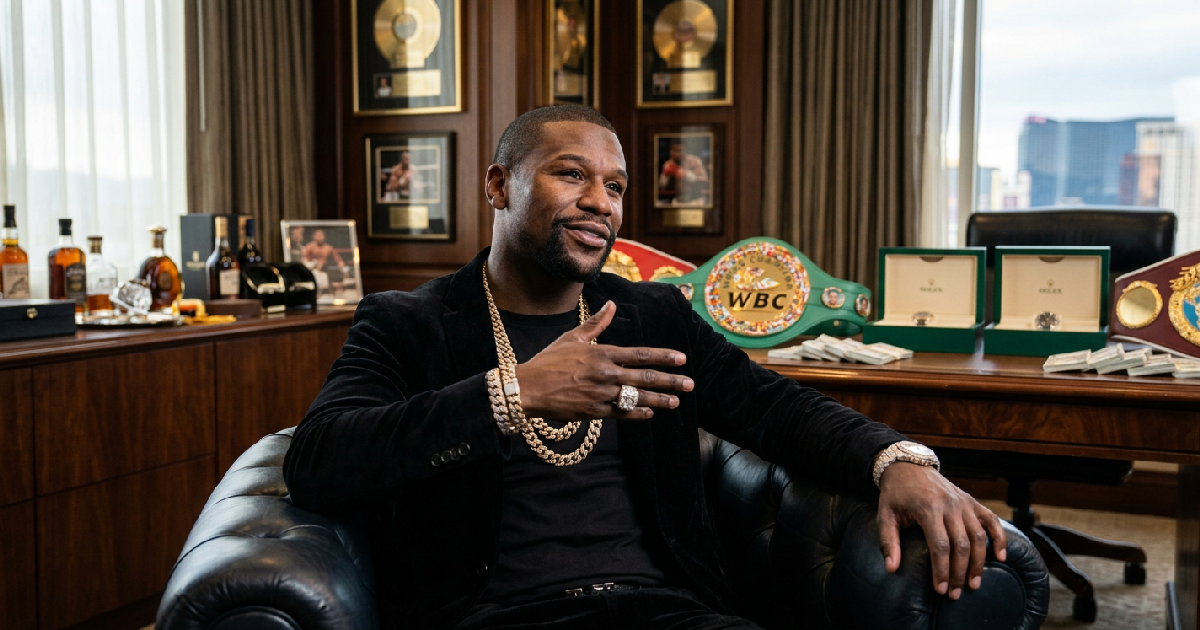
Floyd Mayweather Jr. is an undefeated boxing legend who claims fans who once bet on him are now hoping for his financial ruin. has addressed the “hostility” he feels from fans, claiming those who once leveraged their homes to bet on his success are now praying for his financial downfall.
Speaking in a recent sit-down interview with the rapper Cam’ron, the 49-year-old former five-weight world champion suggested that many people who profited from his 50-0 professional record have grown resentful of his enduring wealth and lifestyle.
Floyd Mayweather Jr. identifies a trend of betting resentment
The veteran fighter, who was 48 years old as of September 2025, noted a specific irony in the way public sentiment has shifted against him. He believes supporters were happy to use his consistency in the ring as a guaranteed investment but turned cold after collecting their winnings. This commentary arrives as Floyd Mayweather Jr.
continues to manage a high-profile post-retirement career that includes a confirmed exhibition bout against Mike Tyson set for April 2026.
During the interview, Floyd Mayweather Jr. was blunt about how he perceives the relationship between his performance and the gambling public. “These people will pull equity out of their house, bet their life savings, and they bet it on Floyd because I’ve proved that I’m 100% when I get in that ring,” he stated.
He argued that his reliability made him a safe harbor for those looking to secure significant financial gains through sports wagering.
But the sentiment changes once the fight is over. According to the man formerly known as “Pretty Boy,” the goodwill vanishes as soon as the bettor heads home with the payout. “And then after they go home and they got everything they want, they praying on my downfall,” he said.
He added that there is a faction of the public that simply does not “want to see Floyd with nothing,” highlighting a distinction between sporting rivalry and personal malice.
The marketing of the villain persona
The shift in fan attitude isn’t entirely accidental. Throughout his career, Floyd Mayweather Jr. leaned into a polarizing “Money” persona designed to sell pay-per-views by making fans want to see him lose. While Manny Pacquiao has analyzed the skills of his past rivals, Mayweather often focused on the business side of the sport, intentionally becoming the “heel” that people paid to see defeated.
Because that professional defeat never came, the desire to see him fall has migrated to his life outside the ring. Millions tuned in for years hoping to see a challenger like Canelo Alvarez or Oscar De La Hoya take his “0.”
Now that he is retired from professional ranks, every legal challenge or business headline is scrutinized by those still waiting for a metaphorical knockout that never happened during his active years.
Defending the empire against financial scrutiny
Floyd Mayweather Jr. also used the platform to address persistent rumors regarding his liquid assets and tax history. He has faced significant public scrutiny over the years, including a 2017 U.S. Tax Court petition involving a $22.2 million bill from 2015.
Despite these reports, the champion insists his financial foundation is solid, asserting that he still owns his properties and supports his extended family and employees.
While some see his frequent exhibition matches as a sign of financial necessity, he maintains it is a tactical business choice. He has often stated that he does not do anything for free, a philosophy that differs from the contract disputes that stall negotiations in today’s heavyweight division. For Mayweather, getting paid for low-risk appearances is simply staying “the best in the business of boxing.”
A history of high-stakes gambling success
The boxer’s comments about betting are backed by his own extensive history in the gambling world. He frequently posts winning slips on social media, such as the $827,272.73 he won in March 2015 from NBA and boxing wagers.
His track record includes a reported $4.7 million haul from NFL betting in late 2014 and more recent wins on the Philadelphia Eagles during Super Bowl LIX in 2025.
His connection to the betting house is so deep that he reportedly attempted to place a $400,000 bet on himself to stop Conor McGregor in 2017. Though bookmakers blocked that specific prop bet, he reportedly had another party place a significant wager on his behalf.
This level of involvement gives him a unique perspective on the psychology of bettors who, in his view, have turned on the person who once enriched them.
Preparing for the Mike Tyson exhibition in April 2026
Despite the criticism, Floyd Mayweather Jr. remains a massive draw. He has signed contracts for an exhibition fight against Mike Tyson, tentatively scheduled for April 25, 2026, in the Democratic Republic of Congo.
The event, which will be an eight-round contest with heavier gloves, is the latest in a series of global exhibitions that mirror the historic bout details released for other legends fighting in unique locations like Egypt.
The match pits the 49-year-old Mayweather against a 59-year-old Tyson, a pairing that has generated controversy due to the age gap and a potential 70-80 pound weight difference. Tyson has called the fight “unpredictable,” while Mayweather views it as a way to give fans “what they want.”
This fight represents another opportunity for Mayweather to generate revenue while his critics wait to see if this unconventional matchup finally provides the downfall they have predicted.
Navigating legacy in the social media era
Living in the public eye means Floyd Mayweather Jr. faces a level of scrutiny that past legends did not. Every business move or legal filing is dissected in real-time, often used by detractors as evidence of a crumbling empire. However, the champion appears comfortable with his “Money” identity, acknowledging the legal challenges but insisting he resolves them as they arise.
Whether he is fighting Mike Tyson or managing his promotional firm, Mayweather’s primary focus remains the bottom line. He continues to bank on the fact that whether fans are betting on him to win or praying for him to lose, they are still paying to watch.
His career serves as a reminder that in modern sports, curiosity and hostility can be just as profitable as universal adoration.