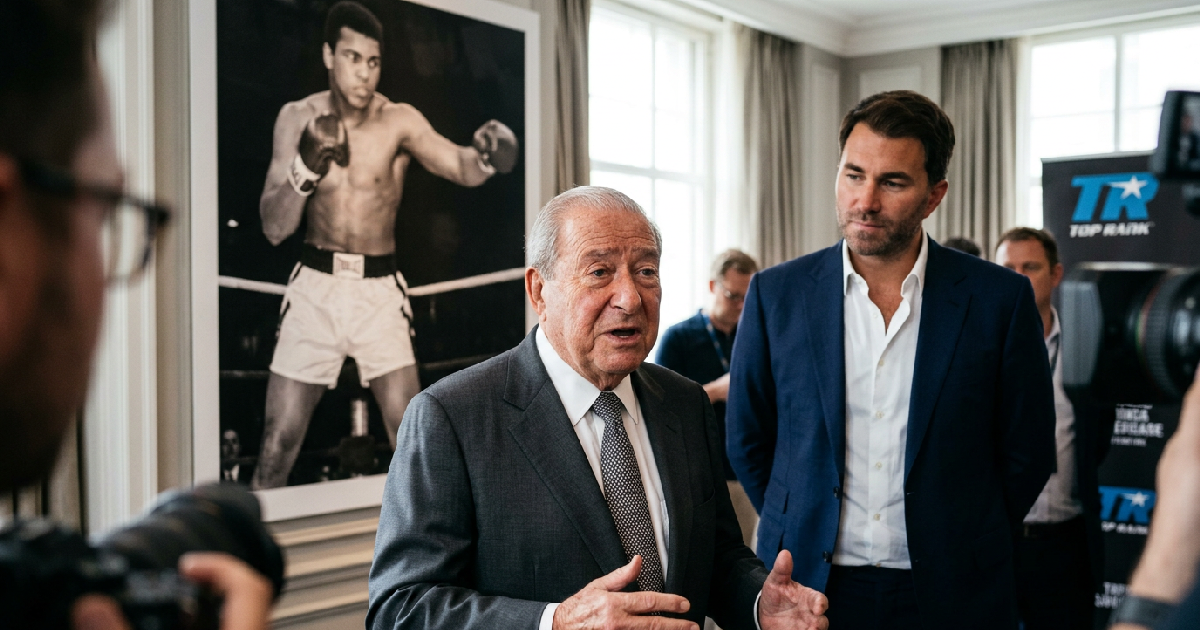
Bob Arum reveals insights into his career and boxing’s evolving mechanics alongside Eddie Hearn on July 9, 2026.
The 94-year-old Bob Arum revealed that he never initially intended to become a lifelong fixture in the sport, but found himself “dragged back in” by the magnetic presence of legends like Muhammad Ali and the subsequent eras of Sugar Ray Leonard and Marvin Hagler.
Bob Arum on his transition from law to boxing promotion
The discussion, which brought together two generations of the sport’s most influential dealmakers, highlighted the personal connections that bind the industry together. Bob Arum reflected on his long-standing friendship with Barry Hearn, Eddie’s father, noting that seeing the younger Eddie Hearn emerge as a top-tier promoter was a source of pride for both families.
The exchange offered a candid look at the differences between the “Golden Era” of the 1970s and 1980s and the digital-led promotion strategies required to navigate the modern American and British markets today.
For Eddie Hearn, the meeting was an opportunity to acknowledge the vast historical shadow cast by his American counterpart. During the session, Eddie Hearn recounted a humbling moment in Wales prior to the Anthony Joshua vs.
Joseph Parker bout, where he attempted to tout the 90,000-person attendance of Joshua’s win over Wladimir Klitschko as his career pinnacle. Bob Arum simply responded by citing the “Rumble in the Jungle” and the “Thrilla in Manila,” leaving Eddie Hearn to admit he still has a “long way to go” to match such a legacy.
The trajectory of Top Rank founder Bob Arum is one of the more improbable stories in sports history. A Harvard-educated attorney who worked for the Department of Justice under Robert F. Kennedy, Bob Arum did not grow up with the ambition of donning the promoter’s cap.
His entry into the sport was catalyzed by NFL legend Jim Brown, who introduced him to Muhammad Ali and the members of the Nation of Islam. This meeting changed the course of Bob Arum’s life, turning a legal professional into the primary architect of Muhammad Ali’s most famous bouts.
Bob Arum admitted during the reflection that he fully expected to walk away from the ring once the Muhammad Ali era concluded. However, the sport has a way of anchoring its most successful figures.
“One thing happens after another,” Bob Arum explained, comparing his tenure in boxing to the iconic “they pull me back in” line from The Godfather.
The arrival of generational talents like Sugar Ray Leonard and Marvin Hagler ensured that Bob Arum remained at the center of the world’s biggest prize fights for decades longer than he anticipated.
This longevity has allowed Bob Arum to witness the promotion of George Foreman’s miraculous comeback and the rise of Oscar De La Hoya. It is a career that spans the distance from the era of closed-circuit television to the dawn of global streaming.
Even at 94, Bob Arum remains active, illustrating a work ethic that mirrors the legendary fighters he has represented. His perspective is unique because he has seen the promotional machine work at its most manual and its most automated stages.
Generational ties between Top Rank and Matchroom
The relationship between Bob Arum and the Hearn family is not merely one of business rivalry; it is deeply rooted in personal history. Bob Arum worked extensively with Barry Hearn during the 1980s and 1990s, a period that helped establish Matchroom as a powerhouse in the United Kingdom.
Seeing Eddie Hearn take the reins of the company and expand its footprint into the United States has been a full-circle moment for the veteran Hall of Famer.
Bob Arum recalled a specific moment during the Joshua-Parker fight week when Barry Hearn expressed immense pride in his son’s achievements. This “whole connection,” as Bob Arum described it, serves as a backdrop to the current era of cross-promotional collaboration.
While the two firms often compete for broadcast dates and signatures, there is a fundamental respect derived from decades of shared history. This camaraderie is increasingly important as boxing match delayed by contract talks becomes a recurring headline, requiring veteran heads to smooth over complex negotiations.
Promoting in the digital age versus the newspaper era
One of the sharpest contrasts identified by Bob Arum is the decline of traditional media in the United States. He noted that the United Kingdom has managed to preserve its “boxing writer” culture, with newspapers still dedicating significant space to the sweet science.
In the United States, however, the disappearance of dedicated boxing beats in major dailies has forced promoters to rethink how they generate hype for their events.
Bob Arum pointed out that modern promotion is “much more difficult” in terms of reaching a broad, mainstream audience. In the past, a major fight would be front-page news across dozens of metropolitan newspapers, creating a unified national conversation.
In 2026, the fragmentation of the internet means that promoters must fight for attention in a crowded digital space. While social media offers direct access to fans, it lacks the institutional weight that the old-school press once provided to the sport.
This shift has turned promoters into content creators and media moguls in their own right. Eddie Hearn has leaned heavily into this change, utilizing YouTube and social platforms to build personae for his fighters.
Nevertheless, both men agree that the fundamental challenge remains the same: convincing the public to invest emotionally and financially in the outcome of a fight. Whether through a print column or a viral clip, the goal is still to sell a narrative of conflict and glory.
What separates good fighters from the greats
The discussion eventually turned to the physical and mental attributes that lead to championship success. Eddie Hearn and Bob Arum both emphasized that talent is often the least important factor in the long-term success of a professional.
Eddie Hearn used Anthony Joshua as a primary example, noting that while others might possess more natural technique, Anthony Joshua’s dedication to “living the life” — avoiding distractions and staying in the gym — is what keeps him at the top of the heavyweight division.
Bob Arum corroborated this by looking back at the “Four Kings” era. He described Marvin Hagler as a “machine” in the gym, a blue-collar worker from New England who succeeded through sheer toughness and work ethic. While Hagler may not have had the fluid technique of Sugar Ray Leonard, his discipline was unmatched.
Conversely, Bob Arum fondly remembered Roberto Duran as one of the most hardworking yet “fun” fighters he ever promoted, a man who never took himself too seriously outside the ring but was a ferocious competitor once the bell rang.
This distinction between “good” and “great” often comes down to the psychological ability to handle the rigors of the sport. We see this today in the heavyweight ranks as Tyson-Fury and Anthony Joshua contracts still pending, with both men needing to maintain peak mental focus during long periods of inactivity.
The ability to remain “a professional” when there is no fight scheduled is what Bob Arum considers the hallmark of a true pound-for-pound great.
The future of the promotional landscape
As Bob Arum enters his mid-90s, the question of succession and the future of Top Rank remains a topic of industry speculation. During the session, he joked that Eddie Hearn “is looking for a way to get out,” while Bob Arum himself seems content to continue until the end.
Bob Arum’s presence provides a bridge to the past, but he is clearly focused on the future, praising Eddie Hearn as a “helluva promoter” who will likely carry the torch for the next several decades.
The industry is currently in a state of flux with new players entering the market and traditional platforms evolving. The recent rumors of high-profile returns, such as Andy Ruiz Jr. reportedly nearing comeback, show that the heavyweight division remains the primary engine of the sport.
For Eddie Hearn and Bob Arum, the task is to maintain the momentum of the current “Super Fight” era, ensuring that the best continue to fight the best without the lengthy delays that frustrated fans in years past.
The cooperation between Top Rank and Matchroom, specifically on transatlantic shows, has proven that the “Cold War” between rival promoters can be thawed when the financial incentives are high enough. Both men acknowledged that the fans are smarter than they used to be and can see through “ducking” or poor matchmaking.
In the current climate, transparency and the willingness to take risks are the qualities that define a successful promotional brand.
Final reflections on a life spent ringside
For Bob Arum, the legacy is not just the fights themselves, but the opportunities he was given as he grew older. He expressed a sense of gratitude for being able to promote at the highest level for over sixty years.
From Muhammad Ali in the 1960s to the prospects of 2026, he has maintained a level of relevance that is virtually unheard of in any other field of business.
His advice to Eddie Hearn and the next generation of promoters was simple: stay in the game, because once boxing gets into your blood, it never leaves.
Eddie Hearn, meanwhile, appears to be settling into his role as the sport’s primary global ambassador. While he admitted to feeling “evaporated” by Bob Arum’s accomplishments, he has successfully modernized the British boxing scene and made significant inroads into the U.S. market.
The joint reflection served as a reminder that while the technology and media platforms may change, the human drama of the ring remains constant. As Bob Arum noted, “one thing happens after another,” and in boxing, there is always another story, another fight, and another fighter waiting around the corner to drag you back in.
The session concluded with both men looking toward the upcoming autumn schedule. With major heavyweight clashes on the horizon and the middleweight divisions heating up, the promotional duo will continue to be the primary conductors of the sport’s most valuable orchestral pieces.
Their ability to reflect on their past while remaining focused on the next “special” fighter ensures that boxing’s narrative will continue to be written by the men who know its history best.