
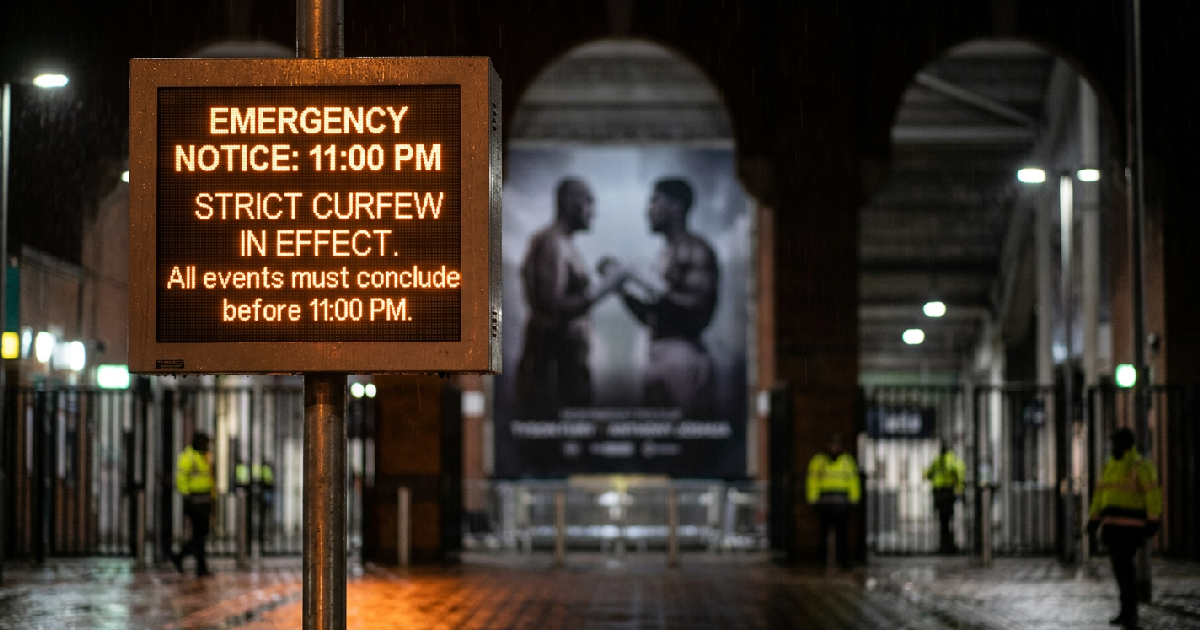
Local government curfews at Wembley Stadium could force the highly anticipated Tyson Fury and Anthony Joshua heavyweight super fight to relocate to Cardiff as organizers push for a 2:00 a.m. start time. The proposed late-night slot is designed to capture the lucrative North American pay-per-view market, but London’s stringent 11:00 p.m. noise and event restrictions remain a significant roadblock for the national stadium.
The conflict between commercial interests and local regulations has placed the Principality Stadium in Cardiff at the forefront of the conversation. While Wembley remains the sentimental favorite for the “Battle of Britain,” the Welsh Rugby Union (WRU) has already signaled its willingness to accommodate a post-midnight ring walk to facilitate global broadcasting demands.
Why the Wembley Stadium curfew threatens the Tyson Fury bout
Organizers are targeting a 2:00 a.m. BST start time to ensure the main event airs during prime time in the United States, a move essential for maximizing revenue in what is expected to be the biggest financial event in British boxing history.
However, Brent Council, which oversees the area surrounding Wembley, has traditionally enforced an 11:00 p.m. cutoff for major events to minimize disruption to local residents. Without a specific waiver, the stadium cannot legally host the bout in the early hours of the morning.
Wembley Stadium represents the pinnacle of British sporting venues, but its location in a densely populated residential area of North London makes late-night exceptions rare. The standard 11:00 p.m. curfew is a condition of its operating license, designed to manage noise pollution and ensure that tens of thousands of fans can access public transport before the London Underground ceases service for the night.
If the 2:00 a.m. start time remains a firm requirement for the promoters, Wembley’s involvement hinges entirely on a special agreement with local authorities. Such an extension would not only require an exception for noise but also a massive logistical coordination with Transport for London (TfL) to keep train lines running well into the night.
This adds layers of cost and bureaucracy that could make the London venue less attractive than its competitors.
For the fighters and their teams, the venue choice is as much about the atmosphere as it is about the paycheck. Previous negotiations have often been derailed by logistics, and boxing match delayed by contract talks in the past shows how easily these mega-events can fall through when smaller details aren’t aligned.
The curfew isn’t just a minor hurdle; it is a fundamental clash between the fight’s global financial model and local London law.
Broadcast demands and the North American market
The push for a 2:00 a.m. ring walk isn’t a whim of the promoters but a calculated business decision. A 2:00 a.m. start in London translates to 9:00 p.m. on the East Coast of the United States and 6:00 p.m. on the West Coast.
This is the “sweet spot” for pay-per-view sales, allowing the fight to headline a Saturday night television block without competing with early-day programming or airing in the middle of the afternoon.
Given the expected purses for Tyson Fury and Anthony Joshua, the domestic UK market alone may not be enough to satisfy the financial requirements of the deal. The involvement of international investors and major streaming platforms means that the “prime time” window in the U.S. is a non-negotiable factor for many stakeholders involved in the multi-million dollar production.
Cardiff emerges as the leading alternative for the super fight
As Wembley’s status remains clouded by the curfew issue, Cardiff’s Principality Stadium has moved aggressively to position itself as the ideal host. The venue, owned and operated by the Welsh Rugby Union, has a proven track record of hosting late-night boxing events.
Most notably, it hosted Joe Calzaghe’s unification victory over Mikkel Kessler in November 2007, which also featured a late start time to suit international audiences.
A spokesperson for the Welsh Rugby Union told Sky Sports that the organization would be “delighted” to bring the fight to Wales. They highlighted the stadium’s unique features, including its fully closeable roof, which eliminates concerns about the British weather—a factor that Wembley, with its open-air design, cannot guarantee.
This roof also helps contain noise, potentially making a 2:00 a.m. finish more palatable for city officials.
Anthony Joshua has a successful history at the Principality Stadium, having defeated Carlos Takam there in 2017 and later outpointing Joseph Parker in a unified heavyweight title bout in 2018. For Joshua, returning to Cardiff would mean fighting at a venue where he has already secured major hardware.
While the Fury-Joshua contracts still pending officially list Wembley as a preferred site, the logistical ease of Cardiff is becoming harder for promoters to ignore.
The technical advantages of the Principality Stadium
The presence of a retractable roof is much more than a convenience; it is a critical piece of infrastructure for a 2:00 a.m. event. In London, an open-air stadium at that hour could face significant temperature drops and wind issues, affecting the athletes’ performance and the comfort of fans who have paid premium prices.
Cardiff’s ability to “indoor” the event provides a controlled environment that is far more predictable for high-stakes broadcasting.
Furthermore, the Principality Stadium is situated directly in the Cardiff city center. While this presents its own crowd-management challenges, the proximity to hotels and late-night amenities makes it a more compact “fight hub” compared to the sprawling industrial and residential mix surrounding Wembley.
Local authorities in Cardiff have historically been more flexible with sporting curfews, viewing these events as massive economic boosters for the city’s hospitality sector.
Comparing the financial and cultural impact of the venues
Wembley Stadium holds a capacity of approximately 90,000 for boxing, whereas the Principality Stadium usually taps out around 75,000 to 78,000 depending on the ring and floor seating configuration. For a fight of this magnitude, those extra 12,000 to 15,000 tickets represent millions of pounds in lost gate revenue. This is the primary reason why Wembley remains the first choice despite the curfew headaches.
The cultural gravity of Wembley cannot be overstated. It is the site where Anthony Joshua famously stopped Wladimir Klitschko in 2017 in front of a post-war record crowd.
For Tyson Fury, who has expressed a desire to cement his legacy on the grandest stage possible, Wembley is the only venue that truly matches the scale of his personality. The “Wembley Arch” has become synonymous with the biggest moments in British sports history.
However, if the choice is between a midnight finish at Wembley with lower U.S. buy rates, or a 2:00 a.m. finish in Cardiff with maximized global revenue, the business side of boxing usually wins.
Decisions of this scale are often influenced by the Fury-Joshua bout penciled in for late 2026, as promoters look to lock in locations that offer the path of least resistance for their broadcast partners.
The role of Turki Alalshikh in venue selection
The influence of Saudi Arabia’s General Entertainment Authority and its chairman, Turki Alalshikh, has shifted the traditional dynamics of British boxing. With much of the financial backing for heavyweight mega-fights now originating from the Middle East, the demands for specific start times have become more rigid.
Alalshikh has been vocal about wanting the best possible experience for a global audience, which includes the 2:00 a.m. window.
If the Saudi backers insist on the late-night timing as a condition of their investment, the pressure on Brent Council to grant a waiver will be immense. Alternatively, they may simply move the entire production to Cardiff to avoid the political and legal wrangling associated with London’s regulations.
The “Riyadh Season” brand has shown it is willing to break with tradition to ensure the commercial success of its events.
What happens next in the race to host Fury vs Joshua
The next few months will be critical as representatives for both fighters and the event promoters engage in deep-dive discussions with local councils. A formal application for a curfew extension at Wembley is expected to be the first major move. If that application meets swift resistance from local resident groups or the London Mayor’s office, the shift toward Cardiff will likely become official.
Fans should also keep an eye on transport announcements. For Wembley to host a 2:00 a.m. fight, the “Night Tube” service would have to be significantly bolstered on the Jubilee and Metropolitan lines. The costs of this additional service are usually passed back to the promoters, which could further tip the scales in favor of the more centrally located Cardiff venue.
Ultimately, the location of Tyson Fury vs. Anthony Joshua will tell us a lot about the current state of the sport. It is a battle between the prestige of the traditional national stadium and the pragmatic, digital-first requirements of the modern global broadcast era.
Whether the fighters walk out under the Wembley arch or the closed roof of the Principality Stadium, the logistical battle behind the scenes is proving just as intense as the one expected inside the ropes.
While Cardiff offers a “turnkey” solution for a late-night broadcast, the allure of Wembley remains the gold standard. Until the authorities in London make a definitive ruling on the 11:00 p.m. cutoff, the boxing world remains in a state of suspense.
The final decision will likely come down to a balance of ticket revenue, pay-per-view projections, and the willingness of city officials to let the party continue into the early hours of the morning.