
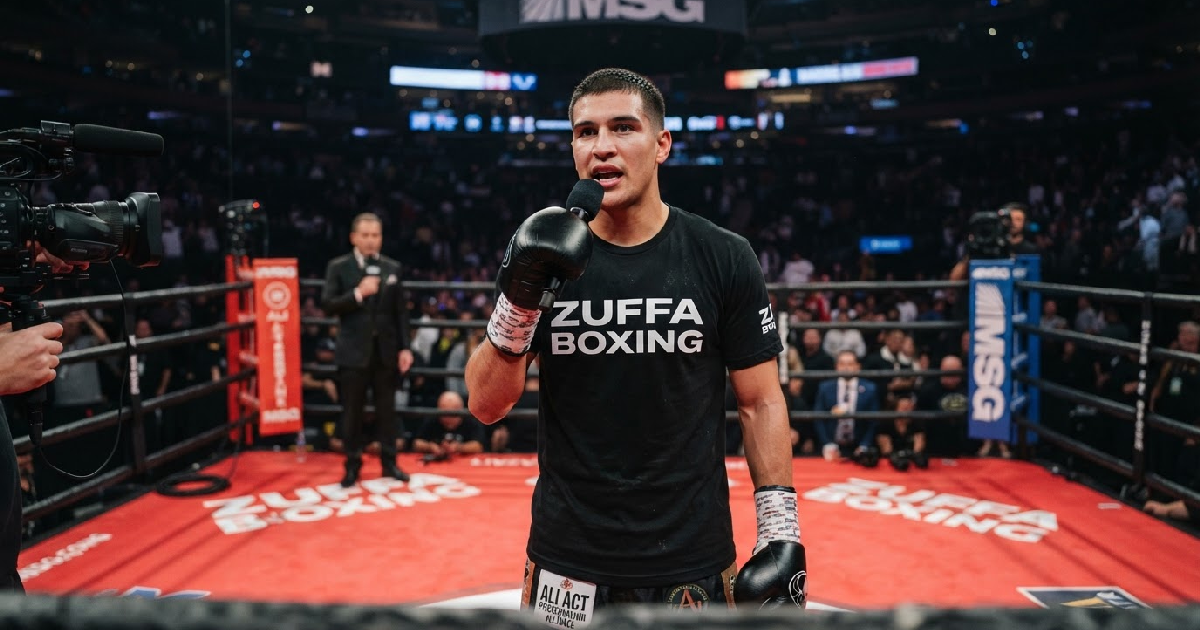
Nico Ali Walsh, grandson of boxing legend Muhammad Ali, made a surprising appearance on the Zuffa Boxing 09 broadcast on July 27, 2026. The middleweight boxer, with a professional record of 13 wins, 2 losses, 1 draw, and 1 no contest, seized the opportunity at Madison Square Garden in New York City.
He was there by invitation from TKO/Zuffa, but he used the platform to publicly oppose the controversial “Muhammad Ali American Boxing Revival Act,” a bill championed by TKO Group Holdings.
Ali Walsh’s calculated appearance on Zuffa Boxing
His presence on a broadcast by the very company pushing legislation he vehemently opposes highlights a significant tension within professional boxing. Ali Walsh wasn’t there to promote Zuffa’s events; he made it clear his sole purpose was to advocate for fighters and defend the foundational protections of the original Muhammad Ali Boxing Reform Act.
The decision by TKO Group Holdings, the parent company of Zuffa Boxing, to invite Nico Ali Walsh to their broadcast was an intriguing one. Ali Walsh, who founded and chairs the Ali Act Preservation Alliance in April 2026, accepted the invitation with a specific goal in mind. He aimed to speak directly to Zuffa’s audience about his deep-seated concerns regarding the proposed legislation.
He didn’t shy away from his stance during the broadcast. “No offense, I don’t care about Zuffa. I’m only here for boxing. I’m here for the fighters,” Ali Walsh stated unequivocally. This bold declaration prevented any misunderstanding that he was aligning with Zuffa’s corporate interests, instead reinforcing his dedication to fighter welfare.
Madison Square Garden hosts a defiant message
The Zuffa Boxing 09 event took place at the Infosys Theater, located within the iconic Madison Square Garden. This provided a high-profile stage for Ali Walsh to deliver his message. His willingness to challenge the bill’s proponents on their own terms underscores the urgency he feels about the issue.
It was a strategically astute move, turning a potentially promotional moment for Zuffa into a public forum for dissenting views. For a relatively young boxer, still carving out his career, such a public and confrontational stand carries inherent personal and professional risks. But Ali Walsh has consistently prioritized advocacy, connecting his family’s legacy to the broader struggle for boxer rights.
The contentious Muhammad Ali American Boxing Revival Act
At the center of this burgeoning conflict is the proposed “Muhammad Ali American Boxing Revival Act.” TKO Group Holdings, Zuffa Boxing’s parent company, is actively championing this new legislation. Critics, led by Nico Ali Walsh, contend that the bill would drastically reshape professional boxing.
They fear it would lead to a greater consolidation of power, potentially mirroring the UFC’s tightly controlled structure within mixed martial arts. A core concern centers on possible exemptions for Unified Boxing Organizations (UBOs) from requirements of the original Muhammad Ali Boxing Reform Act. This act includes crucial protections for fighters, such as the mandatory disclosure of event revenue.
Protecting the original Ali Act’s legacy
The original Muhammad Ali Boxing Reform Act was a pivotal piece of legislation. It aimed to inject transparency and fairness into a sport that had long struggled with exploitative practices. Ali Walsh and his allies are convinced the proposed “Revival Act” directly jeopardizes these hard-won protections, potentially diminishing boxer independence and earnings.
They argue that allowing UBOs to bypass revenue disclosure would hand promoters undue leverage during contract negotiations. This could severely impact a fighter’s earning potential and career stability. It’s ultimately a battle over who controls the sport’s economic future: the promoters or the athletes themselves, a dynamic often at play in protracted contract disputes.
Ali Act Preservation Alliance challenges powerful interests
Nico Ali Walsh didn’t just voice his concerns; he established the Ali Act Preservation Alliance in April 2026 to specifically combat this new legislation. This organization serves as a dedicated platform, actively advocating against the proposed bill. Its mission is to safeguard the crucial rights enshrined in the original Ali Act.
His advocacy extends well beyond public appearances. Ali Walsh has traveled to Washington D.C., testifying against the bill before the Senate alongside prominent figures like Oscar De La Hoya. These direct lobbying efforts demonstrate a serious commitment to influencing policy at the highest levels, a rare but impactful move for an active professional athlete.
WBC support and growing opposition coalition
The World Boxing Council (WBC) has acknowledged Ali Walsh’s steadfast dedication by naming him an ambassador for justice. This endorsement from a major sanctioning body adds significant weight to his advocacy efforts. It suggests a growing recognition within the broader boxing community of the potential threats posed by the “Muhammad Ali American Boxing Revival Act.”
The Alliance is actively building a broad coalition of support. It brings together current fighters, former champions, and various organizations deeply concerned about the bill’s implications for the sport. This united front underscores the profound worry that these proposed changes could unravel decades of work aimed at improving fighter welfare and fair compensation, vital for any boxer planning their career trajectory.
Zuffa Boxing’s ambitions clash with boxing’s structure
Zuffa Boxing, legally known as Boxing OpCo, LLC, is the brainchild of Dana White, the figure behind the UFC’s success. White aims to bring a more unified and streamlined structure to professional boxing, similar to the model he implemented in mixed martial arts. But this vision often clashes with boxing’s long-standing, fragmented ecosystem of promoters and sanctioning bodies.
Critics worry that Zuffa Boxing intends to replicate the UFC’s model too closely. In the UFC, the promotion exerts substantial control over fighter careers and earnings. While this model has brought consistency to MMA events, many believe it centralizes too much power, potentially limiting fighter negotiation power and competitive opportunities in boxing.
UFC model versus boxing tradition
The UFC operates primarily as a single entity, handling promotion, matchmaking, and often fighter management under exclusive contracts. Boxing, in stark contrast, relies on a diverse array of independent promoters, managers, and multiple sanctioning bodies. This creates a more distributed, albeit sometimes less efficient, power structure.
This traditional fragmentation, despite its challenges, also offers fighters more avenues for competition and greater leverage in contract talks. An unchecked Unified Boxing Organization (UBO) model, as implied by the “Revival Act,” could strip away these options. This would leave boxers with fewer choices and less financial autonomy, a crucial consideration for women’s boxing’s emerging prime and beyond.
Broader implications for boxing’s future
The ongoing legislative battle surrounding the “Muhammad Ali American Boxing Revival Act” carries significant implications for the future of professional boxing. It represents a fundamental struggle for control over the sport’s economic and structural foundations. The outcome could profoundly influence fighter compensation, matchmaking processes, and the overall competitive landscape for many years.
If the act passes in its current form, it could usher in a more centralized boxing model. This might offer more consistent events but potentially at the expense of fighter independence. Conversely, a victory for Ali Walsh and his alliance would reinforce existing protections for boxers, albeit within a system that some argue requires modernization.
Fighter welfare remains the core issue
Ultimately, the heart of this conflict revolves around fighter welfare. For Nico Ali Walsh, it’s a deeply personal mission, inextricably linked to his legendary grandfather’s legacy and his own experiences within the ring. He firmly believes boxers deserve fair compensation and complete transparency.
This battle between the Ali Act Preservation Alliance and TKO Group Holdings transcends a mere legislative squabble. It’s a referendum on the ethical responsibilities of promoters and the fundamental rights of athletes in a high-stakes sport. How this unfolds will undoubtedly shape the careers of both current and future generations of boxers.