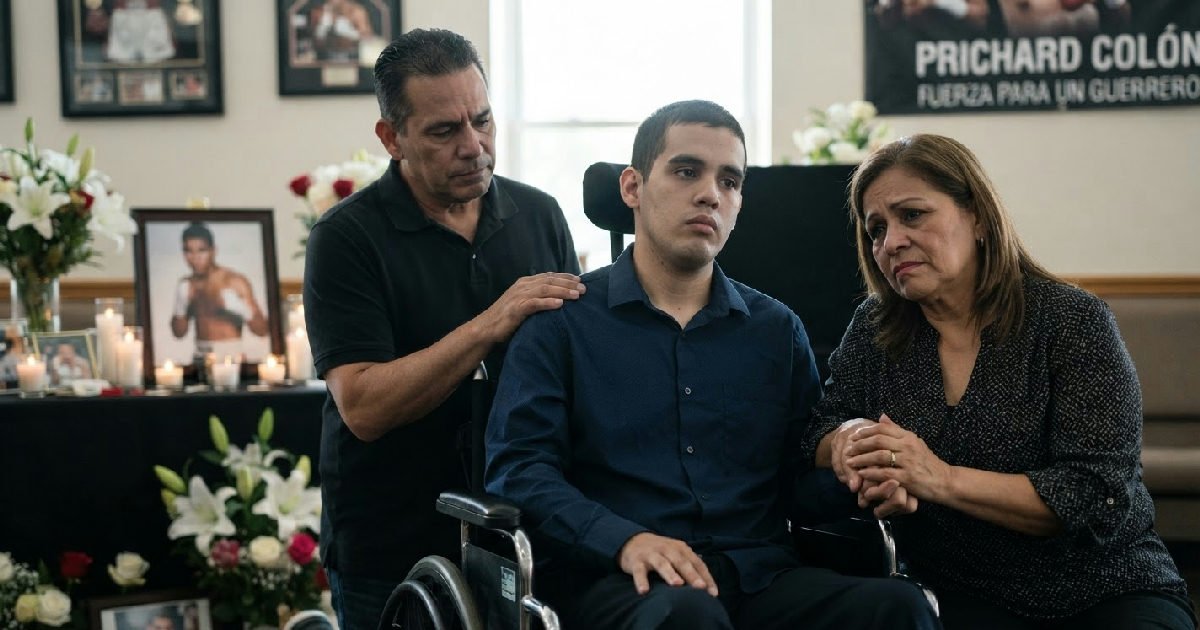
Prichard Colón Meléndez, the promising Puerto Rican boxing prospect who spent nearly 11 years in a persistent vegetative state after suffering a severe brain injury during a 2015 professional fight, has died. He was 33 years old. His father, Richard Colón, confirmed the devastating news on August 13, 2026, marking the end of a long and arduous battle for life.
Colón’s tragic journey began on October 17, 2015, during a controversial bout against Terrel Williams. The fight resulted in catastrophic injuries that plunged Colón into a 221-day coma and fundamentally altered his life and the lives of his parents, Richard and Nieves Colón, who became his devoted caregivers. His passing resonates deeply within the boxing community, reigniting conversations about fighter safety and regulatory oversight.
The fight that altered Prichard Colón’s life forever
The fateful match took place at EagleBank Arena in Fairfax, Virginia, where Colón, then undefeated with a 16-0 record and 13 knockouts, faced Terrel Williams. It was an undercard bout, broadcast on NBC, but it quickly devolved into a contentious affair. Throughout the fight, Williams repeatedly landed illegal punches to the back of Colón’s head, known as “rabbit punches.”
Colón frequently complained to the referee, Joe Cooper, about these illegal blows, but reports indicate Cooper largely dismissed his concerns, reportedly telling him to “take care of it.” In the fifth round, Colón received a two-point penalty for a low blow, escalating the tension in the ring.
The critical moment arrived in the seventh round when a rabbit punch from Williams sent Colón to the canvas.
Controversial conduct and ringside medical judgment
After being knocked down, Prichard Colón clutched the back of his head, visibly in pain. He was given five minutes to recover, and referee Joe Cooper deducted one point from Williams for the illegal strike. Ringside physician Dr. Richard Ashby examined Colón, who reported feeling dizzy and experiencing head pain.
Despite these complaints, Dr. Ashby cleared Colón to continue fighting, believing he would “shake it off.” The decision would later become a central point of legal contention. The fight ultimately ended in the ninth round when Colón was disqualified after his corner mistakenly removed his gloves, believing the bout was over.
A decade-long struggle for recovery
The severity of Colón’s injuries became tragically apparent almost immediately after the fight. Back in his dressing room, he began vomiting and collapsed, prompting an urgent transfer to Inova Fairfax Hospital. Doctors there diagnosed him with a left-sided subdural hematoma, a critical accumulation of blood outside the brain, and performed an emergency hemicraniectomy to relieve pressure.
Colón remained in a coma for 221 days following the surgery. Although he eventually emerged, he was left in a persistent vegetative state, unable to speak or move independently. This marked the beginning of an 11-year struggle for Prichard and his family, a battle that unfolded largely outside the public eye but captivated the boxing world.
Family’s unwavering dedication and advocacy
After initial treatment, Prichard Colón was moved to the Shepherd Center in Atlanta, Georgia, for rehabilitation before returning home to Orlando, Florida, where his mother, Nieves Colón, became his primary caregiver. His parents provided round-the-clock care, a testament to their profound love and commitment.
Medicaid provided 25 hours per week of in-home specialized treatment, but the family constantly sought additional avenues for his recovery. In 2017, they relocated to Jacksonville, Florida, to facilitate rehabilitation at Brooks Rehabilitation. There, Prichard showed incremental progress, including improved eye-tracking and some movement in his elbow, wrist, and fingers.
Legal battles spotlight boxing regulations
Colón’s injury sparked significant legal action and scrutiny of boxing regulations and medical protocols. In May 2017, his parents filed a lawsuit in D.C. Superior Court, seeking over $50 million in damages. The suit targeted ringside physician Dr. Richard Ashby, along with co-promoters HeadBangers Boxing and DiBella Entertainment.
The Colón family alleged negligence, arguing that Dr. Ashby failed to intervene appropriately when Prichard complained of head pain. They also claimed the promoters were derelict in their duty to ensure proper brain injury protocols were in place and that qualified medical staff were hired. This legal challenge highlighted critical gaps in fighter protection and accountability within the sport.
Accountability and the “Prichard Colón Rule”
An investigation by the Virginia Department of Professional and Occupational Regulation (DPOR) largely absolved Dr. Ashby and referee Joe Cooper of wrongdoing. The DPOR stated that Colón was cleared to continue because he did not exhibit “impaired vision, severe lacerations, apparent broken bones, or any other obvious physical injury” and appeared “coherent, responsive, and able to stand on his own.”
However, the lawsuit faced complications. In May 2019, DiBella Entertainment and HeadBangers, Inc. were dismissed, with the court ruling that under Virginia regulations, promoters were not responsible for ringside protocols or hiring ringside physicians. The case against Dr.
Ashby reportedly remained unsettled as of April 2017, a stark reminder of the complexities involved in seeking justice for such injuries. Concerns about fighter well-being continue to be a pressing issue for boxing administrators globally.
Prichard Colón’s enduring legacy
Beyond the legal battles, Prichard Colón Meléndez became a powerful symbol within the boxing community. His unwavering fight for life transformed him from a promising prospect into an inspiration for countless individuals facing adversity. The World Boxing Council (WBC) recognized his incredible resilience, naming him an honorary champion and presenting him with a world championship belt.
This gesture acknowledged a different kind of championship, one won through sheer will and the strength of the human spirit. World Boxing News (WBN), a publication that had a personal connection with Prichard dating back to before his professional debut, continued to cover his journey, ensuring his story remained in the public consciousness.
A personal connection with the boxing world
Phil Jay, Editor-in-Chief of WBN, shared how Prichard Colón himself initiated their friendship. Before his professional debut in February 2013, a then 20-year-old Prichard reached out, introducing himself as an “ex-member of the Puerto Rican Boxing Olympic Team” and asking for an interview. This initial contact blossomed into a lasting friendship.
Throughout his career, Prichard kept WBN updated on his fights, opponents, and ambitions. But their exchanges weren’t solely about boxing; they included Christmas and New Year messages, and casual check-ins on how things were going. This personal relationship underscores the profound impact Prichard had on those around him, extending beyond the professional realm. The boxing community, including many active fighters, often forms strong bonds.
The wider impact on boxing safety
Prichard Colón’s story serves as a tragic reminder of the inherent dangers of professional boxing and the critical need for robust safety protocols. His death, 11 years after the injury, underscores the long-term, devastating consequences that can arise from concussive and sub-concussive blows, particularly those delivered illegally. The boxing world has seen other instances where fighter safety has come under intense scrutiny.
Medical professionals, regulators, and promoters face ongoing pressure to refine rules, enhance ringside medical capabilities, and ensure referees consistently enforce fair play. While organizations like the WBC have introduced measures, the legal complexities and differing regulatory standards across jurisdictions remain challenging. Prichard’s case will undoubtedly fuel further debate on what constitutes adequate protection for athletes in combat sports.
His passing also brings to the forefront the psychological toll on families, who often bear the brunt of long-term care and advocacy. It’s a stark lesson for aspiring fighters and seasoned veterans alike about the brutal reality that a single misstep or unpunished foul can forever alter a life.
The sport must continue to evolve, learning from such tragedies to safeguard its participants. Even in high-profile events, undercard fights carry significant risks.
Remembering Prichard Colón Meléndez
Prichard Colón Meléndez, nicknamed “Digget” for his towering presence, was born on September 19, 1992, in Maitland, Florida. He grew up representing Puerto Rico in amateur boxing, where he won five national championships and a gold medal at the 2010 Pan American Youth Championship, finishing with an impressive 170-15 amateur record.
His professional aspirations were clear: he wanted to be a world champion. While he never achieved that dream in the ring, his enduring fight outside of it earned him a different kind of respect and admiration. He became a beacon of resilience, his struggle resonating with thousands who followed his story.
WBN has committed to adding Prichard permanently to their Boxers page, ensuring he won’t be forgotten.