
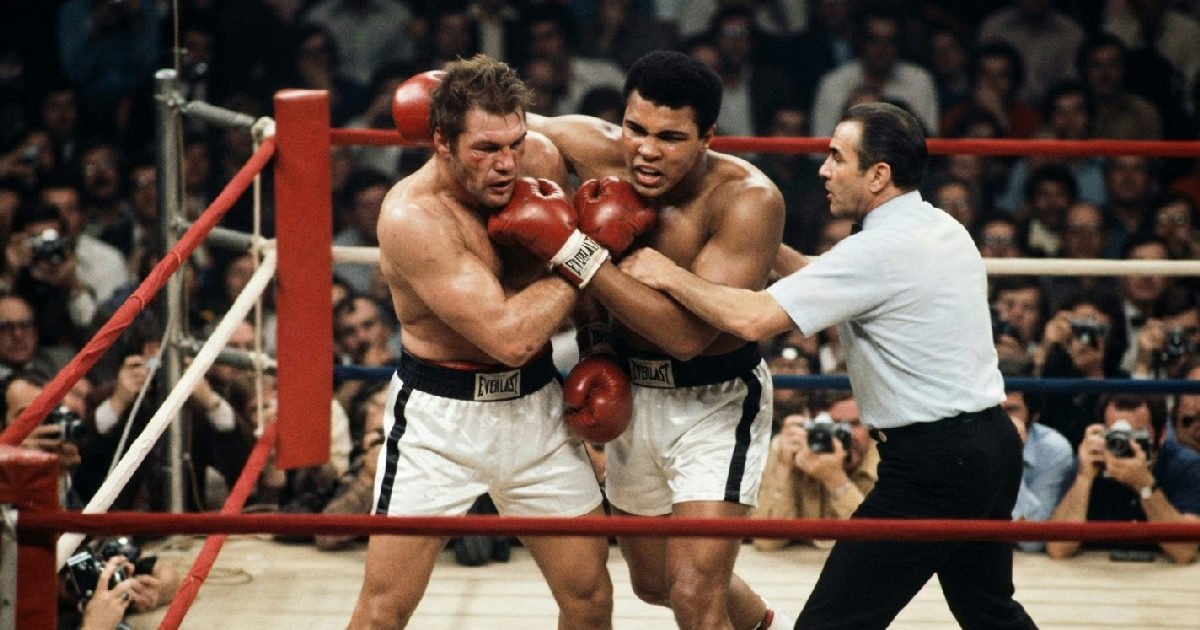
The heavyweight championship bout between Muhammad Ali and Chuck Wepner on March 24, 1975, at the Richfield Coliseum near Cleveland, Ohio, devolved into a surprisingly contentious affair. Ali, making his first title defense since reclaiming the undisputed crown, faced an unexpected challenge from Wepner’s relentless, often illegal, tactics.
Wepner’s consistent use of rabbit punches—blows to the back of the head—visibly angered the reigning champion, turning what many expected to be a routine defense for Ali into a gritty, 15-round slugfest. The Ali vs. Wepner fight would ultimately become known for its unsportsmanlike conduct as much as for Ali’s eventual technical knockout victory.
Ali’s Comeback Reign Begins Against a Massive Underdog
Just five months earlier, Muhammad Ali had recaptured the WBA, WBC, and The Ring undisputed Heavyweight Championship in the legendary “Rumble in the Jungle.” That eighth-round knockout of George Foreman in Zaire had re-established Ali as boxing’s premier figure.
His opponent for this first defense, Chuck Wepner, a 36-year-old liquor salesman from Bayonne, New Jersey, represented a significant step down in competition. Known as “The Bayonne Bleeder” due to his susceptibility to cuts, Wepner entered the ring as a staggering 10-1 betting underdog, holding a record of 30-9-2 (12 KOs).
Ali, aged 33 years and 2 months with a 45-2 (32 KO) record, weighed 224 pounds. Wepner came in at 225 pounds. The fight, promoted by flamboyant local promoter Don King, was financially guaranteed by Carl J. Lombardo, an alumnus of Case Western Reserve University.
It was marketed with the provocative slogan “Give the White Guy a Break.” Despite the perceived mismatch, 14,000 fans packed the Richfield Coliseum, with tickets ranging from $10 to $75, and another 4,200 tickets quickly sold out.
Wepner’s Unorthodox Strategy: Rabbit Punches and Foul Play
Understanding he couldn’t out-skill Muhammad Ali, Chuck Wepner adopted a relentlessly physical approach. He pressed forward, throwing wide, looping punches designed to land wherever they could, often wrapping around Ali’s guard.
Crucially, many of these blows repeatedly struck Ali in the back of the head, known in boxing as “rabbit punches.” These were not merely incidental contact during clinches; Wepner delivered them with considerable force from a distance.
The Dangerous Reality of Rabbit Punches
Rabbit punches are illegal in professional boxing for a critical reason: they target an extremely vulnerable area. Strikes to the back of the head or the base of the skull can cause severe, even life-threatening, injuries.
These range from damage to cervical vertebrae and the spinal cord, potentially leading to paralysis, to serious brain trauma or even instantaneous death. The back of the head, particularly where the brainstem connects to the spine, lacks the natural protection afforded to other areas.
Muhammad Ali complained vociferously to Referee Tony Perez about Wepner’s persistent fouling. Despite the champion’s pleas, Perez seemed unwilling or unable to control Wepner’s illegal tactics.
This inaction eventually led to Ali resorting to similar tactics himself, hammering Wepner with clubbing right hands to the back of the head during close exchanges. As Ali himself later put it, “They were dirty rabbit punches… the dirt was allowed. So I got dirty with him, takes dirt to fight dirt.”
The Controversial Knockdown and Ali’s Fury
For most of the fight, Ali dominated, building a comfortable lead on the scorecards. But the ninth round brought a dramatic and controversial moment that would define the Muhammad Ali Chuck Wepner fight. A right hand from Wepner to the body sent Ali to the canvas.
Referee Tony Perez officially counted it as a knockdown, marking only the fourth and final time Ali was officially knocked down in his storied professional career. Ali, however, vehemently insisted that Wepner had stepped on his foot, causing him to lose balance and fall, rather than a clean punch.
Footage from the fight continues to fuel debate over the legitimacy of the knockdown, though Wepner consistently maintained his punch was responsible. Regardless of the exact cause, the impact on Wepner was immediate.
“Start the car up, Al, we’re going to the bank, we’re millionaires!” Wepner reportedly exclaimed to his manager, Al Braverman, believing he had just altered the course of his life. But his celebration was short-lived.
Ali rose from the canvas, visibly angry and with a renewed, ferocious urgency. The constant illegal blows, combined with the perceived injustice of the knockdown, ignited a deeper fire within the champion. He began to relentlessly attack Wepner.
The Punishment Accumulates: Wepner’s Valiant Stand
From the ninth round onward, the fight became a one-sided battering. Ali landed combination after combination to Wepner’s head, who, despite the accumulating damage, continued to trudge forward, a testament to his remarkable toughness.
Cuts began to open around Wepner’s eyes, and his face swelled badly under the relentless assault. The punishment grew increasingly severe as the later rounds progressed, but “The Bayonne Bleeder” refused to capitulate.
By the final round, Ali held a commanding lead. Perez had scored the fight 135-130 in Ali’s favor. Judges Jackie Keough and Sam Taormina had even wider margins, 136-129 and 138-129 respectively, through 14 rounds.
With only 19 seconds remaining in the 15th and final round, Ali delivered a powerful combination that sent an exhausted Wepner to the ropes and down to the canvas. Wepner struggled to regain his footing, but Referee Tony Perez stepped in, deeming him unable to continue, and stopped the fight at 2:41.
Ali secured the victory by 15th-round TKO, successfully defending his heavyweight championship. Despite the win, Ali remained bitter about the fouls and the controversial knockdown, later telling reporters Wepner “was dirty and fought like a woman.”
Wepner, battered but unbowed, required 23 stitches after the fight, adding to his career tally of significant facial repairs. His manager’s post-fight comment, “Yeah, yeah, Chuck, but in the ring you’re the king of dirty fighting. You’re both royalty,” captured the essence of Wepner’s unusual performance.
A Legacy Beyond the Ring: The ‘Rocky’ Connection
Though Chuck Wepner never became heavyweight champion, his performance against Muhammad Ali unexpectedly cemented his place in cultural history. Sylvester Stallone, who was watching the fight live, found profound inspiration in Wepner’s valiant, underdog effort.
Stallone reportedly drew on Wepner’s story of an obscure heavyweight receiving an improbable title opportunity when developing the screenplay for his 1976 film, *Rocky*. The movie would go on to become a global phenomenon, transforming Wepner’s real-life struggle into one of cinema’s most enduring underdog narratives.
Wepner’s refusal to quit, his ability to push Ali to the brink, and the sheer physicality of his approach resonated deeply. He had come within 19 seconds of lasting the full 15 rounds with one of the greatest heavyweights of all time.
His post-fight comment to his wife before the bout, “Tomorrow night I want you to wear this [a powder-blue negligee] in bed because tomorrow night you’re going to be sleeping with the heavyweight champion of the world,” and her subsequent retort, “Okay, bigshot…Do I go to Ali’s room, or does he come to mine?” highlight the audacious confidence and eventual reality of the challenger.
The Ali-Wepner bout, initially dismissed as a mismatch, evolved into a memorable chapter in boxing lore. It underscored Ali’s resilience and provided an unlikely challenger with an enduring legacy, proving that sometimes, even in defeat, a fighter can win something far greater than a championship belt.